As impact of super El Nino intensifies, local govts and relevant departments step up response preparations
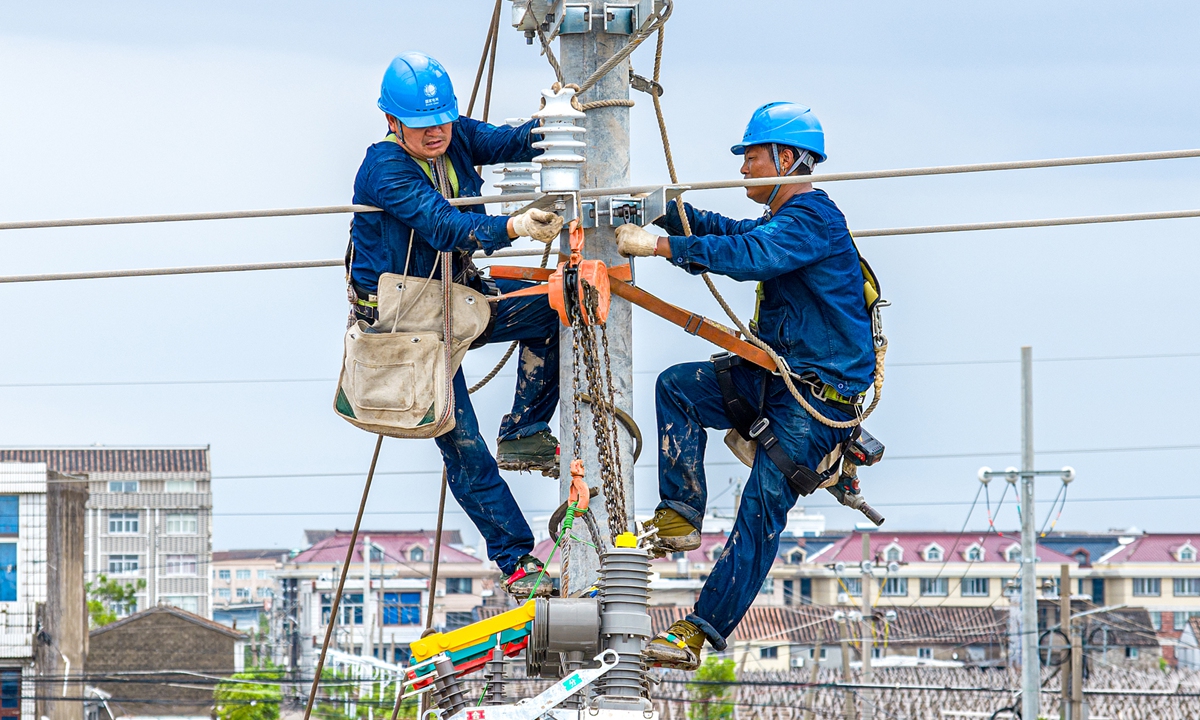
Emergency repair workers from the State Grid city power supply company replace porcelain insulators in Wenling, East China's Zhejiang Province on August 10, 2026, to ensure the supply of power after Typhoon Dolphin made landfall. Photo: VCG
The current El Nino event, having developed into the strongest since records began, prompted authorities across China to roll out measures to mitigate potential impacts on agriculture, energy supplies and air pollution control.
Experts noted on Sunday that the abnormal weather system might have major impacts on power and agricultural sectors, but there are no systemic risks and the precautions can mitigate the damages.
The formation of Cempaka - this year's 32nd typhoon - earlier this month pushed the annual total to its highest since the beginning of the 21st century. The super El Nino has already affected China's climate and is expected to have a significant impact this winter and next spring, the Xinhua News Agency reported Saturday.
Ma Jun, director of the Beijing-based Institute of Public and Environmental Affairs, told the Global Times on Sunday the super El Nino could bring sharp winter temperature swings and frequent cold waves, damaging crops. Its delayed impact may raise the risk of summer floods and droughts.
Extreme weather may also strain power and gas supplies and threaten renewable energy and grid infrastructure, particularly the transmission and transformation equipment, Ma said.
Meanwhile, China's energy supply remains ample and resilient, with no systemic risks, despite the possibility of temporary local disruptions, said Lin Boqiang, director of the China Center for Energy Economics Research at Xiamen University.
Lin told the Global Times that industrial load adjustments can help safeguard residential power supplies during winter temperature swings, and grid blockade is a risk that can be quickly tackled rather than a major challenge.
China is expected to experience a warmer-than-average winter in late 2026 and early 2027, but with slightly more frequent cold waves, sharp temperature fluctuations and risks of sharp temperature drops and heavy snow in the north as well as low temperatures, rain, snow and freezing conditions in the south, Xinhua reported, citing the National Climate Center.
According to the Chinese Ministry of Water Resources, preliminary assessment indicates that the Yangtze River, Taihu Lake and Songhua River basins face potential widespread flooding, with other regions also at risk of flooding to varying degrees. The ministry is stepping up preparations for extreme floods, droughts and rapid shifts between drought and flooding, state broadcaster China Central Television (CCTV) reported Sunday.
In response to El Nino's potential impacts on agricultural production, energy supplies and air pollution control this winter, local governments and relevant departments have recently rolled out targeted measures, according to Xinhua.
The Chinese Ministry of Agriculture and Rural Affairs has issued guidelines on response and proposed methods, including adjustment to planting time and amount, timely irrigation before cold waves, consolidation of greenhouses and removal of snow.
Environmental authorities will integrate satellite remote sensing, air quality and pollution-monitoring data as well as power consumption to identify and trace pollution sources and tackle violations to reduce emissions.
The National Energy Administration is stepping up preparations to ensure adequate winter energy supplies, with tailored plans for key regions and close monitoring of coal production and stock, Xinhua reported.
Local authorities, including South China's Guangxi Zhuang Autonomous Region, Northeast China's Heilongjiang Province, and Central China's Hunan and Hubei provinces, are also stepping up preparations, calling for stronger monitoring, early warnings, infrastructure improvements and emergency preparedness to address worst-case scenarios.
RELATED ARTICLES