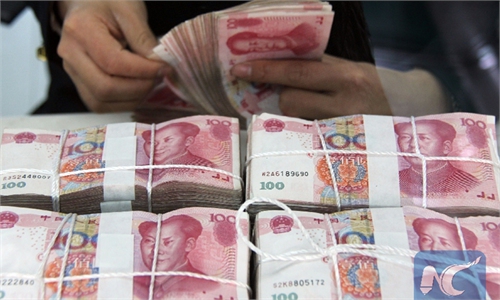
File Photo: Xinhua
Central China's Henan Province will establish a management mechanism for high-risk rural banks as the province pushes to close loopholes, stamp out potential financial risks and strengthen the oversight of financial institutions following a much-watched rural bank case.
According to a notice issued by the province on Tuesday, Henan will establish a management mechanism for key high-risk institutions such as rural banks and rural credit cooperatives, and it will crack down on evasion of financial debts and illegal fund-raising in order to create a good regional financial credit environment.
The province also pledged to strengthen the information sharing system and improve the major risk warning system with a focus on important local financial institutions, listed companies and fin-tech companies so as to identify risks and deal with them.
The measures will help to close loopholes in the rural banking systems in Henan, which has been under the spotlight nationwide after depositors in four rural banks in Henan and one in neighboring East China's Anhui Province found they were unable to access their funds in April as a result of weak supervision, experts said.
"The measures are necessary and are aimed at correcting mistakes and enhancing the supervision of rural banks in Henan," Dong Shaopeng, an expert advisor at the China Securities Regulatory Commission, told the Global Times on Tuesday. It is important and also a conventional practice to have key and targeted supervision of financial institutions that have higher risks, Dong noted.
In the latest development, public security authorities in Henan Province have arrested 234 criminal suspects involved in the rural bank case, and have achieved "major progress" in the recovery of money, the local public security bureau in Henan's Xuchang announced on Monday.
According to the police announcement, it has been found that a criminal gang led by suspect Lü Yi, the actual controller of Henan New Wealth Group, illegally controlled four rural banks, including Yuzhou New Minsheng.
"The criminal gang tempted depositors with an annual return rate of 13-18 percent and paid by using illegally acquired capital. Some clients with large savings were paid an 'interest subsidy,' which was exploited by financial brokers at various levels," the announcement read.
The case has exposed the weak links and hidden risks in rural banks as they failed to follow the relevant measures, Dong said.
The measures will include stronger and increased supervision as well as inspections from local financial offices and branches of the China Banking and Insurance Regulatory Commission (CBIRC), which will have significant value in preventing and resolving risks in related fields, Dong added.
Data from the CBIRC showed that as of the end of June, there were 1,648 village and town banks in China, with total assets of 2.2 trillion yuan and total liabilities of 2 trillion yuan. The balance of outstanding loans was 1.4 trillion yuan, and that of deposits was 1.8 trillion yuan.
RELATED ARTICLES