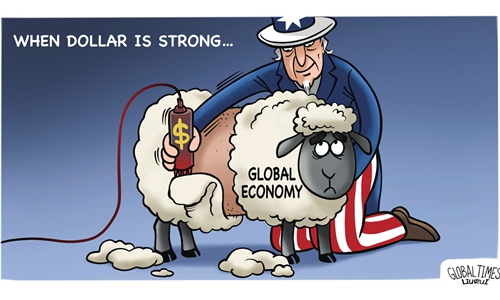
Illustration: Chen Xia/Global Times
When iPhone enthusiasts lined up at Apple stores around the world last month as the company's latest range of iPhones went on sale, fans in Japan eyed the handsets with mixed feelings. According to media reports, the California-based tech giant raised the prices of its iPhone 14 series versus the iPhone 13 in a number of key markets including Japan, even as it kept prices unchanged in the US. Some attributed the price hikes to the weaker yen.The yen has weakened, trading in recent days at 32-year lows of the high 148 range against the US dollar. Some analysts have said that if the yen falls below the key psychological level of 150 per dollar, it's hard to predict where its depreciation will stop.
The yen's value against the US dollar has fallen mainly because interest rates remain low in Japan but are rising in the US. The US Federal Reserve has lifted interest rates five times this year and indicated more increases are to come. In a blog post, IMF economists said the dollar is at its highest level since 2000, having appreciated 22 percent against the yen. The yen is expected to depreciate further as the Fed continues to raise interest rates.
The depreciation has created ripple effects in the economy. First, continued weakness in the yen combined with other factors has led to a rise in prices of imported consumer goods. Second, exchange rate fluctuations are expected to affect global supply chains, as a lower yen raises the prices of Japan's imported raw materials and erodes the competitiveness of American suppliers at the same time. Some believe any economic recovery in Japan will be slow and likely to face huge headwinds thanks to the yen's weakness, which has created uncertainties for both businesses and households.
Japan has been affected, like other Asian economies, by the US central bank's aggressive interest rate hike path. Most Asian currencies fell on Monday, after the hotter-than-expected US inflation report released last week sparked concerns that further interest rate hikes will be needed. South Korea's won, the Indonesian rupiah and Malaysia's ringgit were among the top losers, while Singapore's dollar, India's rupee and Thailand's baht were slightly weaker, Reuters reported.
In the face of soaring inflation, it's unlikely the US will stop raising interest rates, although a stronger dollar tends to depress economic growth in developing countries. Some have warned that Asian markets risk a reprise of financial crisis-level stress as many of the region's most important currencies tumbled due to the onslaught of the strong dollar.
The tumbling currencies of the region's major economies suggested that it's crucial to strengthen industry and supply chains in Asia to withstand external shocks such as a strong dollar. Asian economies should be prepared for a currency crisis and find a way to avoid one.
For instance, if a strong dollar reduces American-brand product sales to Asian markets, this will probably promote the localization of the entire industry chain from research and development, and from production to logistics and distribution, to avoid exchange rate risks. This creates a chance to strengthen Asian industry chains, and Asian economies should seize the opportunity to step up cooperation.
Over the past decade, industry and supply chains have actually evolved for the better in Asia despite all the difficulties and challenges that the process faced. For example, with the joint efforts of China and other 14 economies, the Regional Comprehensive Economic Partnership went into effect. The free trade arrangement is expected to promote the integration of regional industry, supply and value chains, and strengthen efficient production division and cooperation among members.
As the world has entered a period of turbulence and the global economy is facing a grim outlook, only cooperation can help economies along the Asian industry chain. At a time when the US central bank's aggressive interest rate hikes and the resulting weakness of Asian currencies contribute to reshaping global industry chains, hopefully Asian economies can not only survive the difficulties and challenges, but can also push the reorganization of the global industry chain in a direction that serves their interests by enhancing industrial cooperation and strengthening regional supply chains.
The author is a reporter with the Global Times. bizopinion@globaltimes.com.cn
RELATED ARTICLES