Latest research on demography shows Chinese women’s lifelong nulliparity rate at 5.16 percent
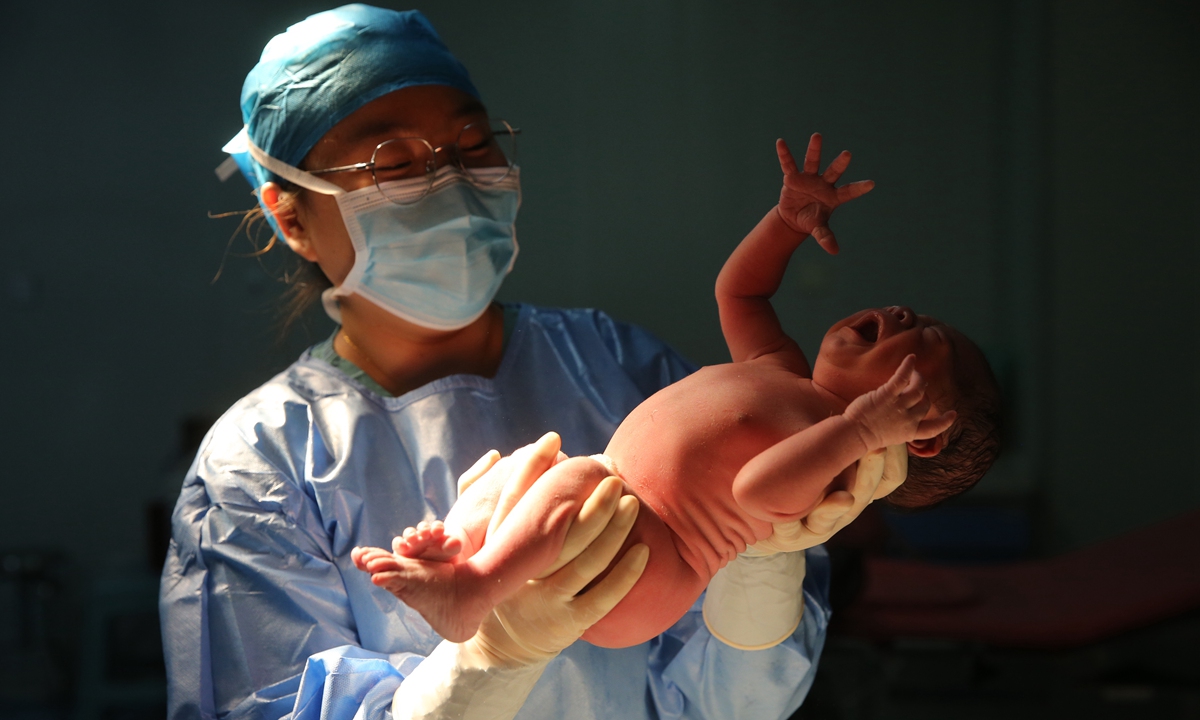
A nurse holds a new born baby in a hospital in Zhengzhou, Henan Province on January 1, 2022. Photo: VCG
Latest research on demography released by Chinese researchers shows that Chinese women’s lifelong nulliparity rate has reached the proportion of 5.16 percent, lower than that of developed countries, but the researchers warned of a further rise.
The research titled Estimation of the Level of Lifelong Nulliparity of Chinese Women conducted by Chinese researchers including Zhang Cuiling, Zhuang Yaer and Jiang Yu from the China Population and Development Research Center (CPDRC) was published in the latest issue of the Chinese demographic academic journal Population Research, China’s first comprehensive professional magazine of demography organized by Renmin University of China and hosted by CPDRC, according to Jiemian News.
Based on data from the seventh national census conducted in 2020, the researchers estimated that the lifelong nulliparity rate of 49-year-old women in China in 2020 was 5.16 percent, lower than the average level of 11 percent in the US and 19 percent in the European Union countries.
However, factors such as the acceleration of urbanization, the popularization of higher education, and the further putting off of marriage and childbearing will further promote the rise of lifelong nulliparity of Chinese women in the future, the researchers pointed out.
Against the backdrop of lower extramarital births and a lower proportion of multiple children, the continuous rising in the level of lifetime nulliparity will exert a stronger negative impact on China’s newborn population and fertility levels and will have a long-term and profound impact on the realization of the moderate fertility level, which should be taken seriously, the thesis of the research said.
According to the demographic indicators commonly used, the reproductive age range for women is typically considered to be 15 to 49 years old. Since women have generally completed their childbearing by the age of 49, the proportion of women without live births at the age 49 is often used to measure the level of lifetime nulliparity among women.
According to Zhang Cuiling, first author of the thesis, in this study, the term “childless” encompasses both the subjective decision not to have children (childfree) and the objective childlessness (due to biological factors, changes in marital status, or secondary infertility caused by a history of induced abortion, for example).
The research shows that the proportion of women aged 40 and above without any live births used to consistently stay relatively low in the past, hovering around 1.5 percent in the 1980s. The proportion has been rising since 2000.
Data from the seventh national census shows that the proportion of Chinese women aged between 35 and 39 who have no live birth was 9.48 percent, the proportion for Chinese women aged 40 to 44 was 6.93 percent and that of the women aged 45 to 49 was 5.58 percent.
In particular, the proportion of Chinese women aged 49 who have no live birth was 5.16 percent, which can be regarded as the current lifetime nulliparity level of Chinese women, much lower than the average levels of 11 percent in the US and 19 percent in European Union countries.
It is worth noting that Chinese women’s lifelong nulliparity level exhibits distinct variations based on time, education level, and regional differences.
When looking at different regions, women in the northeastern part of China consistently have higher lifelong nulliparity rate compared to other regions, while women in the central region with the highest total fertility rate tend to have the lowest lifelong nulliparity rate. The eastern and western regions fall in between, with relatively moderate and similar lifelong nulliparity rate.
In 2020, the highest rate of lifelong nulliparity rate among 49-year-old women was observed in Northeast China at 6.26 percent, while the lowest rate was observed in Central China, at 3.88 percent.
A total of 14 provinces across the country have a proportion of women aged 45 to 49 without live births exceeding 5 percent.
In the first-tier cities with extremely low-fertility like Beijing and Shanghai, the proportions of women aged 45 to 49 without live births are high, reaching 11.92 percent and 8.18 percent respectively. The corresponding proportions in the three northeastern provinces of Jilin, Heilongjiang and Liaoning are also relatively high, ranging from 7 percent to 9 percent.
From an educational perspective, the research also shows that the higher education level the women receive, the higher rate of their lifelong nulliparity.
The research suggests that the vast territory of China, along with regional differences in economic development, cultural factors, and other aspects, all contribute to regional disparities in fertility rates.
The research pointed out that although China’s current level of lifetime nulliparity rate is lower than that of developed East Asian countries such as Japan, South Korea and Singapore, the trajectory of increasing lifetime nulliparity in China shows similarities to these countries. With the accelerated urbanization, continued postponement of marriage and childbirth, and increasing educational attainment, the size of lifetime childless women in China is expected to further expand in the future, and the proportion will continue to rise.
This study reminds that unlike the diverse fertility patterns in Western countries with a higher prevalence of extramarital births and a higher proportion of multiple children (around 20 percent), China has a lower incidence of extramarital births and a lower proportion of multiple children. If the level of lifetime nulliparity rate continues to rise, it will exert a stronger negative impact on China's birth population and fertility rate, which may be difficult to compensate for through other mechanisms.
Global Times
RELATED ARTICLES