Young internet celebrity dies at weight loss camp, sparking controversy over distorted aesthetics
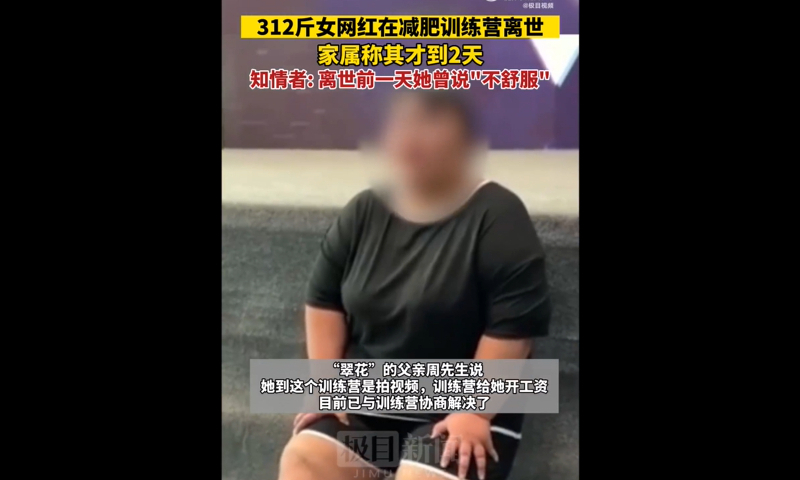
Photo: Screenshot of video from Jimu News
A 21-year-old woman weighing 156 kilograms has died at a weight loss camp in Northwest China's Shaanxi Province, according to media reports on Tuesday. The incident has sparked public concern, with netizens questioning the distorted ideals of thinness in today's Chinese society. They are also calling on relevant authorities to monitor some fat camps that put people's health and even lives at risk.
The woman, named Cuihua, started her weight-loss journey at 156 kilograms. She created a social media account on a short video platform under the name "Cuihua wants to make a comeback" and added "To lose 100 kilograms" to her username, indicating her ultimate weight loss goal. Before the tragic incident, Cuihua posted numerous weight loss-related videos on her account, attracting over 9,000 followers.
"Not the fattest, but I am the best. Let's look forward to my transformation." Cuihua posted on her account on September 14, 2022. From then on, she first went to a training camp in Guangzhou, South China's Guangdong Province in September last year, where she lost some 20 kilograms in merely two months.
Later, Cuihua traveled from Guangzhou to Xi'an, the capital city of Shaanxi, and shed an additional 10 kilograms in less than a month.
A source close to the matter revealed to the media that initially, Cuihua paid the camps to assist with her weight loss. However, after some time, they started paying her. "Make weight loss videos, and this is equivalent to advertising for the fat camp," the source disclosed.
On May 26, Cuihua mentioned on WeChat that she was "feeling unwell." The following morning, camp staff members found her lifeless.
This tragedy occurred just days after media reports of a 15-year-old girl who died after reaching a weight of 24.8 kilograms. According to reports, the girl had not consumed any food for nearly 50 days and survived solely on water.
The girl, who stood at 165 centimeters tall, weighed only 24.8 kilograms. When doctors performed a CT scan, they were astounded by her weight, describing it as "as light as lifting a bedsheet."
Upon her admission to the hospital, she was severely malnourished, experiencing respiratory failure and loss of consciousness. After a diagnosis, she was found to be suffering from anorexia nervosa. Even more distressing was the revelation that her body insecurities stemmed from her admiration for a boy who pursued a girl even thinner than her.
The topic quickly gained attention on Sina Weibo, China's Twitter-like platform, as netizens questioned the unhealthy societal trend that equates thinness with beauty and the extreme levels to which people are willing to go for weight loss. Consequently, various types of weight loss training camps have rapidly emerged.
While it is not appropriate to directly link Cuihua's death to the fat camp, it necessitates a thorough investigation, netizens argue. "Are these weight loss methods scientifically reasonable? Do they comply with the principles of human health? Can they cause harm to the body? Should weight loss training camps be subject to scientific monitoring and early warnings? These are questions worth asking," commented the Beijing News.
The younger generation in China, particularly in metropolitan areas, is becoming aware of the distorted perception that considers thinness and paleness as the sole standards of beauty. They are now advocating for a healthier lifestyle and embracing diverse aesthetics that prioritize happiness and a high quality of life.
Global Times
RELATED ARTICLES