Athlete complaining Tokyo Olympics silver medal turning into 'scrap iron' sparks discussions
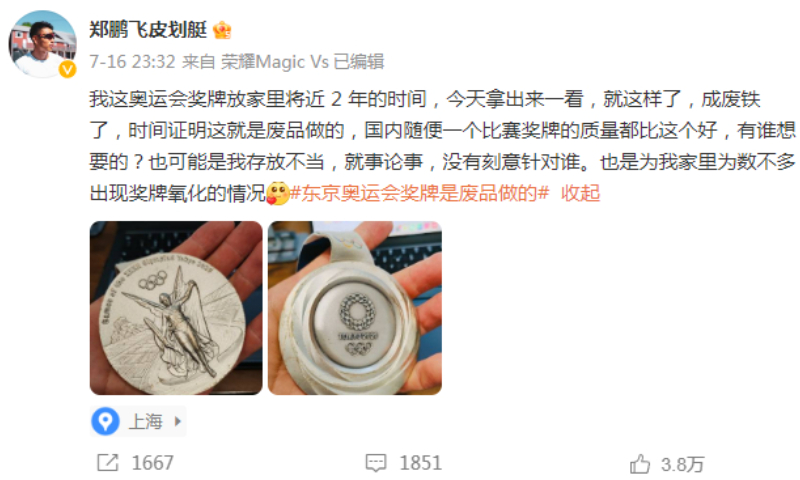
Photo: Screenshot of Weibo
Chinese kayaker Zheng Pengfei showed his silver medal won at the Tokyo Olympics in a short video on Sunday, and complained about its quality. His comment sparked heated discussions among Chinese netizens.
Zheng won the silver medal in the Men's Canoe Double 1000m at the Tokyo 2020 Olympic Games held in 2021. "After only two years, the medal has become 'scrap iron.' Any medal made in China is better quality than this. Maybe I didn't store it properly, but it is one of the few oxidized medals of mine," Zheng posted on his social media account.
Some netizens consoled him by saying the medal is only symbolic, but others questioned its real commemorative significance if its quality is poor. The incident also reminded some others of a Russian gymnast's medal won in the Beijing 2008 Olympic Games. It was said that after a fire at her home, nearly everything was destroyed except her gold medal.
A few netizens took a scientific view. "The oxidization of silver medals shows the silver is pure as only pure silver ought to change like this in the air," one said.
According to the Tokyo Olympics official website, since April 2017, Japan started to collect small home appliances and used cellphones in order to extract pure gold, silver and copper for making Olympics medals. By March 2019, about 78,000 tons of used small electronic devices and 6.21 million used cellphones had been collected. It was reported that the Tokyo Olympic Organizing Committee took this measure to show their efforts in "sustainable development."
Yet quite a few Chinese netizens related the medal problem to Japan's nuclear waste water dumping issue. They believe food security due to Japan's nuclear-contaminated waste discharge is more important than the quality of the silver medal. "Fortunately, the medal is not made of nuclear waste," one said.
Japan decided to release nuclear wastewater from the Fukushima Daiichi nuclear power plant into the Pacific Ocean in 2021, and implement its plan as early as August 2023. It has been reported that once the implementation starts, the discharge will continue for 30 years or longer. Such a plan has been strongly opposed by the local residents of Fukushima and other areas in Japan, its fishery organizations, and international experts as well as the neighboring countries, such as China, South Korea and Indonesia. There are concerns the discharge will result in radioactive contamination of the marine ecological environment.
RELATED ARTICLES