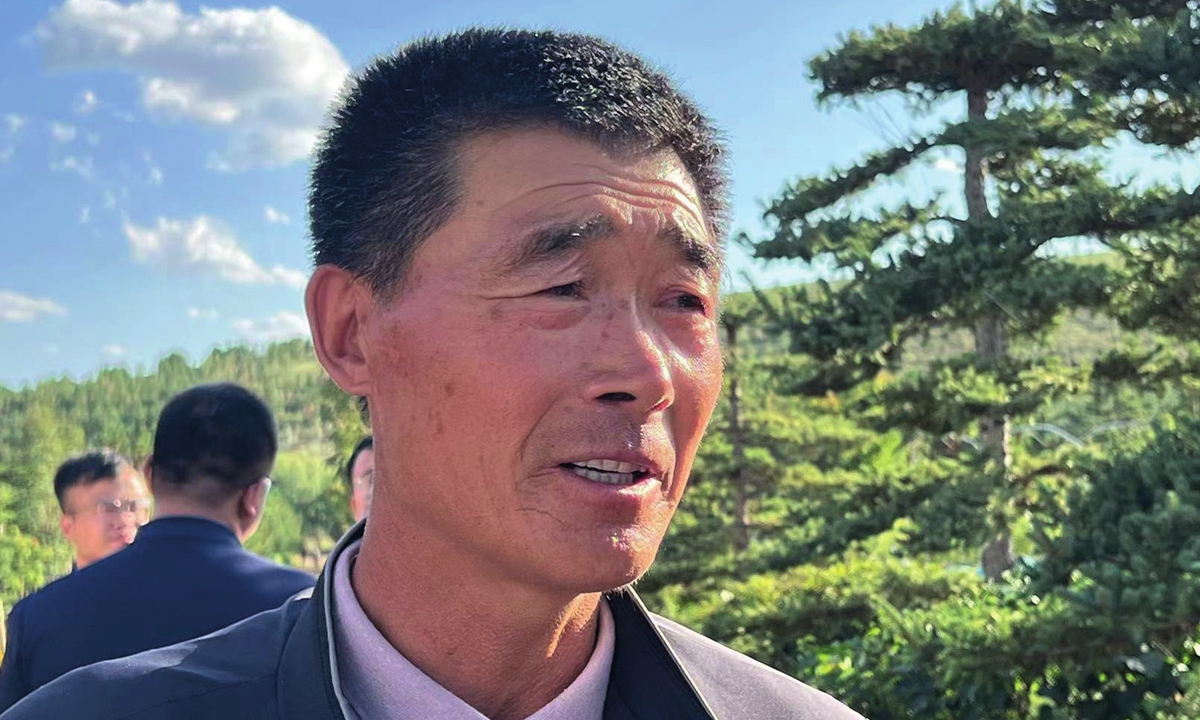
Ma Yunping Photo: Xu Yelu/GT
"Pigs on the roof, sheep jumping walls, children sitting on the eaves, no grain on the ground, and sand burying houses." This jingle had been widely circulated over 20 years ago in Duolun county, Xilin Gol League, North China's Inner Mongolia Autonomous Region, and it is what farmer Ma Yunping spent 20 years trying to change.
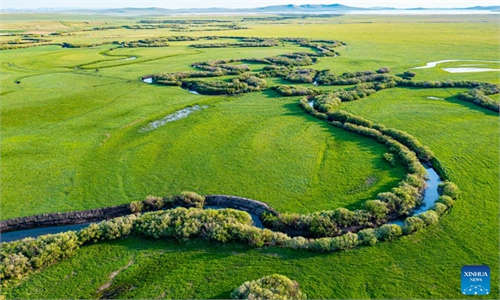
Duolun county is located at the southeastern end of the Xilin Gol League, on the southern edge of the Hunshandake Sandland, in Inner Mongolia. This county, only 180 kilometers away from Beijing, was once where sandstorms which affected Beijing and Tianjin municipalities originated. In the 1970s and 1980s, due to the combined effects of natural and human factors, Duolun suffered severe wind erosion and desertification.
According to satellite remote sensing monitoring in 2000, the county had an area of 5.05 million mu affected by wind erosion, water erosion and desertification, accounting for 87 percent of the total land area.
To solve the problem, in 2001, China launched the Beijing and Tianjin sandstorm source control project. Duolun became the starting point for large-scale ecological construction in northern China, and the local government actively called on villagers and enterprises to contract desertificated lands. However, mobilizing everyone to combat the desert was challenging, with few villagers willing to participate.
Tough decision to make
"Before 2000, the entire Duolun county was filled with sand and dust in spring, and visibility was so poor, you couldn't see anyone, even if they were just a few meters away." In that year, Ma Yunping, a retired soldier, sold six cows from his home to collect 7,000 yuan ($976) and decided to contract 3,700 mu of deserted sandy land three kilometers away from his home.
Although the circumstances at the time were difficult, Ma never thought of relocating. He discussed with his wife about the contract. "She was very reluctant at the time. I secretly signed the contract myself, and only told her afterward," Ma told the Global Times, with a smile on his face. "I still remember when she heard the news she just said: 'You can go and do it yourself.'"
Not only his wife, but other people also said that Ma was crazy, and many had their doubts: With several thousand acres of barren sandy land, could he manage it all by himself?
Facing the vast expanse of yellow sand, as a farmer, Ma initially didn't know where to start. "In the first year, I brought my own food and water, built a simple shelter in the sand and lived there alone. Later, my wife, seeing me working tirelessly alone, couldn't bear it and gradually started to join me and the two of us stepped into this vast desert together," Ma said.
Due to Duolun's unique geological environment, which consists mainly of shifting sand dunes, the inexperienced Ma and his wife tried planting grass without setting up a grid. After a sandstorm, there was hardly anything left. Later, the forestry department guided their work, indicating that they need to set up grids before planting. "We used branches from poplar trees, willow twigs, cow dung and stones to stabilize the dunes. Bit by bit, we surrounded them and planted some grass. However, the sandstorms came frequently. We planted again and again after each storm. We failed many times but kept trying, learning from our mistakes."
For the first three years, aside from farming, whenever Ma had free time, he would work in the sandy areas. Planting grass became his primary job. Slowly, the yellow sand was stabilized, and a touch of green appeared. At that time, there was no water in the land, so he hauled water using horse carts, doing as much as he could handle. "We used up all our family's financial resources to combat desertification, and our child needed to attend school. Sometimes I felt regret but I couldn't tell my wife. I had to bear the burden and motivate my family, making them believe in me," Ma recalled in tears.
After the bitter comes the sweet
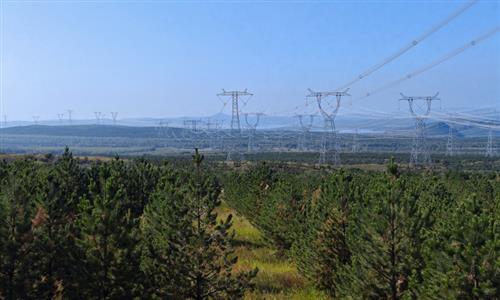
After 2006, Ma and his family began to see a modest profit because the saplings they had planted earlier could be sold in the market. According to Ma, the annual income reached 30,000 from selling saplings. With this initial return on investment, plus government subsidies, Ma began planting more and more trees, including poplars, elms, apricot trees, as well as many other trees. Now, in this area, Ma has planted about 400,000 trees in total. All of them have grown into flourishing vegetation, and not a speck of yellow sand can be found.
To increase his income, Ma began to cultivate Chinese herbal medicines in tree gaps. Now, the annual income from the herbal medicines grown on 20 mu of land can reach around 200,000 yuan. This experience truly made me understand that "lucid waters and lush mountains are invaluable assets," Ma said.
In 2016, Ma established a professional cooperative, which now has over 40 members. I can't prosper on my own. I want everyone in my village to actively participate in preventing and treating desertification and to share in the green achievements, he noted. In 2017, Ma was named the national advanced individual for combating desertification.
"All along this journey, I just kept working diligently, never imagining that I could transform such a vast desert into this," Ma said. "The immense change has far exceeded my expectations."
Currently, 66-year-old Ma still often visits the vegetation he built. "Walking into the vegetation I planted feels as awe-inspiring as walking into a forestry farm. The environment is excellent, and every blade of grass and every tree feels as dear as my own child."
Reflecting on the 20-year journey of combating desertification, Ma has long engraved the patches of green on the dunes into his heart. "I am so fond of the greenery, and I want to keep following it," Ma told the Global Times.
RELATED ARTICLES