Dutch FM's China visit signals trend of EU countries returning to pragmatic engagement with China: expert
By Published: May 21, 2025 11:41 PM

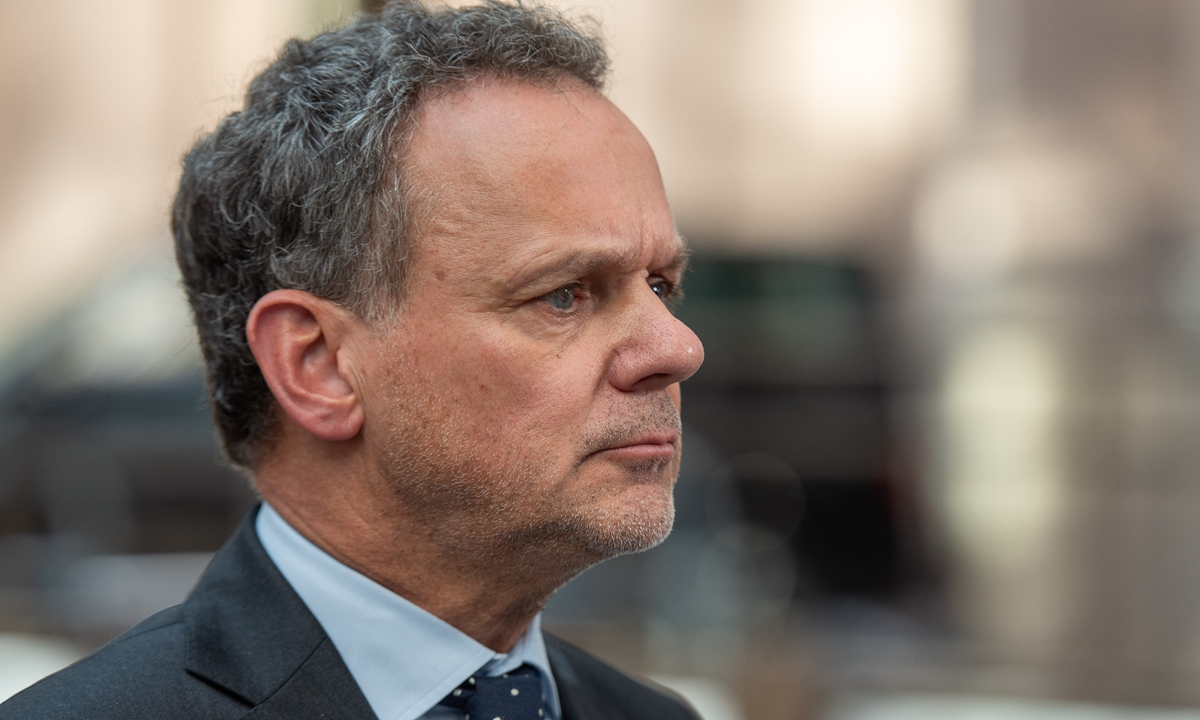
Dutch Foreign Minister Caspar Veldkamp speaks to the press after the meeting of European foreign and defense ministers. Photo: AFP
Dutch Foreign Minister Caspar Veldkamp is set to begin a two-day visit to China on Wednesday, which may aim to revitalize bilateral relations amid a shifting geopolitical landscape, a Chinese expert said, also noting that the visit, which comes on the heels of a series of high-level exchanges between China and the European Union, may also signal a broader trend of European countries returning to pragmatic engagement with China.
At the invitation of Member of the Political Bureau of the Communist Party of China (CPC) Central Committee and Foreign Minister Wang Yi, Foreign Minister of the Netherlands Veldkamp will visit China from Wednesday to Thursday, according to the Chinese Foreign Ministry.
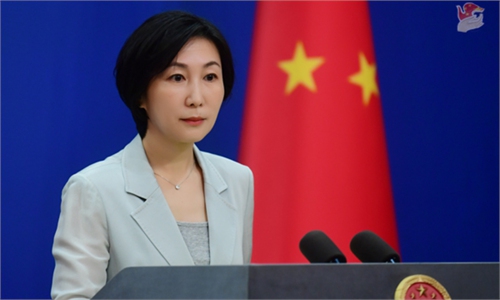
At a press conference on Monday, Foreign Ministry spokesperson Mao Ning stated that this will be Minister of Foreign Affairs Veldkamp's first visit to China since he assumed office.
China hopes that through this visit, the two sides will have in-depth exchanges on bilateral relations and international and regional issues of mutual interest, expand common understandings, deepen cooperation, inject new momentum into the development of China-EU relations, and contribute to upholding multilateralism, the international order based on international law and an open world economy, said Mao.
No details of Veldkamp's schedule in China had been released by the Chinese side as of press time. According to Veldkamp's agenda published by the Dutch government, he is expected to hold discussions with Wang on bilateral relations and current geopolitical issues.
Veldkamp on Wednesday posted on his X account that "This week, I will pay my first visit to #China as Foreign Minister. Our cooperation is crucial, especially in a shifting geopolitical reality."
The visit reflects a shared commitment to deepen and expand China-Netherlands relations, Cui Hongjian, professor of the Academy of Regional and Global Governance at Beijing Foreign Studies University, told the Global Times on Wednesday.
Bilateral trade remains strong due to the Netherlands' key role as a logistics hub in China-Europe trade. However, as both an EU core member and an active NATO country, the Netherlands often adopts a higher political tone, yet it is now reassessing its foreign policy toward China in light of recent global shifts, including the impact of US policies, Cui said.
The visit may also suggest a desire to explore new dynamics in its China policy. China, for its part, remains open and committed to strengthening China-EU ties through dialogue and cooperation despite differences, said the expert.
Veldkamp's visit to China comes amid a recent flurry of high-level exchanges between China and the EU. On Monday, Wang Yi held talks with Danish Foreign Minister Lars Løkke Rasmussen, who is in China for a visit. Also on Monday, Wang had a phone call with the new German Foreign Minister Johann David Wadephul at the latter's request, according to the Chinese Foreign Ministry.
Cui said that as China and the EU mark the 50th anniversary of diplomatic ties, exchanges are expected to increase, driven by a positive atmosphere that encourages European countries to enhance dialogue with China. Meanwhile, amid deepening global shifts, even the Netherlands and Denmark are rethinking their policies.
The split between the US and EU regarding tariffs has widened. According to a Reuters report on May 18, US Vice President JD Vance met European Commission President Ursula von der Leyen and Italian Prime Minister Giorgia Meloni on Sunday and said he hoped their encounter would help move forward trade talks between the EU and the US.
The White House has imposed a 25 percent tariff on imports of steel, aluminum and cars, as well as a baseline 10 percent tariff on almost all countries, with additional "reciprocal" tariffs - a combined 20 percent in the EU's case - lined up if negotiations during a 90-day pause fail, Reuters reported.
The evolution of China-EU relations should not be solely attributed to changes in Europe-US ties. Economic realities have pushed Europe to reassess its China policy, with most countries - whether openly or not - acknowledging the need for cooperation with China to safeguard their own interests, said Cui.
As a result, pragmatic cooperation is once again taking center stage in China-EU relations. Experience has shown that economic decoupling is unrealistic. Europe is now steering its China policy back on track and seeking a new strategic balance driven by its own interests and evolving geopolitical realities, said the expert.
RELATED ARTICLES