Experts slam CIA deputy director's claim of tech race with China; rhetoric reflects 'growing hostility, anxiety' against China's tech progress
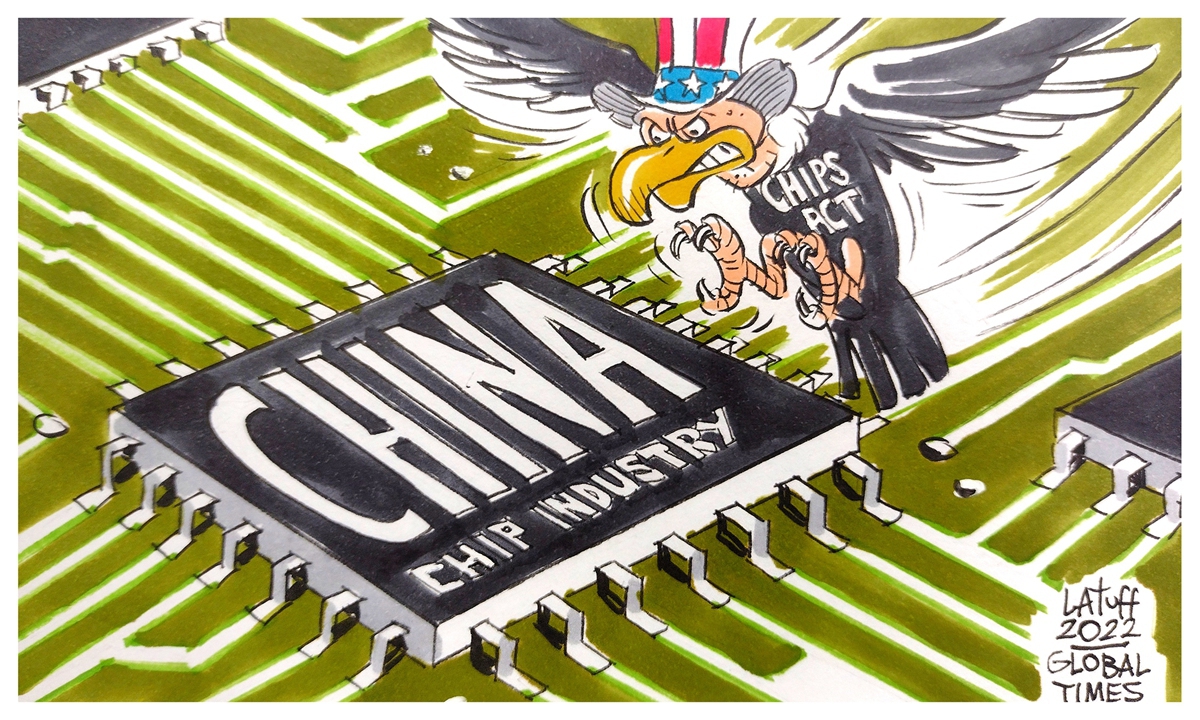
US claws at China's chip industry fanning flames on tech confrontation. Cartoon: Carlos Latuff
Chinese experts criticized the remarks of US Central Intelligence Agency (CIA) Deputy Director Michael Ellis as hyping "China threat" and further politicizing science and technology cooperation. Ellis claimed in the interview that the US' top intelligence focus is the technology race with China, stressing the need to help US companies maintain an edge against China.
In an interview with Axios published Thursday, Ellis claimed that "the top priority for the CIA's new leadership is China," particularly in "helping US companies maintain a decisive technological advantage" in areas such as artificial intelligence (AI), semiconductors, biotechnology, and battery technologies.
Ellis even claimed in the Axios interview that "China is the existential threat to American security in a way we really have never confronted before."
The remarks reveal growing hostility and anxiety of certain circles in the US administration over China's technological progress," Li Haidong, a professor at the China Foreign Affairs University, told the Global Times on Thursday. "Some in Washington are even willing to mobilize intelligence agencies to suppress China's tech development."
Such actions, Li said, will make exchanges in science and technology increasingly difficult — whether in academic communication, personnel visits, or industrial cooperation — creating significant new barriers.
Experts also emphasized that these moves would not stop China's technological progress but could slow global development.
China is a major country that cannot be expected to abandon its own technological development, Lü Xiang, a research fellow at the Chinese Academy of Social Sciences, told the Global Times on Thursday. "The more the US tries to block China's rise — including through intelligence means — the stronger China's internal drive for innovation will become," Lü added.
"If both sides can develop together and complement each other's strengths, it would lead to a healthy competition," Lü said. "But if the US insists on decoupling and refuses cooperation, it risks creating a 'parallel tech world,' ultimately harming global progress."
Beyond intelligence operations, the US has continued to tighten restrictions on China's high-tech sector. The US Department of Commerce recently issued guidance stating that using Huawei Ascend AI chips "anywhere in the world" could violate US export control rules. The wording was later softened to a general warning to "alert industry to the risks of using PRC advanced computing ICs, including specific Huawei Ascend chips."
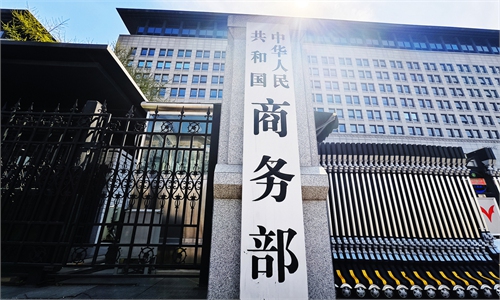
Such measures were condemned by a spokesperson from China's Ministry of Commerce on Wednesday, who said the US move deprives other countries of their right to develop advanced computing chips and high-tech industries such as AI. The spokesperson criticized that the US is abusing export controls to restrain and suppress China, which violates international law and the basic norms of international relations, severely harms the legitimate rights and interests of Chinese enterprises and undermines China's development interests.
The US restrictions have also drawn criticism from within its own tech sector. Nvidia CEO Jensen Huang said Wednesday that the AI chip export controls to China were "a failure," adding that the assumptions behind the policy were "fundamentally flawed," Reuters reported.
RELATED ARTICLES