China successfully launches its first asteroid probe and sampling mission Tianwen-2, continues interstellar exploration
Significant endeavor to improve humanity’s understanding of solar system, Earth evolution: experts
By and Fan Wei in Xichang Published: May 29, 2025 02:39 AM

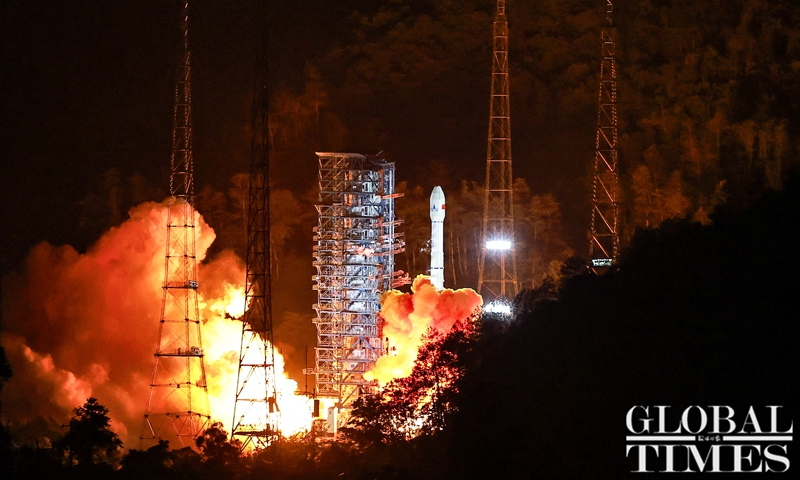
Carrying the Tianwen-2 asteroid probe, China's Long March-3B carrier rocket takes off from the Xichang Satellite Launch Center in Southwest China's Sichuan Province on early Thursday morning. Photo: Deng Xiaoci/GT
China continued its interstellar exploration, with Tianwen-2 - the country's first asteroid probe and sampling mission - being successfully launched on Thursday early morning via a Long March-3B carrier rocket from the Xichang Satellite Launch Center in Southwest China's Sichuan Province.
After a flight of around 18 minutes, the Tianwen-2 probe extended its solar panels and entered its predetermined orbit smoothly, marking a full success of the launch stage for the asteroid probe and sampling mission, according to the China National Space Administration (CNSA).
The Tianwen missions are a series of robotic interstellar exploration launched by the CNSA to explore the solar system. The name comes from the long poem "Tianwen," meaning Heavenly Questions or Questions to Heaven, written by Qu Yuan (around 340-278 BC) one of ancient China's most esteemed poets.
China has previously launched the Tianwen-1 Mars probe mission on July 23, 2020, and achieved all designated goals including orbiting, landing, and deploying a rover to survey the Martian surface in a single mission.
Participants and insiders involved in the latest Tianwen-2 mission, speaking to Global Times reporters in Xichang, have shared new details about China's latest space endeavor and the challenges that lie ahead.
Fastest probe to date
The Tianwen-2 mission marks the first time a Long March 3A-series launch vehicle has performed a launch to an Earth-escape trajectory, according to Wei Yuanming of China Aerospace Science and Technology Corporation (CASC), the mission's contractor.
In prior missions carrying payloads to Earth-bound orbits, the rocket separation velocity was at the first cosmic velocity or 7.9 kilometers per second. However, for this mission, the rocket exceeded the second cosmic velocity of 11.2 kilometers per second at the point of separation, enabling the probe to escape Earth's gravitational pull. Achieving this requires extremely high speed and energy, he explained.
"When an object moves at a higher speed, it inevitably becomes more difficult to control. The probe launched this time is the fastest among all known probes China has ever sent into space so far," Wei said. "At the same time, it also has the highest precision requirements - twice as high as those of previous missions. These are the main challenges for the launch period of Tianwen-2."
It's akin to driving a car at high speed and trying to park it precisely in a designated spot - the difficulty is extremely high. Or it is like standing in Beijing and throwing a basketball into a fixed hoop in Shanghai - the level of precision required is similarly demanding, Wei told the Global Times.
Furthermore, due to the small size, low mass, and weak gravity of asteroids, they are very difficult to capture, placing extremely high demands on orbital insertion accuracy. In this mission, despite the rocket speed at 11.2 kilometers per second, the permissible speed deviation was under one meter per second; exceeding this could result in trajectory errors spanning millions of kilometers, the expert noted.
To meet these stringent requirements, the development team implemented an iterative guidance system alongside terminal velocity correction technology, enabling real-time adjustments to the rocket's speed and attitude before separation to ensure precise orbital insertion, according to Wei.
As China's primary vehicle for high-orbit launches, the Long March 3B is the most powerful of the Long March 3A series "triplets." Since the launch vehicle team began a dual-upgrade program in 2020 to boost both payload capacity and reliability, the rocket's performance has further improved. Its capacity to geosynchronous transfer orbit (GTO) has now increased to 5.55 tons, better matching the mass requirements of the Tianwen-2 probe, making it the optimal choice for this mission.
The Long March 3B is also China's first single Long March rocket model to surpass 100 launch missions. Having been tested and refined over many missions, it has become increasingly stable and now boasts a success rate on par with international standards. Since its inaugural flight in 1996, it has launched payloads like Beidou, Chang'e, Fengyun, and Tianlian, contributing significantly to major national space projects.
After the launch
According to the CNSA, the Tianwen-2 mission will collect samples from the near-Earth asteroid 2016HO3 and explore the main-belt comet 311P, the Xinhua News Agency reported on Tuesday.
"This is an ambitious mission to explore a fascinating object," astrophysicist Amy Mainzer of the University of California, Los Angeles, told the journal Science on May 23.
Asteroid exploration is of great significance, and scientific research on asteroids holds immense value, said Liu Jianjun, deputy chief designer of the Tianwen-2 mission.
He explained that asteroids formed about 4.5 billion years ago in the early solar system, and their key feature is that they have not undergone major physical or chemical changes like the Earth. As a result, they have preserved their original composition and state. Therefore, they are referred to as cosmic fossils or time capsules, retaining information from the early solar system.
Liu also told the Global Times that from another perspective, studying asteroids can provide important information for understanding Earth and its evolution. "Scientists generally believe that Earth did not have water or organic materials during its early formation, and these substances were brought to Earth through collisions with small celestial bodies, which played a crucial role in Earth's evolutionary process. Besides that, the impact of small celestial bodies has had a significant influence on Earth's evolution, such as the extinction of the dinosaurs. These impact events have profoundly affected Earth's changes."
Chen Chunliang, another mission insider with the CASC, told the Global Times that the near-Earth asteroid 2016HO3 is such a "living fossil" of the solar system. "By exploring it, we can gain a better understanding of the solar system's origins."
As for the main-belt comet 311P, it was selected because it exhibits characteristics of both an asteroid and a comet — it has asteroid-like orbit, but also displays comet-like activity such as outgassing, Chen explained. "Therefore, both targets are of great scientific value."
In response to Global Times reporters' inquiry about how Tianwen-2's asteroid sampling differs from the lunar surface sampling conducted by Chang'e-5 and -6 missions, Chen explained that the sampling conducted by Chang'e-5 and Chang'e-6 on moon took place under gravitational conditions, whereas asteroid sampling is carried out in a microgravity environment, so the sampling methods are certainly different and a touch-and-go (TAG) sampling technique was adopted in previous international asteroid sampling efforts.
Previously, Japan's Hayabusa missions and NASA's OSIRIS-REx probe collected their asteroid samples used such "touch-and-go" technique, according to the journal Science.
Han Siyuan, Deputy Director of the Lunar Exploration and Space Engineering Center of the CNSA and spokesperson for the Tianwen-2 mission, revealed to the Global Times that the Tianwen-2 project team has also innovated the approach for small celestial body sampling. They have designed three sampling methods. In addition to the "touch-and-go" method, the mission will also attempt hovering sampling and attachment sampling.
Chen noted that specific sampling method for Tianwen-2 will ultimately depend on the actual conditions at the sampling site on the asteroid's surface, which remain highly uncertain at this stage.
According to the mission planners, after sampling the asteroid, the probe's return capsule is expected to deliver the samples back to Earth around 2027, and then the probe would continue its journey to explore the comet in the main asteroid belt between Mars and Jupiter around 2034.
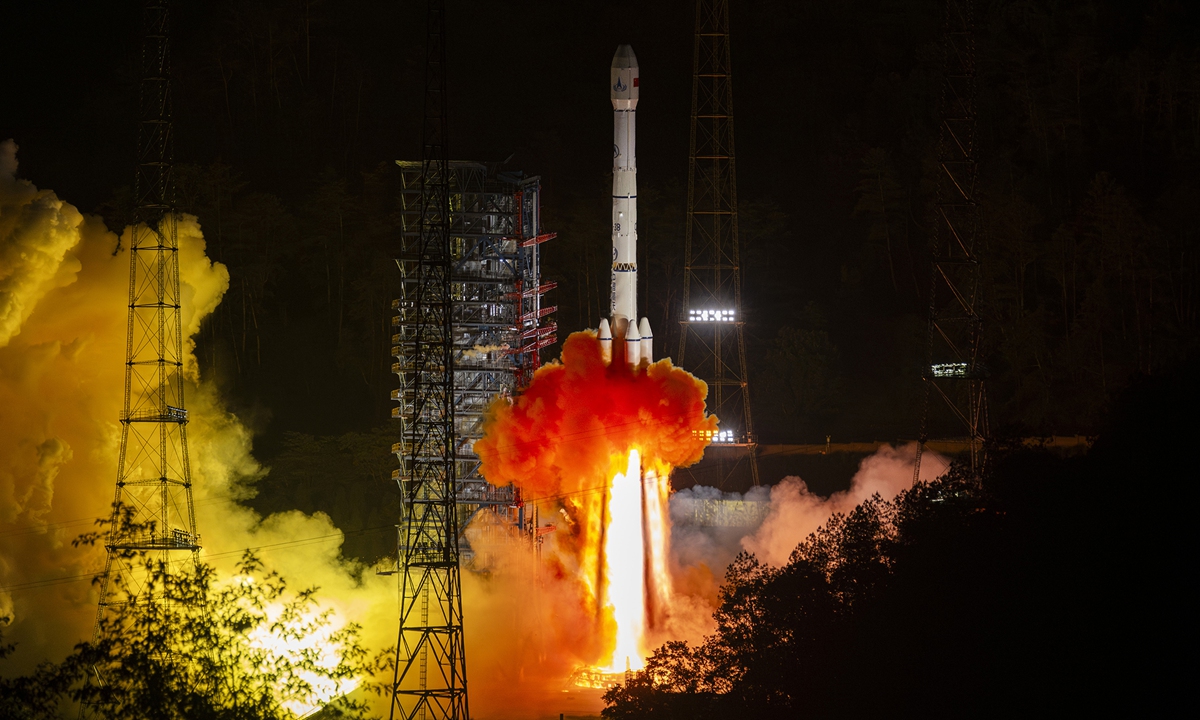
China's Tianwen-2 probe, atop a Long March-3B carrier rocket, lifts off from the Xichang Satellite Launch Center in southwest China's Sichuan Province, May 29, 2025. Photo: Xinhua
Beyond a national success
Amjad Ali, deputy director general of SUPARCO, Pakistan's national space agency, in an exclusive interview with Global Times on Thursday, hailed that we see Tianwen-2 not just as a national success for China, but as a meaningful contribution to global scientific progress. Space exploration is a shared human pursuit - one that thrives on collaboration and collective ambition.
On behalf of the SUPARCO, we extend our heartfelt congratulations to the CNSA and all those contributing to the Tianwen-2 mission. This bold and visionary endeavor - to collect samples from near-Earth asteroid and study main-belt comet - marks another milestone in humanity's journey to understand the origins and evolution of our solar system.
Ali applauded that Tianwen-2 promises to deliver invaluable scientific insights. Asteroids and comets are time capsules of the early solar system, holding clues about planetary formation, the distribution of extraterrestrial resources, and even the origins of life. The mission's complex trajectory, advanced sampling technology, and high-speed return to Earth speak volumes about CNSA's technical prowess and China's growing leadership in deep space exploration.
The asteroid and comet mission will provide China with a range of experience and expertise in mission design and operations, such as advancing spacecraft autonomy, navigation, planning orbits and sampling technologies in extremely challenging environments, Franco Perez-Lissi, Ramses mission systems engineer at the European Space Agency (ESA), was quoted as saying in the SpaceNews coverage of the Tianwen-2 mission on Thursday.
"It's like trying to dock a boat with a mountain floating in space and tumbling really unpredictably and with almost no gravity. So landing, or even just flying close, requires extreme precision, greater autonomy and careful planning," Perez-Lissi said.
RELATED ARTICLES