What causes the DPP to lose its composure is absolutely more than a ‘gym boss’: Global Times editorial
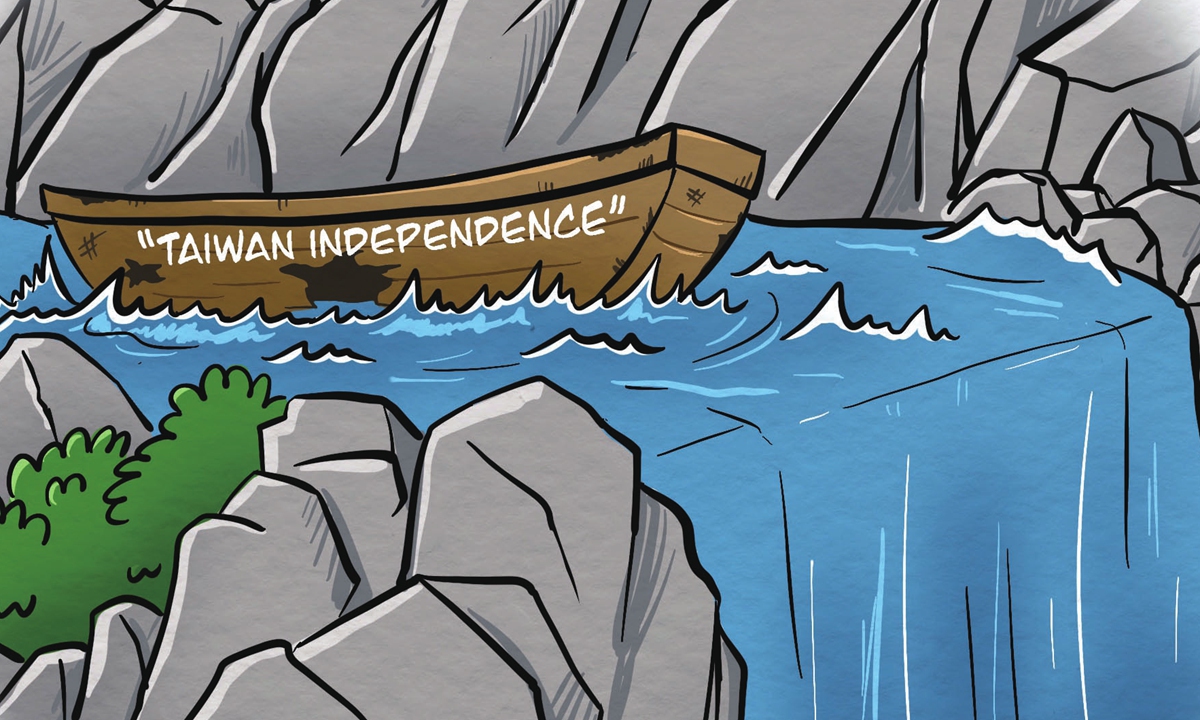
Illustration: Liu Xidan/GT
Taiwan internet celebrity Chen Chih-han, often referred to as Kuan Chang (Chinese for gym boss), arrived in Shanghai on Tuesday and planned a six-day live-streamed trip to many tourist attractions in the mainland. He has attracted a large audience, with live stream viewership surpassing 300,000 at one point. On the same day that Chen flew to Shanghai, Hung Chi-chang, a veteran politician from the Democratic Progressive Party (DPP) and former chairman of the Straits Exchange Foundation, also flew to Beijing and led a delegation from Taiwan's biotech industry for a three-day visit that has achieved positive results. Both events have attracted considerable attention on the island, with some media outlets asking if it is a "coincidence" that the two went to the mainland on the same day.
In fact, in two days, cross-Straits exchanges will set off a greater wave. More than 7,000 people from all walks of life in Taiwan will attend the 17th Straits Forum, which will open on Saturday. Ma Ying-jeou, former chairman of the Kuomintang, will lead Taiwan youths in attendance. On the surface, "Kuan Chang" is an internet celebrity who runs a self-media account, while Hung and Ma have different party backgrounds. The participants in the Straits Forum come from diverse sectors of Taiwan society. Their recent intensive trips to the mainland for various exchange activities may be coincidental in timing, but they reflect the reality that cross-Straits civil exchanges and cooperation are becoming increasingly active. In a sense, this situation is inevitable.
The Lai authorities have suppressed and blocked cross-Straits exchanges, aggressively promoted "de-Sinicization," capitulated to the US on economic and trade issues by selling out Taiwan, and clamped down on cross-Straits cooperation. As a result, Taiwan Semiconductor Manufacturing Co (TSMC), dubbed the "sacred mountain" protecting the island, has become "USSMC," while Taiwan's "five shortages" (land, water, electricity, labor and talent) have worsened. Taiwan companies are left without a way forward, and investment on the island has cooled. Criticism of the Lai authorities for selling out and destroying Taiwan, thereby undermining its vital interests, is rising in public opinion on the island. At the same time, more people in Taiwan are coming to deeply understand that peaceful and integrated development across the Straits is crucial for Taiwan's prosperity and stability. Even some within the green camp have begun questioning and opposing Lai Ching-te's radical approach. Under these circumstances, the genuine need for cross-Straits people-to-people exchange and integrated development is increasing, which is an objective fact.
Take Hung's recent visit to Beijing as an example. In media interviews, he described it as purely an industrial exchange, saying "only through exchange can there be understanding and cooperation." His itinerary focused on areas like AI and biotechnology - fields where Taiwan's industries are eager for breakthroughs, and where the mainland holds clear advantages. Especially as concerns grow in Taiwan over the future of its manufacturing sector, calls for hitching a ride on the mainland's development momentum and pursuing coordinated cross-Straits growth are growing louder.
Similarly, the gym boss visiting Shanghai should have been a normal event, but due to the long-term creation of an "information cocoon" by the DPP authorities, there is a severe lack of real information about the mainland. As a result, this unedited, unscripted live stream has attracted a large amount of attention from Taiwan netizens. These trends reflect a growing mainstream public desire in Taiwan for peace, development, exchange, and cooperation.
Ironically, under the Lai authorities' extreme suppression, a "mainland fever" has emerged in Taiwan. For instance, many Taiwan residents have traveled to Harbin; the game Black Myth: Wukong and the movie Nezha 2 have sparked heated discussions among young people on both sides; and the recent mainland TV drama The Legend of Zang Hai starring Xiao Zhan has remained in Taiwan's daily top 10 most-watched shows for seven consecutive days. Even under the obstruction of the DPP's "green terror," in 2024, 4.405 million trips were made across the Straits, an increase of 53.8 percent year on year. The number of Taiwan residents applying to settle in mainland has been increasing month by month, and the total applications have already surpassed the sum of the previous 10 years. The shared history, culture, and blood ties between both sides of the Straits are inherently close and cannot be changed by any force. In the face of extreme suppression, this bond will demonstrate even greater resilience.
It is not just the gym boss that has caused the Lai authorities to lose their composure; they have also put forward the 17 strategies, targeting groups such as mainland spouses and patriotic entertainers for political persecution. Even Mazu, the goddess worshipped by coastal residents on both sides of the Straits for centuries, has been labeled as a "united front tool." Hwang Yangming, a media figure in Taiwan, stated that the green camp is actually "afraid." Remarks of "Taiwan independence" hardliner Shen Paoyang have exposed his true thinking - many Taiwan entertainers who return from the mainland "start to say that China, not even a bit can be left behind, oppose Taiwan independence, support cross-Straits unification, and affirm that blood is thicker than water and that both sides of the Straits are a family." In fact, this is precisely because they have witnessed the achievements of the mainland's modernization and have personally felt the irreversible trend toward cross-Straits unification, which has awakened their national sentiment as members of the same family.
The tide of civil exchanges between the two sides of the Straits is rolling forward relentlessly. No matter how many political maneuvers the DPP employs, it can't stop or interrupt this historical trend. The mainland will continue to actively promote the normalization and regularization of exchanges in all areas between the two sides. If the DPP authorities remain stubborn and self-serving, they will inevitably lose even more the support of the people.
RELATED ARTICLES