Temperatures break records across Northern Hemisphere in first heatwave in 2025
Intensity of extreme weather highlights urgency of global climate action

People escape the heat at an amusement park in Changxing, East China's Zhejiang Province on June 30, 2025. Maximum temperatures are expected to approach 40 C these days. Photo: VCG
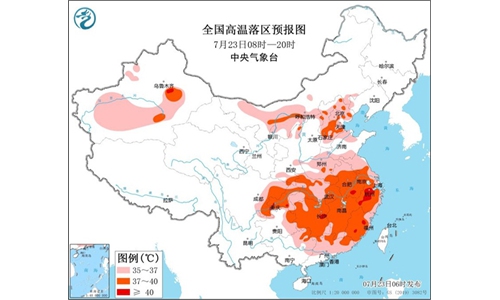
In the coming days, regions in China such as Jianghuai and Jiangnan will face widespread high temperatures, with some areas expected to exceed 40 C, according to the National Meteorological Center (NMC).
Other regions in the Northern Hemisphere are also experiencing unusual heat waves, from South Korea to countries in sweltering Europe and North America, and frequency and intensity of extreme weathers amid climate change again underscore the urgency of global efforts to tackle the threat to humanity, observers said.
From Monday to July 6, regions including Huanghuai, Jianghuai, and central and eastern parts of South China are expected to face sustained high temperatures ranging from 35 to 39 C, with some areas possibly exceeding 40 C, according to the NMC.
Except for the western part of Northeast China and the eastern part of Inner Mongolia Autonomous Region, where temperatures remain below average, most parts of the country are experiencing elevated heat.
A total of 102 national meteorological stations reported daily maximum temperatures that broke historical June records.
Globally, South Korea's weather agency issued heat wave watches for much of the country this week, including Seoul, warning of scorching daytime temperatures, tropical nights and increased risk of heat-related illnesses, as the country faces its first major heat spell of the summer, the Korea Times reported.
Europe sweltered as early summer heat broke records. Temperatures soared past 40 C across parts of the continent over the weekend, as an early-summer heat wave tightened its grip, Deutsche Welle reported.
A new June temperature record of 46 C was set on Saturday in the town of El Granado, according to Spain's national weather service, which also noted this month is on track to becoming the hottest June on record.
Red heat warnings are in effect in parts of Portugal, Italy and Croatia, with numerous amber warnings covering areas of Spain, France, Austria, Belgium, Bosnia & Herzegovina, Hungary, Serbia, Slovenia and Switzerland.
In the US, about 18.3 million people live in the areas expected to have dangerous levels of heat, according to a heat index compiled by the New York Times.
Labor losses due to heat exposure cost the US economy approximately $100 billion, a figure projected to rise to $500 billion annually by 2050.
While it is difficult to link individual extreme weather events to climate change, heatwaves are becoming increasingly frequent and intense due to climate change, according to the BBC.
Ma Jun, director of the Beijing-based Institute of Public and Environmental Affairs, told the Global Times that although 2025 may mark the onset of a La Nina event, typically expected to moderate sweltering weather, the fierce first heat wave pointed to an alarming trend of accelerated warming.
The year 2023 was declared the warmest on record, only to be surpassed in 2024. UN experts from the World Meteorological Organization (WMO) confirmed that 2024's average temperature was 1.55 C above pre-industrial temperatures.
Last year marked the first time the benchmark 1.5 C was crossed, highlighting the shortcomings of global efforts to reduce emissions and control warming, Ma said. "Although countries like China are actively promoting energy transition and our carbon peak and carbon neutrality goals go on smoothly, emission cut requires rigorous global efforts."
The heat wave is a reminder that in the face of a global challenge like this, no country or region can stand alone, the expert said.
RELATED ARTICLES