As climate melts the hegemony’s geopolitical chessboard, how should the US react?
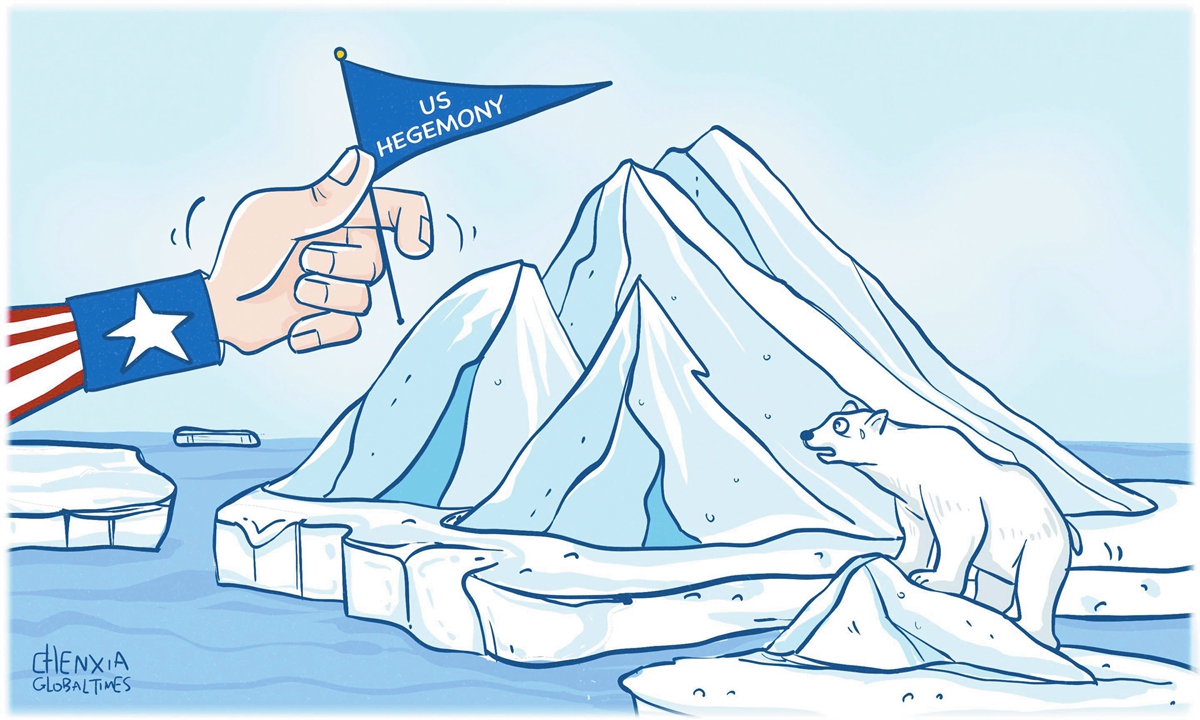
Illustration: Chen Xia/GT
In recent weeks, Western reports revealed a jarring contradiction in the US polar strategy. The US "big and beautiful" bill allocates nearly $9 billion to build at least six icebreakers, intended to "compete with China and Russia in the Arctic region." Yet, simultaneously, the US National Science Foundation plans to slash Antarctic research funding by 70 percent in 2026.
This schizophrenic approach - militarizing one pole while abandoning science at the other - exposes a more profound truth: The ice caps are vanishing, the planet is burning, but Washington's vision remains frozen in last century's rivalries. Its focus remains on maintaining hegemonic power over the entire Earth.
NASA data confirm that between 2002 and 2023, Greenland shed an average of 270 billion metric tons of ice per year. When NATO's own Arctic bases sink into thawing permafrost, what empire is left to defend? This isn't a competition; it's climate change that is creating one disaster after another, threatening human survival. We have already felt this threat at our doorstep from the recent effects of global warming, which are affecting half the planet.
Washington prioritizes abstract dominance over concrete survival, mistaking icebergs for chess pieces. This is the short-sightedness of hegemony.
For decades, the US has taken pride in its leadership in science, exploration, and international cooperation. Yet, in the face of unprecedented global warming, when polar ice is disappearing at a rate never before seen, placing the entire planetary ecosystem at risk, Washington doubles down on confrontation and unilateralism rather than collaboration and shared scientific purpose.
The world watches as America oscillates between evoking threats from abroad and withdrawing from those very projects that once defined its global stewardship.
Contrast this with the US polar approach. China expands its Antarctic facilities, including the new Qinling Station. But unlike US insinuations, these aren't covert military hubs. They host international scientists who study together.
Cooperation is already sprouting where the US geopolitical interests lie. China is advancing global efforts to address climate change through international cooperation and knowledge sharing. Amid this drama, China's position is clear: tackle climate change through science-based, open, and cooperative approaches.
In recent years, China has expanded its investment in polar research, sending more scientific teams to Antarctica and the Arctic, constructing new research stations, and sharing its findings with the global community. China's motto is: Shared knowledge for shared survival.
While Washington weaponizes polar politics, Beijing builds research bridges. The gap between these philosophies widens faster than the crack in the Ross Ice Shelf.
No missile shield stops sea-level rise in Miami. No spy satellite can relieve Phoenix from its scorching summer heat. It's not about "losing" to China; it's about losing Earth.
What the global community needs now is genuine leadership to confront the climate emergency. We should recall that modern polar science has always been strongest in moments of international cooperation - the International Geophysical Year, the achievements of multinational Antarctic research and the open sharing of satellite data.
When political rivalry trumps scientific progress, everyone loses. As the landscapes of the Arctic and Antarctic change before our eyes, so too must our priorities shift: from competition to cooperation, from zero-sum to win-win.
RELATED ARTICLES