Sugarcane industry sweetens rural life
Exploring China's beautiful, harmonious countryside along Xi's footsteps
Editor's Note:
China Rural Revitalization magazine has published a series of articles on the rapid development and transformation of rural China. The articles reflect the arduous efforts of rural revitalization across the country, which is an important and genuine solution to China's rural economic development. In the future, articles selected from this series will be published.
In December 2023, Xi Jinping, general secretary of the Communist Party of China Central Committee, inspected the city of Laibin in South China's Guangxi Zhuang Autonomous Region. While visiting a sugarcane base in the city, he noted that Guangxi, the country's major sucrose production base, should further develop its characteristic sugar industry so as to play a bigger role in ensuring national sugar security and increasing sugarcane farmers' income.
Guided by Xi's strategic vision, Laibin has advanced toward high-yield sugarcane, integrated industrial chains, and harvest. By the 2024-2025 harvest season, Laibin's sugarcane planting area spans 1.8212 million mu (121,413 hectares), with an estimated 9.5 million tons of sugarcane to be processed and over 1.2 million tons of sugar to be produced, generating over 16 billion yuan ($2.2 billion) in value from sugar production and comprehensive utilization.
Innovation-driven growth
Historically, the lack of improved sugarcane varieties hindered Laibin's industry. "Today, challenges like poor soil, extreme weather, smut disease, and low mechanization are overcome through advanced breeding," said Li Ming, a sugarcane breeding scientist and a researcher at Guangxi Academy of Agricultural Sciences.
Li highlighted several sugarcane varieties, advantages such as high yield, high sugar content, strong smut resistance, and adaptability. These varieties, developed through crossbreeding, space mutagenesis, and heavy-ion irradiation, have become a cornerstone of Laibin's sugarcane fields.
Local research institutions, such as the Guangxi Academy of Agricultural Sciences, the Liucheng Sugarcane Research Center and Guangxi University, have continuously advanced seed technology.
In recent years, Laibin has taken the national lead in introducing and demonstrating over 30 drought-resistant, cold-tolerant, and lodging-resistant sugarcane varieties, establishing 20,000 mu of breeding bases with an annual capacity to supply 300,000 mu of disease-free seedlings annually. The planting rate of improved varieties reaches 99 percent. So far, the city has designated 2.0587 million mu as sugarcane production protection zones and built 1.0645 million mu of high-yield, high-sugar sugarcane bases. Laibin also hosts two regional sugarcane demonstration zones and China's only national modern agricultural industrial park dedicated to sugarcane.
China's sugar industry is faced with fierce international competition, Xi said in December 2023 while visiting a local sugar company in Laibin, calling for efforts in boosting sci-tech innovation, extending the industrial chain and increasing added value to promote the high-quality development of the industry.
Inspired by his remarks, Guangxi Laibin Dongtang Fenghuang Co invested over 30 million yuan in a digital control center and nearly 100 million yuan in equipment upgrades in 2024, boosting daily sugarcane crushing capacity to 12,000 tons. For the 2024-2025 crushing season, it expects to process 950,000 tons of sugarcane and produce 130,000 tons of sugar, said Luo Bin, head of the company.
Laibin is fully leveraging the potential of the sugarcane industry, developing five advanced circular economy industrial chains using bagasse, molasses, filter mud, and sugarcane leaves. More than 30 large-scale enterprises, engaged in the deep processing of sucrose and the comprehensive utilization of by-products, have been cultivated and developed. They produce diverse products like sugar, eco-friendly tableware, and yeast extracts, with 100 percent recycling of molasses, bagasse, and filter mud. In the 2023-2024 season, the sugar industry's output exceeded 14 billion yuan, showcasing Laibin's commitment to innovation-driven, sustainable growth.
Since its founding in October 2017, the Fuku Agricultural Machinery Professional Cooperative in Laibin's Fenghuang township, has grown from 5 to 55 employees and from 10 to 60 machines, covering all sugarcane farming stages - tilling, planting, management, harvesting, and transporting, according to Yu Caiku, founder of the cooperative.
Government subsidies for mechanized operations, exceeding 1 million yuan annually, enable cooperative members to earn between 50,000 and 80,000 yuan yearly. Laibin promotes cost reduction and income growth through subsidies for mechanized tilling, harvesting, disease-free seedlings, and integrated water-fertilizer systems, supporting farmers throughout the entire farming process.
Between 2020 and 2025, Laibin disbursed 392 million yuan in mechanization subsidies, reducing costs and increasing income by 170 yuan per mu. With 405 combine harvesters, mechanized harvesting saves 300 yuan per mu. Laibin also piloted 35 distributed harvesting stations, processing 116,700 tons of sugarcane by machinery, reducing labor intensity and boosting efficiency. In the 2023-2024 season, mechanized harvesting achieved 393,500 tons in Laibin, ranking first in Guangxi by both volume and rate. For the 2024-2025 harvesting season, Laibin aims for over 60 distributed harvesting stations and 700,000 tons in mechanized harvests.
To ensure sustained income for farmers, Laibin established stable benefit-sharing mechanisms. It has developed a "government + farmers + sugar enterprises + N" model to enhance farmers' income. Village cooperatives promoting sugarcane planting received over 4 million yuan in rewards in 2023-2024 season, while smaller cooperatives earned an additional 2.4 million yuan annually on average.
Laibin has introduced a "base price + 6 percent sugar price linkage" mechanism, under which farmers receive additional payments when market sugar prices exceed the benchmark rate. In the 2023-2024 season, farmers enjoyed 155.84 million yuan in secondary settlements from rising sugar prices.
These policies are injecting strong momentum into the sugarcane industry's high-quality development, laying a solid foundation for rural prosperity.
Livable and thriving
Wei Shaomiao, Party secretary of Xinlong village of Fenghuang township, a Zhuang ethnic cadre and retired soldier, was inspired by General Secretary Xi's focus on the sugarcane industry.
"His remarks motivated me to transform my hometown," said Wei. Since 2021, Wei has driven Xinlong's development by expanding the sugarcane industry, boosting collective income, and enhancing living conditions.
Xinlong, a village of over 7,000 residents, increased its sugarcane planting area from 10,100 to 10,300 mu in 2024. Per capita sugarcane planting reached 1.5 mu, generating 30 million yuan in total income, with over 4,300 yuan per resident. Wei also prioritized infrastructure, with paved roads, beautiful village appearance, with villagers now living in modern houses, possessing household vehicles.
Public amenities have flourished, including three standard-lit basketball courts, two performance stages, a cultural training room, an activity room, and a library. Six amateur basketball teams and eight cultural troupes enrich community life. Tan Zhibo, 88, a villager in Xinlong, noted the shift from cluttered, idle villages to vibrant spaces where residents enjoy singing, dancing, and sports. Cultural events during the Spring Festival and other holidays feature lion dances and singing competitions.
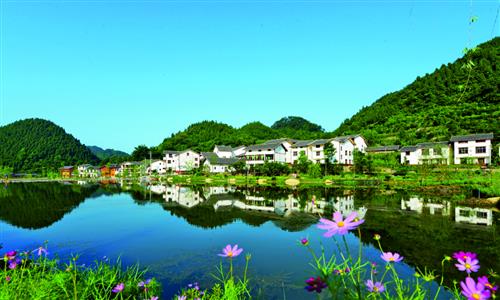
This transformation paints a vivid picture of robust collective economies, beautiful surroundings, and harmonious rural life.
"Farmers' material and spiritual lives are thriving together, with beautiful villages blooming across Laibin. Ensuring the prosperity of both people's wallets and minds is our constant goal," said Huang Liangxin, deputy head of Laibin's publicity department.
Since late 2023, Laibin has focused on fostering modern rural customs, improving living conditions, and enriching cultural life, creating a vibrant new countryside. The increasingly scenic sugarcane region has drawn more visitors for study tours and sporting events. In December 2024, Laibin hosted a bicycle race, showcasing the region's "sweet industry" to a wider audience.
Wen Yan is a correspondent for China Rural Revitalization magazine.
China Rural Revitalization magazine has published a series of articles on the rapid development and transformation of rural China. The articles reflect the arduous efforts of rural revitalization across the country, which is an important and genuine solution to China's rural economic development. In the future, articles selected from this series will be published.
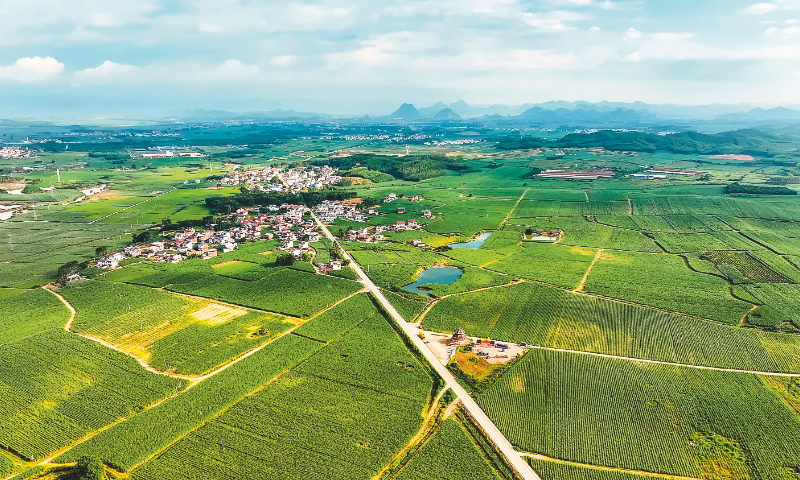
A view of Huang'an sugarcane base in Laibin, South China's Guangxi Zhuang Autonomous Region Photo: Courtesy of China Rural Revitalization magazine
In December 2023, Xi Jinping, general secretary of the Communist Party of China Central Committee, inspected the city of Laibin in South China's Guangxi Zhuang Autonomous Region. While visiting a sugarcane base in the city, he noted that Guangxi, the country's major sucrose production base, should further develop its characteristic sugar industry so as to play a bigger role in ensuring national sugar security and increasing sugarcane farmers' income.
Guided by Xi's strategic vision, Laibin has advanced toward high-yield sugarcane, integrated industrial chains, and harvest. By the 2024-2025 harvest season, Laibin's sugarcane planting area spans 1.8212 million mu (121,413 hectares), with an estimated 9.5 million tons of sugarcane to be processed and over 1.2 million tons of sugar to be produced, generating over 16 billion yuan ($2.2 billion) in value from sugar production and comprehensive utilization.
Innovation-driven growth
Historically, the lack of improved sugarcane varieties hindered Laibin's industry. "Today, challenges like poor soil, extreme weather, smut disease, and low mechanization are overcome through advanced breeding," said Li Ming, a sugarcane breeding scientist and a researcher at Guangxi Academy of Agricultural Sciences.
Li highlighted several sugarcane varieties, advantages such as high yield, high sugar content, strong smut resistance, and adaptability. These varieties, developed through crossbreeding, space mutagenesis, and heavy-ion irradiation, have become a cornerstone of Laibin's sugarcane fields.
Local research institutions, such as the Guangxi Academy of Agricultural Sciences, the Liucheng Sugarcane Research Center and Guangxi University, have continuously advanced seed technology.
In recent years, Laibin has taken the national lead in introducing and demonstrating over 30 drought-resistant, cold-tolerant, and lodging-resistant sugarcane varieties, establishing 20,000 mu of breeding bases with an annual capacity to supply 300,000 mu of disease-free seedlings annually. The planting rate of improved varieties reaches 99 percent. So far, the city has designated 2.0587 million mu as sugarcane production protection zones and built 1.0645 million mu of high-yield, high-sugar sugarcane bases. Laibin also hosts two regional sugarcane demonstration zones and China's only national modern agricultural industrial park dedicated to sugarcane.
China's sugar industry is faced with fierce international competition, Xi said in December 2023 while visiting a local sugar company in Laibin, calling for efforts in boosting sci-tech innovation, extending the industrial chain and increasing added value to promote the high-quality development of the industry.
Inspired by his remarks, Guangxi Laibin Dongtang Fenghuang Co invested over 30 million yuan in a digital control center and nearly 100 million yuan in equipment upgrades in 2024, boosting daily sugarcane crushing capacity to 12,000 tons. For the 2024-2025 crushing season, it expects to process 950,000 tons of sugarcane and produce 130,000 tons of sugar, said Luo Bin, head of the company.
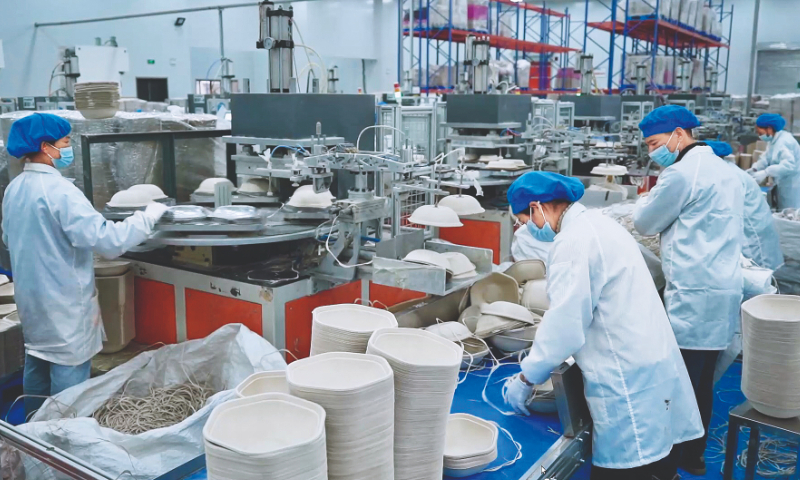
Laibin is fully leveraging the potential of the sugarcane industry, developing five advanced circular economy industrial chains using bagasse, molasses, filter mud, and sugarcane leaves. More than 30 large-scale enterprises, engaged in the deep processing of sucrose and the comprehensive utilization of by-products, have been cultivated and developed. They produce diverse products like sugar, eco-friendly tableware, and yeast extracts, with 100 percent recycling of molasses, bagasse, and filter mud. In the 2023-2024 season, the sugar industry's output exceeded 14 billion yuan, showcasing Laibin's commitment to innovation-driven, sustainable growth.
Workers use bagasse to produce eco-friendly tableware materials at a factory in Laibin, South China's Guangxi Zhuang Autonomous Region. Photo: Courtesy of China Rural Revitalization magazine
Multiple supportSince its founding in October 2017, the Fuku Agricultural Machinery Professional Cooperative in Laibin's Fenghuang township, has grown from 5 to 55 employees and from 10 to 60 machines, covering all sugarcane farming stages - tilling, planting, management, harvesting, and transporting, according to Yu Caiku, founder of the cooperative.
Government subsidies for mechanized operations, exceeding 1 million yuan annually, enable cooperative members to earn between 50,000 and 80,000 yuan yearly. Laibin promotes cost reduction and income growth through subsidies for mechanized tilling, harvesting, disease-free seedlings, and integrated water-fertilizer systems, supporting farmers throughout the entire farming process.
Between 2020 and 2025, Laibin disbursed 392 million yuan in mechanization subsidies, reducing costs and increasing income by 170 yuan per mu. With 405 combine harvesters, mechanized harvesting saves 300 yuan per mu. Laibin also piloted 35 distributed harvesting stations, processing 116,700 tons of sugarcane by machinery, reducing labor intensity and boosting efficiency. In the 2023-2024 season, mechanized harvesting achieved 393,500 tons in Laibin, ranking first in Guangxi by both volume and rate. For the 2024-2025 harvesting season, Laibin aims for over 60 distributed harvesting stations and 700,000 tons in mechanized harvests.
To ensure sustained income for farmers, Laibin established stable benefit-sharing mechanisms. It has developed a "government + farmers + sugar enterprises + N" model to enhance farmers' income. Village cooperatives promoting sugarcane planting received over 4 million yuan in rewards in 2023-2024 season, while smaller cooperatives earned an additional 2.4 million yuan annually on average.
Laibin has introduced a "base price + 6 percent sugar price linkage" mechanism, under which farmers receive additional payments when market sugar prices exceed the benchmark rate. In the 2023-2024 season, farmers enjoyed 155.84 million yuan in secondary settlements from rising sugar prices.
These policies are injecting strong momentum into the sugarcane industry's high-quality development, laying a solid foundation for rural prosperity.
Livable and thriving
Wei Shaomiao, Party secretary of Xinlong village of Fenghuang township, a Zhuang ethnic cadre and retired soldier, was inspired by General Secretary Xi's focus on the sugarcane industry.
"His remarks motivated me to transform my hometown," said Wei. Since 2021, Wei has driven Xinlong's development by expanding the sugarcane industry, boosting collective income, and enhancing living conditions.
Xinlong, a village of over 7,000 residents, increased its sugarcane planting area from 10,100 to 10,300 mu in 2024. Per capita sugarcane planting reached 1.5 mu, generating 30 million yuan in total income, with over 4,300 yuan per resident. Wei also prioritized infrastructure, with paved roads, beautiful village appearance, with villagers now living in modern houses, possessing household vehicles.
Public amenities have flourished, including three standard-lit basketball courts, two performance stages, a cultural training room, an activity room, and a library. Six amateur basketball teams and eight cultural troupes enrich community life. Tan Zhibo, 88, a villager in Xinlong, noted the shift from cluttered, idle villages to vibrant spaces where residents enjoy singing, dancing, and sports. Cultural events during the Spring Festival and other holidays feature lion dances and singing competitions.
This transformation paints a vivid picture of robust collective economies, beautiful surroundings, and harmonious rural life.
"Farmers' material and spiritual lives are thriving together, with beautiful villages blooming across Laibin. Ensuring the prosperity of both people's wallets and minds is our constant goal," said Huang Liangxin, deputy head of Laibin's publicity department.
Since late 2023, Laibin has focused on fostering modern rural customs, improving living conditions, and enriching cultural life, creating a vibrant new countryside. The increasingly scenic sugarcane region has drawn more visitors for study tours and sporting events. In December 2024, Laibin hosted a bicycle race, showcasing the region's "sweet industry" to a wider audience.
Wen Yan is a correspondent for China Rural Revitalization magazine.
RELATED ARTICLES