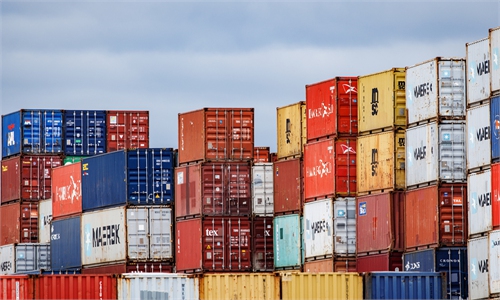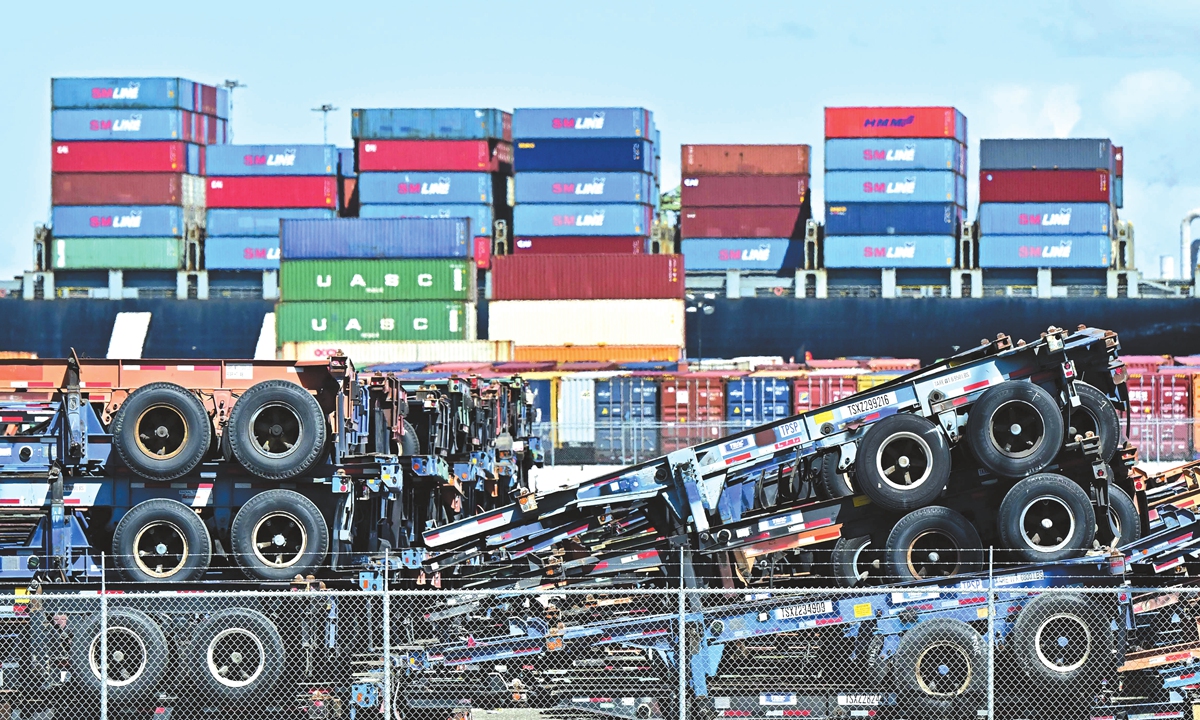
Shipping containers are stacked behind truck flatbeds at the Port of Long Beach, California, on April 2, 2025. Photo: VCG
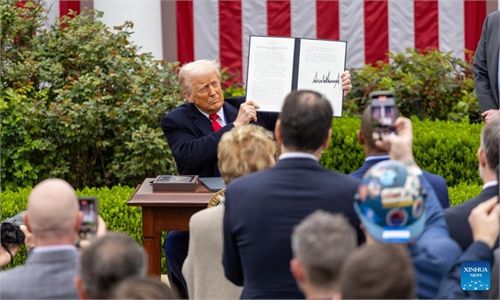
US President Donald Trump on Wednesday announced a second wave of tariff letters targeting US trading partners across Asia, Africa, and Europe, as his administration presses ahead with sweeping new import duties set to take effect on nearly every country starting August 1, according to Politico.
The Trump administration sent a second set of tariff letters targeting six emerging economies — the Philippines (20 percent), Moldova (25 percent), Iraq (30 percent), Brunei, Algeria, and Libya — with those tariffs scheduled to begin on August 1.
The US will also impose a 50 percent tariff on Brazilian goods starting August 1, the highest rate announced so far in President Trump's recent letters to foreign governments, according to the Washington Post.
Trump criticized the Brazilian government in a letter for putting former President Jair Bolsonaro on trial for an alleged coup attempt against the Lula government, as well as for taking legal action against US tech firms, the Washington Post reported. He wrote that the tariffs would be based on Brazil's "insidious attacks on Free Elections" and the "fundamental Free Speech Rights of Americans," referring to US-based social media platforms.
Brazil's president Luiz Inácio Lula da Silva firmly rejected Trump's claim and responded in a forceful statement on X that "Brazil is a sovereign country with independent institutions that will not accept being taken for granted by anyone."
Lula noted the US trade deficit claim was false, stating that the US has had a trade surplus of more than $410 billion with Brazil over the past 15 years.
Lula said the US' 50 percent tariffs on goods from Brazil would trigger the country's economic reciprocity law, which allows trade, investment and intellectual property agreements to be suspended for countries that harm the South American nation's competitiveness, according to AP news.
Brazil's Vice President Geraldo Alckmin on Wednesday local time said it was "unjust" for Trump to impose a 50 percent tariff on Brazilian products, the Xinhua News Agency reported.
"I see no reason to increase tariffs on Brazil. Brazil is not a problem for the United States; it is important to reiterate that. The United States has a trade deficit, but a surplus with Brazil. Of the 10 products they most export to us, eight have a zero (tariff) rate, paying no taxes," Alckmin said in statements, according to Xinhua.
Meanwhile, Malaysia's Investment, Trade and Industry Minister Tengku Zafrul Aziz said on Wednesday that the country will not cross certain "red lines" in its negotiations with the US , as talks continue to seek a reduction of the 25 percent tariff imposed on Malaysian exports, Reuters reported Wednesday.
Minister Zafrul declined to elaborate on the specific limits, citing non-disclosure agreements, but said the US had put forward demands that encroached on Malaysia's national interests and sovereignty, Reuters reported.
"If the deal does not benefit Malaysia, we should not have a deal... We have to be firm on that," he said.
The latest batch of tariff letters came after Trump signed an executive order on Monday further delaying the imposition of his "reciprocal" tariffs on exports from nearly 60 trading partners, with rates ranging from 10 to 50 percent. The tariffs, which briefly took effect on April 9, have now been postponed to August 1, according to Politico.
He said on Truth Social, a US-based social media platform, that no further deadline extensions beyond August 1 would be granted.
The US imported $7.5 billion worth of goods from Iraq last year; $3 billion from Sri Lanka; $2.4 billion from Algeria; $1.5 billion from Libya; $238 million from Brunei; and $136 million from Moldova, Politico reported.
Global Times
RELATED ARTICLES