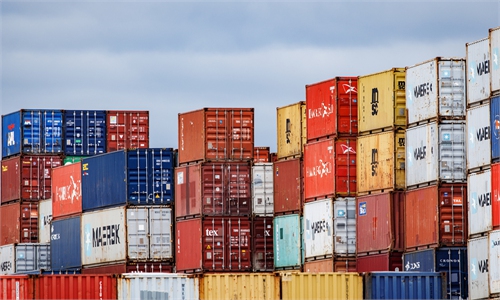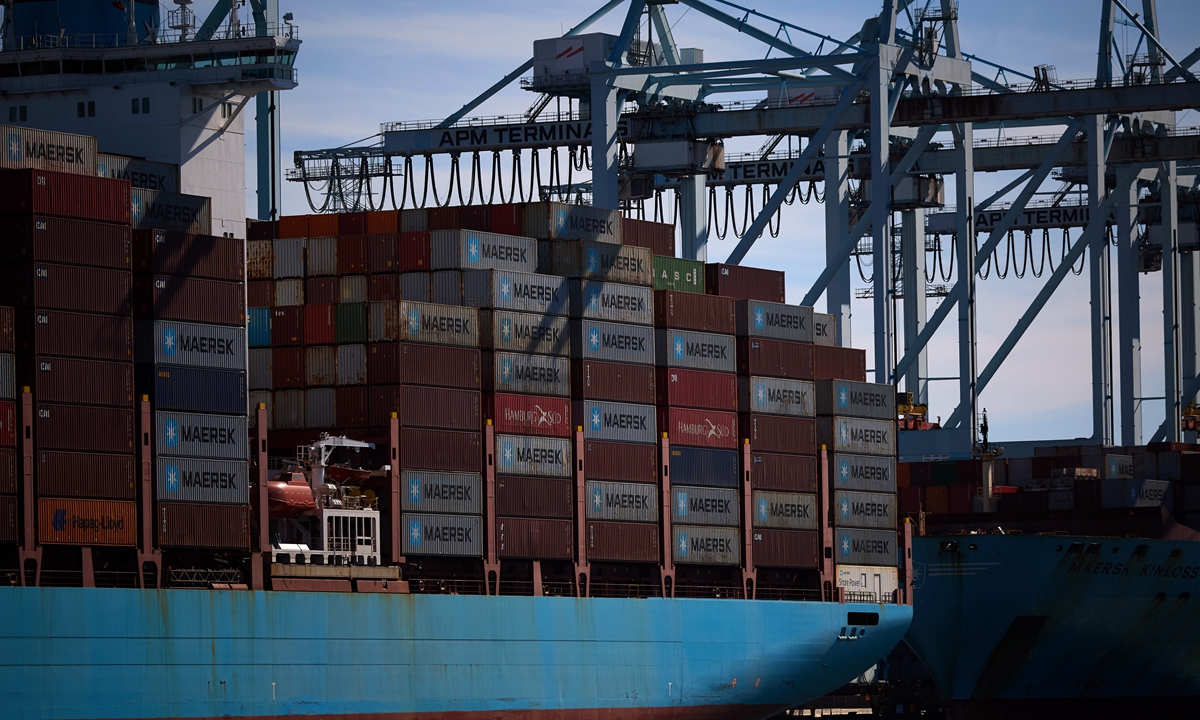
Shipping containers are loaded and unloaded onto ships at the Port of Los Angeles, California, on July 9, 2025. US President Donald Trump has sent letters to multiple countries dictating new US tariff rates on their countries' imports to the USA. Photo: VCG
According to Politico, the Trump administration sent a second set of tariff letters targeting seven economies — the Philippines (20 percent), Moldova (25 percent), Iraq (30 percent), Sri Lanka (30 percent), Brunei (25 percent), Algeria (30 percent), and Libya (30 percent) — with those tariffs set to begin on August 1.
In addition, the US will also impose a 50 percent tariff on Brazilian goods starting August 1, the highest rate announced so far in President Trump's recent letters to foreign governments, according to the Wall Street Journal.
Also on Wednesday, the US announced a 50 percent tariff on copper imports, which will go into effect on August 1. The decision was made after Trump received a national security assessment, he said in a post on Truth Social, according to CNBC.
As for China, US Commerce Secretary Howard Lutnick said that he and other top American trade officials may meet Chinese negotiators in early August. In response, He Yongqian, spokesperson from China's Ministry of Commerce, said on Thursday that both sides are currently maintaining close communication at multiple levels on their respective concerns in the economic and trade field.
"We hope that the US will meet China halfway, uphold the principles of mutual respect, peaceful coexistence, and win-win cooperation, leverage the China-US trade consultation mechanism, continue to strengthen dialogue and communication, and take concrete actions to maintain and implement the important consensus reached by the two heads of state during their phone call, jointly promoting a stable, healthy, and sustainable development of China-US economic and trade relations, and inject greater certainty and stability into global economic development," He noted.
Causing more uncertainty
However, the US' new tariff stick has triggered wider concern over escalating global economic uncertainties and unstable supply chains.
The Wall Street Journal reported that Trump criticized the Brazilian government in a letter for putting former President Jair Bolsonaro on trial for an alleged coup attempt against the Lula government, as well as for taking legal action against US tech firms.
Brazil's president Luiz Inácio Lula da Silva responded in a forceful statement that "Brazil is a sovereign country with independent institutions that will not accept being taken for granted by anyone," according to AP News.
Lula noted the US has had a trade surplus of more than $410 billion with Brazil over the past 15 years. He added that the US' 50 percent tariffs on goods from Brazil would trigger the country's economic reciprocity law, which allows trade, investment and intellectual property agreements to be suspended for countries that harm the South American nation's competitiveness, AP News said.
The Philippines is concerned about the US' decision to impose 20 percent tariffs on Philippine exports but will continue to negotiate, its economic affairs minister said on Thursday. Secretary Frederick Go told reporters that the Philippines remains committed to talking with the US in pursuit of a bilateral deal, such as a free trade agreement, according to Reuters.
Li Tianguo, a deputy director with the Department of Emerging Economies at the National Institute of International Strategy, told the Global Times on Thursday that the US administration's adherence to "America First" and its unilateralism, particularly in the imposition of tariffs, has significantly increased transaction costs for the vast majority of its trading partners.
Even its allies are experiencing severe impacts on their relevant export industries and view these tariffs as plunging the global economy into a state of perplexing uncertainty, Li said.
The central banks of South Korea and the UK have warned of the impact of the US tariffs on the global economy. A monetary policy statement released by the Bank of Korea on Thursday stated that "starting with changes in external conditions, the global economy is expected to experience a gradual slowdown as the impact of high tariff rates begin to materialize amid prolonged uncertainties surrounding the trade environment."
On Wednesday (UK time), the Bank of England said in its Financial Stability Report that it continued to see dangers from "geopolitical tensions, global fragmentation of trade and financial markets, and pressures on sovereign debt," according to Reuters.
Noting the US-Brazil trade conflict, Zhou Zhiwei, an expert on Latin American studies at the Chinese Academy of Social Sciences, told the Global Times on Thursday that the latest US tariff threats against Brazil are largely driven by political motives rather than purely economic considerations, and they also reflect the US' intent to interfere in Latin America's current domestic and foreign policies.
The US actions not only severely violate the international relations principle of non-interference in other countries' internal affairs but will also further undermine the international credibility of the US, Zhou warned.
Regarding the tariff on copper imports, Chile's Foreign Minister Alberto van Klaveren on Thursday said the US will not be able to replace the copper it was importing from the Latin American nation or other countries that supplied it, the Financial Times reported.
Many analysis reports have also pointed out that the US is highly reliant on copper imports and it takes a long time to build up copper capacity in the US.
"A 50 percent tariff on copper imports would hit US companies that use the metal because the country is years away from meeting its needs," said Ole Hansen, head of commodity strategy at Saxo Bank.
Bloomberg also noted that if the tariff takes hold, it will inflict higher costs across a broad section of the US economy due to the myriad of industries and applications that rely on copper.
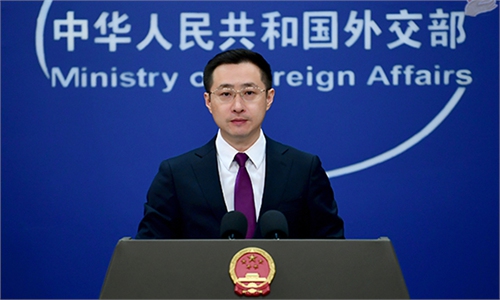
Commenting on the 50 percent tariff on copper imports, Mao Ning, a spokesperson from China's Foreign Ministry, told a press conference on Thursday that China's position is very clear. China has all along opposed moves to overstretch the concept of national security, and has always upheld that trade and tariff wars have no winners, and the abuse of tariffs is in no one's interest, the spokesperson said.
RELATED ARTICLES