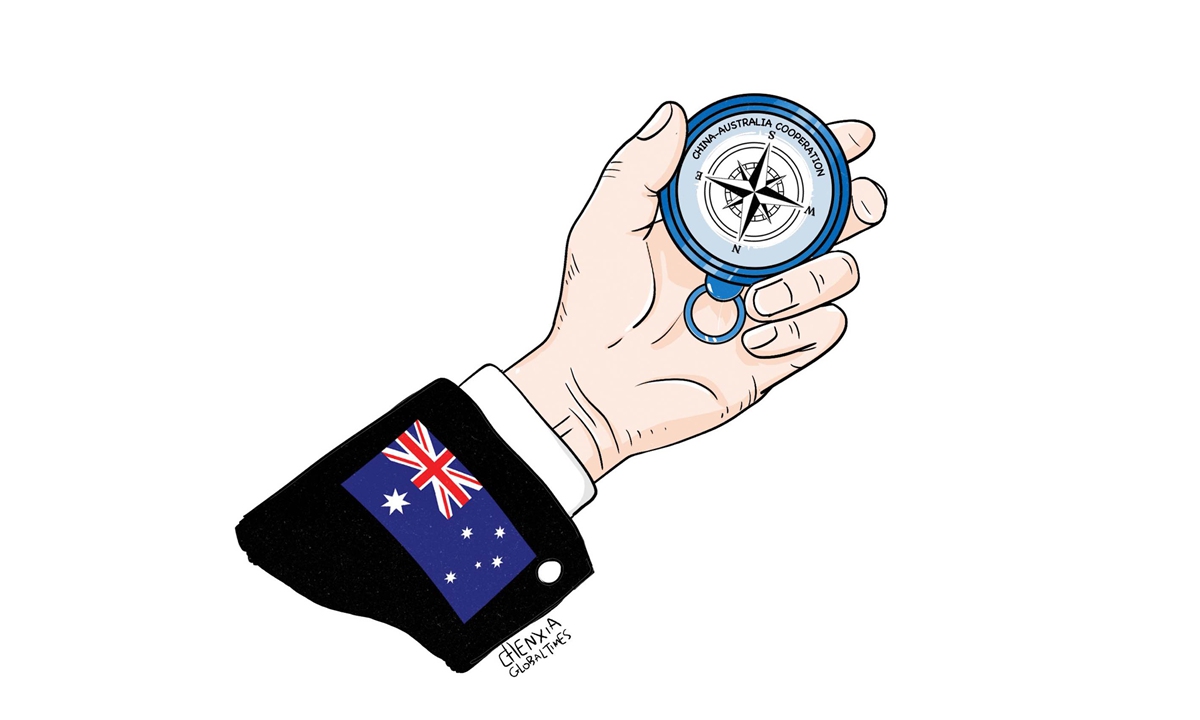
Illustration: Chen Xia/GT
Editor's Note:
China-Australia relations are developing positively. With Australian Prime Minister Anthony Albanese's China visit from July 12 to 18, the bilateral ties are expected to gain new momentum. In an interview with Global Times (GT) reporter Su Yaxuan, former Australian foreign minister Gareth Evans (Evans) shared his views on the current trajectory of China-Australia ties, highlighting economic complementarity and the importance of mature dialogue. He also offered sharp criticism of the AUKUS agreement, raising concerns about sovereignty, cost-effectiveness, and strategic autonomy.
GT: Prime Minister Albanese kicked off his visit to China on July 12. As a long-standing and influential voice on the development of China-Australia relations, how do you see the current improvement between the two countries? Does it align with your expectations for the future direction of bilateral ties?
Evans: China and Australia have a very good cooperative economic relationship, which is the foundation of much of our prosperity, and it's something to which we are deeply committed. The China-Australia Free Trade Agreement, now 10 years old, is a very important contributor to that.
I think although we've been through some difficult periods in recent years in terms of our economic and trade relations, there is an underlying recognition that we have very common interests in regional economic integration, and in supporting both the regional and global free trading environment.
We have some common ground there. In terms of security issues, I think it's important to recognize - and not overstate - the grounds for concern we might have about each other.
But we should be able, I think, with a mature and sophisticated dialogue, to work together. As our own political leaders have been saying, "we will cooperate where we can, disagree where we must, but engage in our national interest, and that is in the interest of Australia and in the interest of China, as well as in the interest of regional stability." That's the basis of our relationship, and I'm sure it can continue to be effective.
I think the kind of dialogue that we're entering into - at a ministerial level, and with the visit of Prime Minister Anthony Albanese to China - will be an important way of furthering that. What we can be confident is the future course of Australia-China relations.
GT: The Australian government recently rejected the Trump administration's call to raise defense spending to 3.5 percent of GDP. As a former foreign minister, how do you view this demand from the US? Can Australia's clear rejection be seen as an effort to pursue greater strategic autonomy?
Evans: We've made it very clear that we will make our own decisions about what defense expenditure we need, like any other country. We have to build our defense capability not on any assumptions about adversaries' intent, but just on the basic realities of potential adversaries' capability. Every country has the same dynamic at work, and we'll make assumptions of that kind, and we will build our defense capability accordingly.
My own judgment is that the current government is setting appropriate targets for expenditure. But it's not setting arbitrary numerical targets. It's saying, let's focus on what we need to build our capability to deal with any possible contingencies in the future. And let's make our expenditure judgments accordingly - not on the basis of any external pressure and not on the basis of any preconceived notion of a particular percentage amount.
We are not going to walk away from our alliance with the US. But we are very cautious about being sucked into, by virtue of that alliance, military commitments that we simply should not be entering into, given our own national interests. We have our own interests to protect, which may not necessarily align with how the US perceives them.
GT: In a recent article, you stated that "Australia should welcome the collapse of the lopsided AUKUS," even calling such a scenario "happy news." Is your perspective widely shared in Australia today?
Evans: In the context of AUKUS, this has been a very controversial issue in Australia as well as more broadly.
My own concern about AUKUS is at three levels. First, I'm talking about the submarine dimension of this - whether the US will be able to release boats from its own inventory in order to meet the Australian need. And what happens thereafter with the UK is also very problematic.
The second concern is a cost-benefit one. Even if we do get these great big boats in 30 or 40 years, because of operational realities and given our vast continent and maritime arrangements, what's the use of these things? Particularly, will this technology advance? Could we be spending that money more wisely on our military capabilities?
The third concern that I've expressed - and many others have expressed in Australia - goes to sovereign agency, our sovereign independence. If we get ourselves enmeshed with the US to the extent that is implied by this gift of very sophisticated technology, in future, will we really have the independence that we need to make our own decisions about what's in our security interests - and not be sucked into decisions made by someone else?
I think the view in Australia is that there are better ways to prepare for contingencies than committing ourselves to this massive expenditure on these particular submarines.
GT: Within Australia, there are still many voices advocating for closer security ties with the US and expressing strong support for related mechanisms. In the current context of intensifying strategic competition between China and the US, how should Australia carefully assess the risks and benefits of these arrangements to ensure its national interests are not compromised by great power rivalry?
Evans: I think it's perfectly possible for us to navigate this tightrope - between maintaining our relationship with China, as by far our biggest economic partner, and also maintaining a relationship with the US as a traditional security partner. I think it's possible for us to manage that relationship. We can't get sucked into - a complete commitment to one side or the other.
We have to walk this tightrope in between, and some other country in the region is walking a similar tightrope - not only countries in East Asia and Indo-Pacific region, but also in Oceania. So we're not alone in walking that particular tightrope. But again, we need cooler heads to prevail.
GT: In your recent review of The Once and Future World Order by Amitav Acharya, a professor at American University, you offered high praise for his view, which discusses the apparent decline of the West and the fragmentation of the US-led international order. Do you believe that the current Western order, centered on US leadership, is increasingly unable to respond effectively to global challenges?
Evans: Clearly the traditional US-dominated global order is in transition - as it must be - to reflect contemporary realities, rather than the realities of the end of the World War II. That's something that everybody has to acknowledge - that particular reality - and recommit ourselves to effective institutions.
China has an obvious determination to become not just a rule taker, but to be part of the emerging new global architecture, economically and in political and geopolitical terms. And that's entirely legitimate.
But what's extremely important is that as this new order evolves, everybody approaches it not with a confrontational mind-set, but with a cooperative mind-set - recognizing that the only sane way forward in the future is to recognize that each country needs its space, needs its own pride to be recognized and acknowledged, and needs to have its strength reflected in the place that it has in the decision-making system.
What everybody has to do is take a deep breath, sit back a bit, and just focus on what really matters for all our people. What people want is just peaceful lives, to get on with their daily routines, and not have the stress of possible war and economic distress. It's very important that mind-set come to pass.
There's a job ahead of us in the present environment. I just hope very much that good sense will prevail.