Essence of China-India ties lies in how to coexist harmoniously, achieve mutual success, Wang Yi told Jaishankar
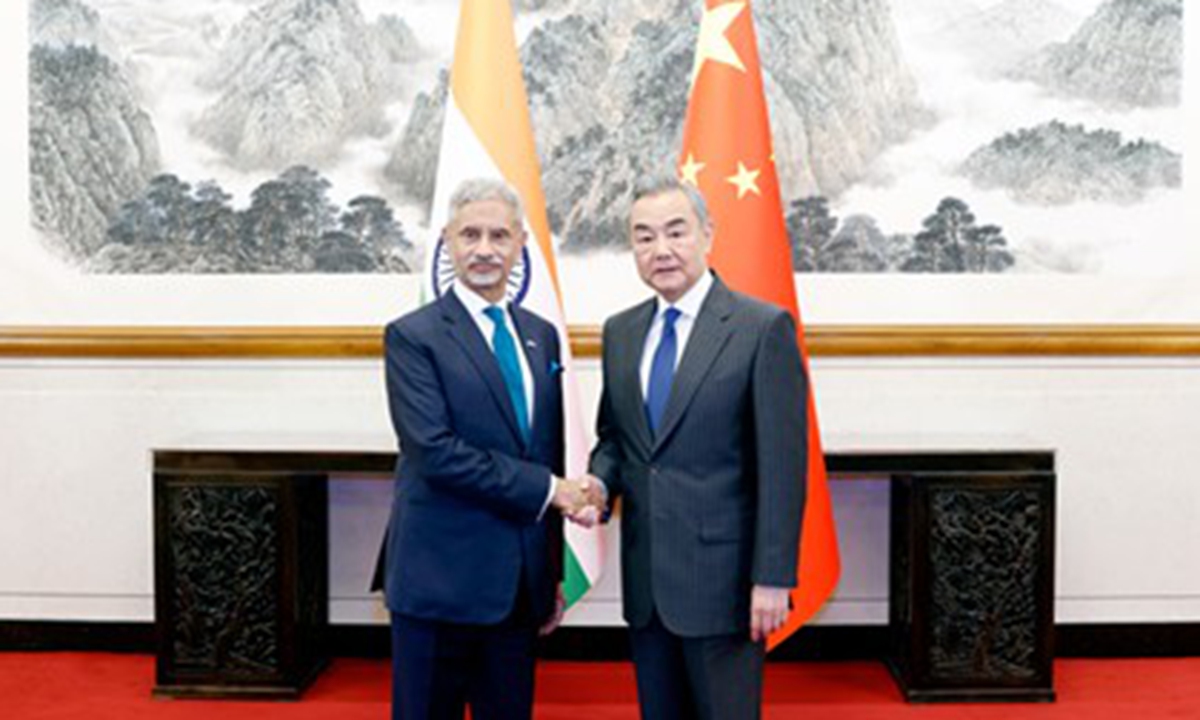
Chinese Foreign Minister Wang Yi holds talks with Indian External Affairs Minister Subrahmanyam Jaishankar in Beijing on July 14, 2025. Photo: from the Chinese Foreign Ministry.
As two neighboring Eastern civilizations and major emerging economies, the essence of China-India relations lies in how to coexist harmoniously and achieve mutual success, said Chinese Foreign Minister Wang Yi when holding talks with Indian External Affairs Minister Subrahmanyam Jaishankar in Beijing on Monday.
Wang, also a member of the Political Bureau of the Communist Party of China Central Committee, said that both sides should adhere to the direction of friendly neighborliness, achieve the "Dragon-Elephant Tango" and find a way for mutual respect and trust, peaceful coexistence, common development and win-win cooperation.
Wang emphasized that this year marks the 75th anniversary of the establishment of diplomatic relations between China and India, and bilateral ties are maintaining a momentum of improvement that is hard-won and should be cherished.
"The relationship has its own historical logic and intrinsic driving force, and it should not target third parties or be disturbed by them. The two sides should build mutual trust instead of suspicion, pursue cooperation instead of rivalry, and support each other's success instead of wearing each other down," Wang noted.
Wang said that China is willing to work together with India to implement the important consensus reached by the leaders of both countries, reflect the strategic foresight of major emerging powers, consistently enhance political mutual trust, expand exchanges and cooperation, address contradictions and differences from a broader perspective, and strengthen collaboration on multilateral platforms such as the Shanghai Cooperation Organization (SCO) to promote the sustained, healthy, and stable development of China-India relations.
Wang said both China and India support multilateralism and hope for the international order to develop in a more just and reasonable direction. "China is willing to strengthen communication and coordination with India to maintain a multilateral trading system, stabilize global supply chains, and create an open and cooperative international environment," Wang noted.
Jaishankar said that the meeting between the two leaders in Kazan provided important guidance for China-India relations, and exchanges and cooperation in various fields are moving towards normalization. He expressed gratitude to China for facilitating the return of Indian pilgrims to sacred sites in Xizang.
India and China are development partners rather than competitors. India is willing to view its relationship with China from a long-term perspective to focus on common interests, deepen mutually beneficial cooperation, enhance cultural exchanges, and jointly maintain peace and stability in the border areas, Jaishankar said.
"Both sides should strive to accumulate positive factors to prevent differences from turning into disputes, and competition from escalating into conflict. As important neighbors, populous countries, and major global economies, the relationship between India and China holds regional and global significance. India adheres to strategic autonomy and pursues an independent foreign policy, and is willing to strengthen coordination and cooperation with China in multilateral areas to promote the establishment of a multipolar world," Jaishankar said.
Jaishankar said that India fully supports China in successfully hosting the summit as the rotating chair of the SCO.
According to the Chinese Foreign Ministry, the Meeting of the Council of the Ministers of Foreign Affairs of the SCO Member States will be held in Tianjin on Tuesday. At the invitation of Wang, foreign ministers of other SCO member states and heads of the SCO's permanent bodies will attend the meeting. In addition to attending the meeting, Jaishankar will also pay a visit to China.
Global Times
RELATED ARTICLES