Illustration: Chen Xia/GT
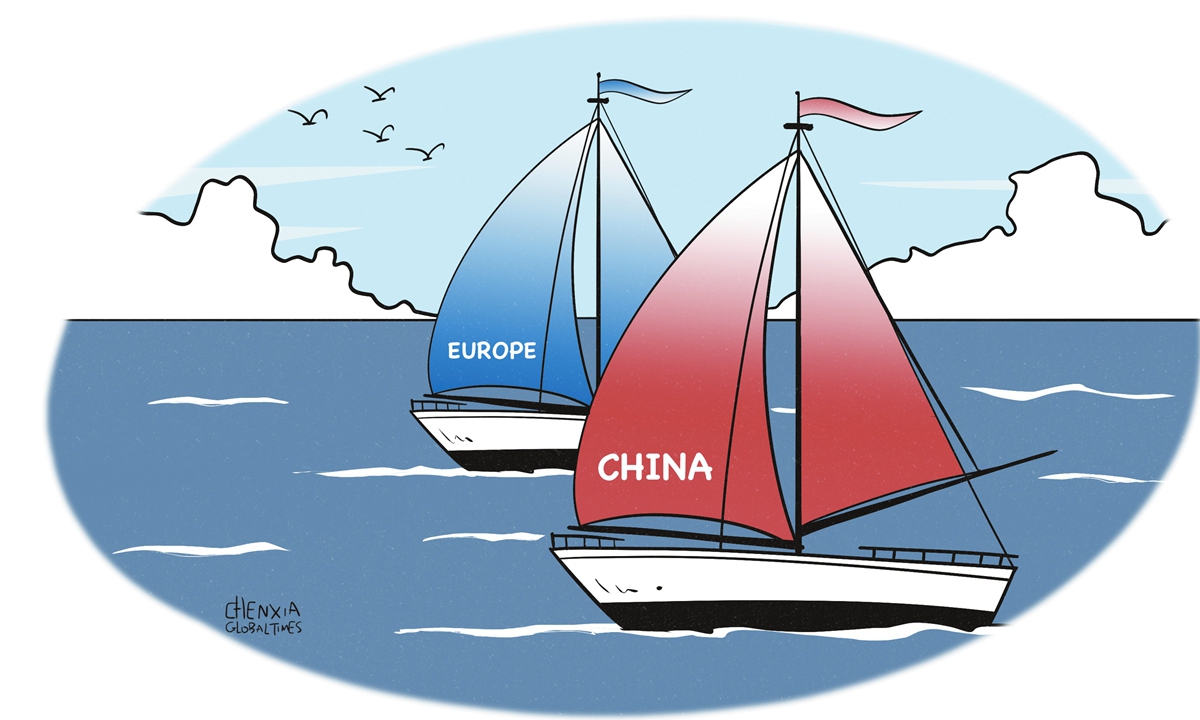
Recently, the EU has continued to express concerns over the "trade imbalance" with China, arguing that Chinese industrial subsidies have caused "overcapacity" and "dumping" and blaming China for market access, export controls and other issues. Citing the bloc's deficit with China, the EU has also claimed that bilateral economic and trade relations are in urgent need of "rebalancing." However, the trade imbalance is a complex issue, often the result of multiple factors. It should not be attributed to a single cause or interpreted one-sidedly, but should be viewed from a historical, dynamic, comprehensive and objective perspective.
Historically, China has run a trade surplus with the EU since 1997. This is primarily the result of the global industrial division of labor. The EU runs a trade surplus with the US and other countries but a trade deficit with China, yet maintains an overall balance. In 2024, the EU posted a total trade surplus of 147 billion euros (around $171 billion), a significant increase from around 34 billion euros in 2023. If the EU expects to maintain surpluses in all major bilateral trade relationships, that is hardly realistic. In fact, since 2022, China's trade surplus with the EU has been on a general downward trend. This is a natural result of market forces. Ultimately, China's supply of goods to Europe is driven by European consumption and production demand.
China has never deliberately pursued a trade surplus; instead, it has tried every means to expand imports. The country hosts the China International Import Expo annually, the world's only national-level exhibition focused on imports. At the 2024 edition of the trade fair, the cumulative intended transaction volume exceeded $80 billion, with EU enterprises among the key participants.
China has always welcomed competitive, high-quality European products and services that meet consumer demand. At present, China is comprehensively implementing strategies to expand domestic demand and boost consumption. As the world's second-largest consumption market, China has the largest and most rapidly growing middle-income group, which will undoubtedly unleash massive consumption demand and provide a vast market for EU businesses.
It must be emphasized that bilateral trade should follow market rules and cannot be based on forced buying or selling. It is contradictory for the EU to complain that China buys too little while simultaneously blocking what it wants to sell. In fact, EU export controls are one of the main causes of the trade imbalance with China. In recent years, the EU has been unwilling or afraid to export some high-tech products, such as semiconductors and lithography machines, to China. How can trade be balanced under such conditions? To better understand the actual pattern of China-EU trade and economic relations, some rarely mentioned figures should be taken into consideration. For example, the EU has long maintained a services trade surplus with China, reaching 21.7 billion euros in 2024. Recently, the US announced its plan to impose high tariffs on the EU, citing goods trade deficits, and the EU responded by highlighting its large services trade surplus with the US. Why, then, does the EU remain silent about this when it comes to China?
The issue of "trade imbalance" should not be blamed on China's market access system. In recent years, China has actively aligned itself with high-standard international economic and trade rules, continuously increased its autonomous opening-up efforts, and created a more open, transparent and stable investment environment. Opening-up in services trade areas, such as telecommunications, the internet, education, culture and healthcare, is steadily advancing and has adopted a negative list approach. China's high-level opening-up will only continue to expand. European companies are always welcome to share in China's development opportunities.
Since the establishment of diplomatic relations between China and the EU 50 years ago, bilateral trade has grown from just $2.4 billion to $785.8 billion today, with the two growing into the world's second and third largest economies respectively. China-EU economic and trade relations have never been a zero-sum game and have always resolved emerging issues through further development. The China-EU Comprehensive Agreement on Investment, negotiated over seven years, will be the key to addressing EU concerns. We hope the EU will demonstrate political resolve to restart the ratification process as soon as possible and work with China to promote a dynamic balance in bilateral trade through continued development.
The author is an observer of international affairs. opinion@globaltimes.com.cn
RELATED ARTICLES