Ishiba vows to stay on as PM after LDP suffers crushing defeat
Fragile administration may disrupt Tokyo policies’ continuity: expert
By and Xing Xiaojing Published: Jul 21, 2025 11:38 PM

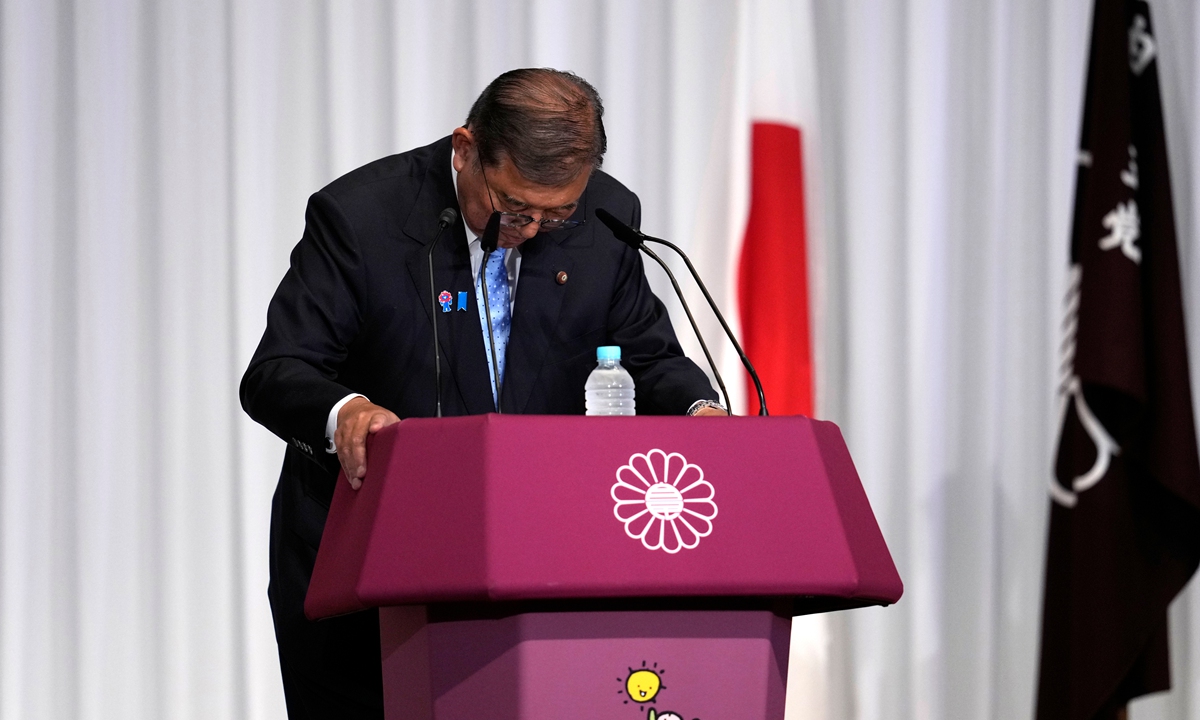
Shigeru Ishiba, Japan's prime minister and president of the Liberal Democratic Party, bows during a news conference at the party's headquarters in Tokyo, Japan, on July 21, 2025, after his ruling coalition suffered a historic setback in an upper house election. Photo: VCG
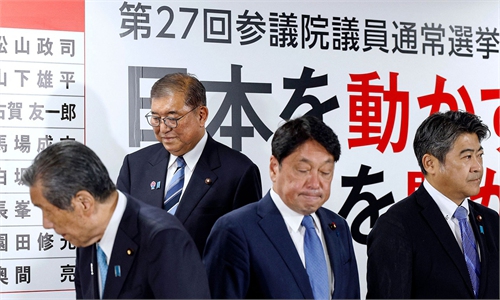
Japanese Prime Minister Shigeru Ishiba vowed Monday to stay in office and ruled out expanding his ruling coalition - composed of the Liberal Democratic Party (LDP) and junior partner Komeito - after a crushing defeat in Sunday's upper house elections. But his insistence on clinging to power has sparked strong dissent, with senior LDP figures questioning his leadership and opposition parties weighed a no-confidence motion, multiple media outlets reported.
The results of Japan's 27th House of Councilors election, held on Sunday, were finalized by Monday afternoon with all elected candidates confirmed, Yomiuri Shimbun reported on Monday.
The LDP secured 39 seats, the Komeito obtained 8 seats, according to the report.
This is the first time the LDP has lost a majority in both houses of parliament since the party's foundation in 1955, AP reported. This development is widely believed to further weaken Ishiba's grip on power even as he vowed to remain party leader, Reuters reported on Monday.
On Monday, Ishiba held a news conference at the Tokyo headquarters of LDP to address issues stemming from the outcome of the July 20 poll, Asahi Shimbun reported.
According to the report, he acknowledged that voters had delivered an extremely harsh verdict, but pointed to pressing issues as reasons to stay on. He cited tariff negotiations with the US, as the August 1st deadline to reach a trade deal approaches. Other vital matters include rising consumer prices and the ever-present need to prepare for a natural disaster.
"Ishiba's stance differs from Japan's historical political norms," Da Zhigang, director of the Institute of Northeast Asian Studies at the Heilongjiang Provincial Academy of Social Sciences, told the Global Times on Monday. "Traditionally, the LDP president would resign after defeat in either elections of upper or lower houses," Da said.
While the ballot does not directly determine whether Ishiba's administration will fall, it heaps pressure on Ishiba who also lost control of the more powerful lower house in October, Reuters noted.
"This constitutes the most significant political shift in Japan since 1955 - a big blow to the LDP," Lü Chao, an expert at the Liaoning Academy of Social Sciences, told the Global Times on Monday.
The back-to-back losses are likely to increase pressure on Ishiba to resign after less than a year on the job. Voters' trust in LDP and its coalition partner, Komeito, has been waning amid rising prices and discontent over the government's handling of inflation, the Washington Post wrote on Monday.
Taro Aso, a former deputy prime minister and LDP heavyweight, said he "couldn't accept" Ishiba staying on as prime minister, The New York Times reported Monday citing Japanese media.
"The current dilemma is that while public confidence in the prime minister has eroded, the party lacks a clearly suitable successor who can simultaneously handle US tariff negotiations and coordinate with opposition parties," Da said. "With the ruling coalition losing majority in both chambers, every legislative matter - bills, budgets and diplomatic treaties - now requires consultation with opposition."
"Now the LDP is besieged by triple pressures: opposition challenges, intra-party opposition and public discontentment," Lü said.
Stronger opposition
The Japan Times reported Monday that populist opposition parties, especially the Democratic Party for the People (DPP) and Sanseito, have boosted their seats.
According to Yomiuri Shimbun, the Constitutional Democratic Party of Japan (CDP) - the largest opposition party - won 22 seats, the DPP received 17 seats, and the Sanseito party obtained 14 seats.
Multiple Chinese analysts have noted that populist parties like Sanseito, which champion "Japan First" rhetoric, are accelerating political rightward drift in Japan.
While opposition parties gained ground, fundamental policy differences between the CDP and DPP prevent viable coalition-building in the near term, Lü commented. "The current situation only demonstrates the LDP's loss of public trust, not the opposition's readiness to govern - Japan's politics remain in flux." The expert added that a "lame duck" legislative paralysis may emerge in the Diet.
Xiang Haoyu, a research fellow at the China Institute of International Studies, told the Global Times on Monday that Japan's political landscape is becoming increasingly fragmented, with power more dispersed between the ruling and opposition parties. He noted this has created significant uncertainty in Japan's political future.
The expert said the election results reflect a notable intensification of right-leaning conservative tendencies in Japan's political ecosystem. This trend, he warned, could substantially increase uncertainties in both domestic and foreign policymaking.
Tough situation
Expert also pointed out that Japanese ruling coalition's defeat in upper house elections could weaken Japan's bargaining position in negotiations with the US. "American officials may question whether a potentially unstable government can honor agreements," Da said.
Trade frictions pose a long-term challenge to the Japanese economy, and Japan will face a tough situation in future negotiations with the US. Meanwhile, the US, dealing with a relatively weaker Japanese government, may impose higher demands in negotiations, making compromises more difficult. This could affect the cohesion of the Japan-US alliance, potentially leading to even greater rifts between the allies, Xiang said.
The expert noted that a fragile administration would adversely affect Japan's bilateral relations with major powers, regional multilateral cooperation and Japan's various stances over international issues.
When asked to comment on Japan's upper house election, Chinese Foreign Ministry spokesperson Guo Jiakun said Monday that "China noted relevant results. This is Japan's internal affairs, and I have no specific comment."
Guo said China and Japan are neighbors. The sound and steady growth of bilateral relations is in the fundamental interests of the two countries and two peoples.
China stands ready to work with Japan to continue dialogue and communication at various levels and in multiple fields, enhance political mutual trust, deepen mutually beneficial cooperation, properly handle differences, jointly promote the China-Japan strategic relationship of mutual benefit in an all-round way, and build a constructive and stable relationship that meets the requirements of the new era, said Guo.
Chen Xingyu contributed to this story.
RELATED ARTICLES