Australia knows its China relations well, doesn’t need outsiders peddling anxiety

Illustration: Chen Xia/GT
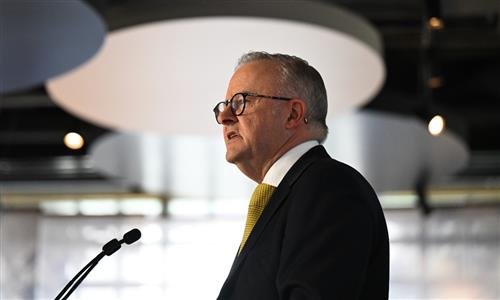
Shortly after the Australian Prime Minister Anthony Albanese wrapped up a positive and productive visit to China, a Dutch general entered the public discourse, urging Australia to beware of China's military rise and to ramp up its defense spending. One can't help but wonder: Do some European officials truly believe they hold a remote control capable of steering the trajectory of Asia-Pacific affairs from halfway across the globe?
The Australian Broadcasting Corporation reported on Monday that General Onno Eichelsheim, the Netherlands' chief of defense, who was visiting Australia for the Talisman Sabre defense exercises, warned Australia about "the threat posed by China to the Indo-Pacific." "China is building up, take it seriously and get ready for something that you hope will never happen," he said, adding that "naivety" should not allow Australia and other countries to avoid preparing for the risk of conflict in the future.
What's puzzling is how a general, usually stationed more than 8,000 kilometers from China, managed to detect a "threat" so far away. While Europe grapples with crises on two fronts - the war in Ukraine and escalating tensions in the Middle East - this Dutch general has journeyed across continents to advise Australia on how to beef up military muscle against China. Funny how that works.
Some Western politicians seem quite skilled at turning a blind eye to the fact that the Asia-Pacific is currently one of the most stable and prosperous regions in the world - a status that didn't come easy. China as a major power has played a key role in maintaining this stability. The Asia-Pacific is also a major engine of the global economy, and at the heart of that engine lies China.
What's more, Australian Prime Minister Albanese recently wrapped up a visit to China, returning with a host of tangible cooperative achievements spanning trade, education, agriculture, tourism, and more. Chen Hong, director of Australian Studies Centre, East China Normal University, summed up this visit with three keywords in an interview with the Global Times: "stable," "new," and "progressive."
Chen said that "stable" refers to the overall steady state of China-Australia relations; "new" highlights the joint efforts to break new ground in emerging fields like the green economy and green iron; and "progressive" signifies a step forward on existing foundations. For instance, the visit's inclusion of diverse cities like Chengdu showcases Australia's intention to engage with China from a broader and more open perspective.
At a time like this, amplifying the "China threat" and stirring the pot in China-Australia relations feels ill-timed. Whether these remarks aim to signal loyalty to the US or NATO, or simply to grab attention for personal fame, they reveal a deeper issue: Some people just don't want to see stability in the Asia-Pacific, a positive thaw in China-Australia ties, or regional cooperation and peace.
But Australia has already spoken for itself. During his visit to China, Albanese stated that Australia values its relations with China; that China's development is vital to Australia; and that the relationship in China means jobs in Australia, it's as simple as that. On the military spending question, Australian Defense Minister Richard Marles made it clear that "ultimately every country, when it goes through its own processes about what kind of defense force it needs to build, does so based on assessing its own strategic need."
Australia has a good grasp of its relationship with China and doesn't need outsiders peddling anxiety. Some Western politicians still believe that NATO's outdated playbook can work in the Asia-Pacific, even though the region has clearly moved on to a very different chapter. Here, people have long understood that conflict reflects the failure of diplomacy, while maintaining peace is the true sign of strength. Trying to fan the flames might stir up a little dust, but disrupting the region's deep-rooted aspirations for peace and prosperity? That's a much harder task.
RELATED ARTICLES