China completes preliminary design of first fourth-generation million-kilowatt commercial fast reactor, marking progress in national energy strategy
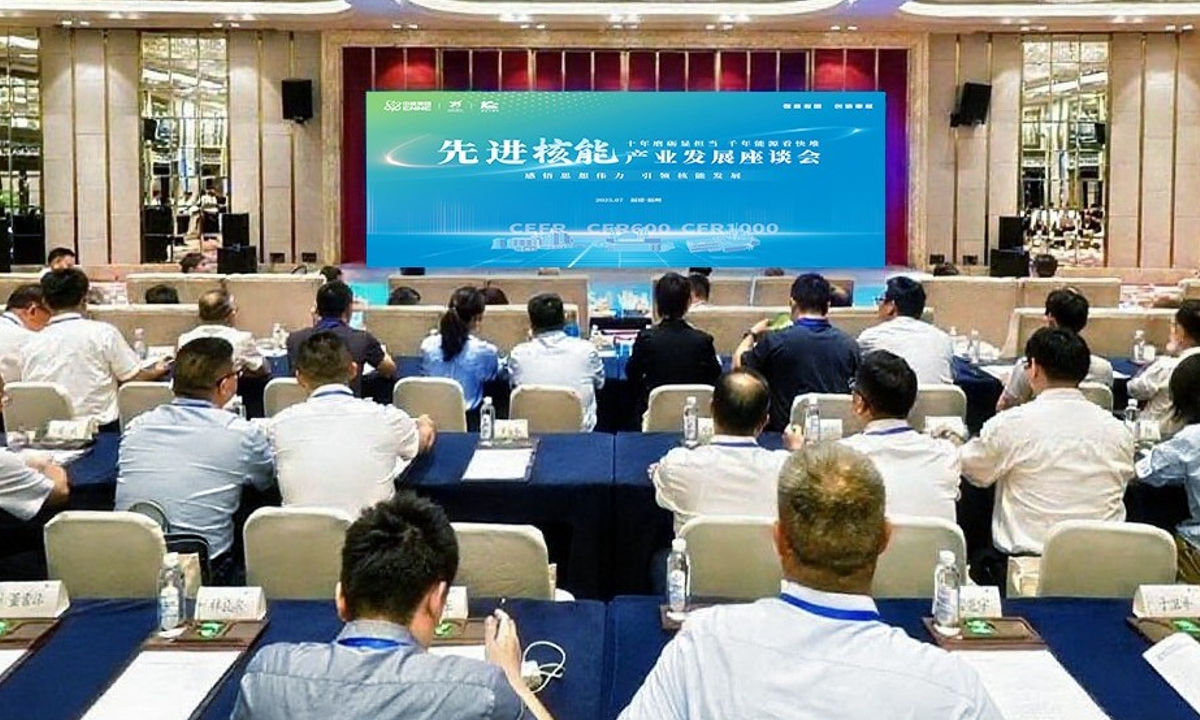
The China National Nuclear Corporation (CNNC) holds a symposium on advanced nuclear energy industry development in Fuzhou, East China's Fujian Province, on July 22, 2025. Photo: courtesy of the CNNC
The China National Nuclear Corporation (CNNC) held a symposium on advanced nuclear energy industry development on Tuesday in Fuzhou, East China's Fujian Province, and announced the completion of the preliminary design for China's first fourth-generation million-kilowatt commercial fast neutron reactor, CFR1000, signifying major progress in China's "three-step" technology roadmap of "thermal neutron reactor - fast reactor - controlled nuclear fusion reactor" for sustainable development.
The fast neutron reactor, which uses fast neutrons for nuclear reactions to generate heat and electricity, is internationally recognized as a preferred reactor type among fourth-generation advanced nuclear energy systems, according to the CNNC.
Currently, three of the six reactor types classified as fourth-generation nuclear power systems globally are fast reactors: sodium-cooled fast reactors, gas-cooled fast reactors, and lead-cooled fast reactors. Among these, sodium-cooled fast reactors stand out as the top choice for fourth-generation nuclear power due to their high breeding ratio, strong capability to transmute long-lived radioactive isotopes, and inherent safety features.
As the most extensively researched and operationally experienced reactor type among fourth-generation nuclear technologies, sodium-cooled fast reactors have accumulated over 400 reactor-years of operational experience worldwide, making them the most advanced and technologically mature option in the fourth-generation category. The development and adoption of fast reactor technology are thus significant for China's energy security and the sustainable, green development of nuclear energy, according to the CNNC.
The Global Times learned from Zhang Donghui, chief scientist at the CNNC, that the advantages of fast neutron reactors could be summarized in three key aspects.
"First is the safety. there are no credible scenarios leading to core meltdown, and even in hypothetical severe accidents, radioactive materials would be contained within the plant," Zhang said. "Second, for environmental benefits, it can incinerate long-lived radioactive waste, and its environmental emissions are extremely low - only one percent of those from current mainstream nuclear power plants."
Third is economic viability. "It uses spent fuel from pressurized water reactors and other waste materials as feedstock, and commercial fast reactors deployed at scale can achieve better capital efficiency than existing mainstream reactors. Additionally, their higher neutron flux, harder energy spectrum, and surplus neutrons enable the production of isotopes in high market demand," Zhang introduced.
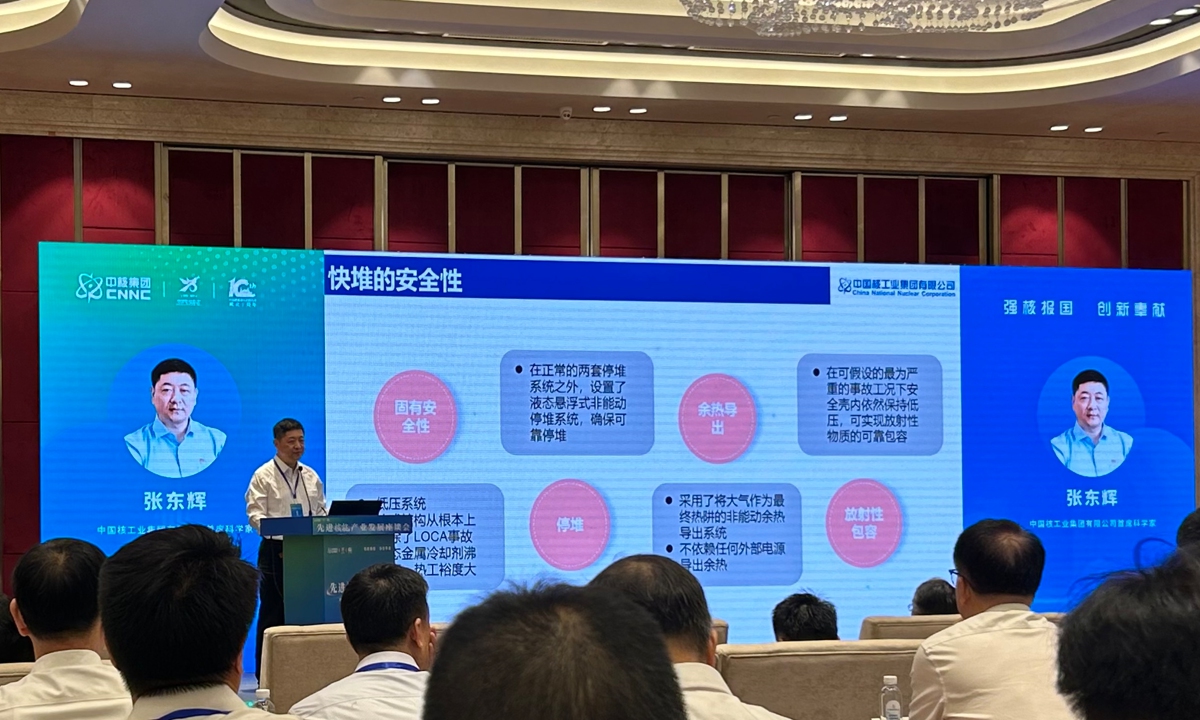
Zhang Donghui, chief scientist at the CNNC, delivers a speech at the symposium on July 22, 2025. Photo: Liang Rui/GT
The CNNC said that fast neutron reactors represent a critical step in China's "three-step" technology roadmap of "thermal neutron reactor - fast reactor - controlled nuclear fusion reactor" for sustainable development. In 2011, China's experimental fast reactor successfully achieved grid-connected power generation. After over a decade of research, exploration, and engineering practice, China has now independently mastered all core and supporting technologies for large-scale fast reactors, and established the world's most comprehensive fast reactor industrial chain.
The country's first million-kilowatt commercial fast neutron reactor fully embodies the fourth-generation nuclear energy system's requirements for safety, sustainability, and economic efficiency, with an installed capacity of 1.2 million kilowatts.
"Through sustained efforts, China's fast neutron reactor technology has now joined the global first tier," Zhang said.
"China possesses a complete set of design and safety analysis software, robust R&D capabilities, full-fledged equipment manufacturing capacity, world-leading construction expertise, and systematic fast reactor project management capabilities," Zhang added.
Meanwhile, during the symposium, a nuclear energy research company and a workstation were inaugurated, and relevant strategic cooperation agreements were signed.
RELATED ARTICLES