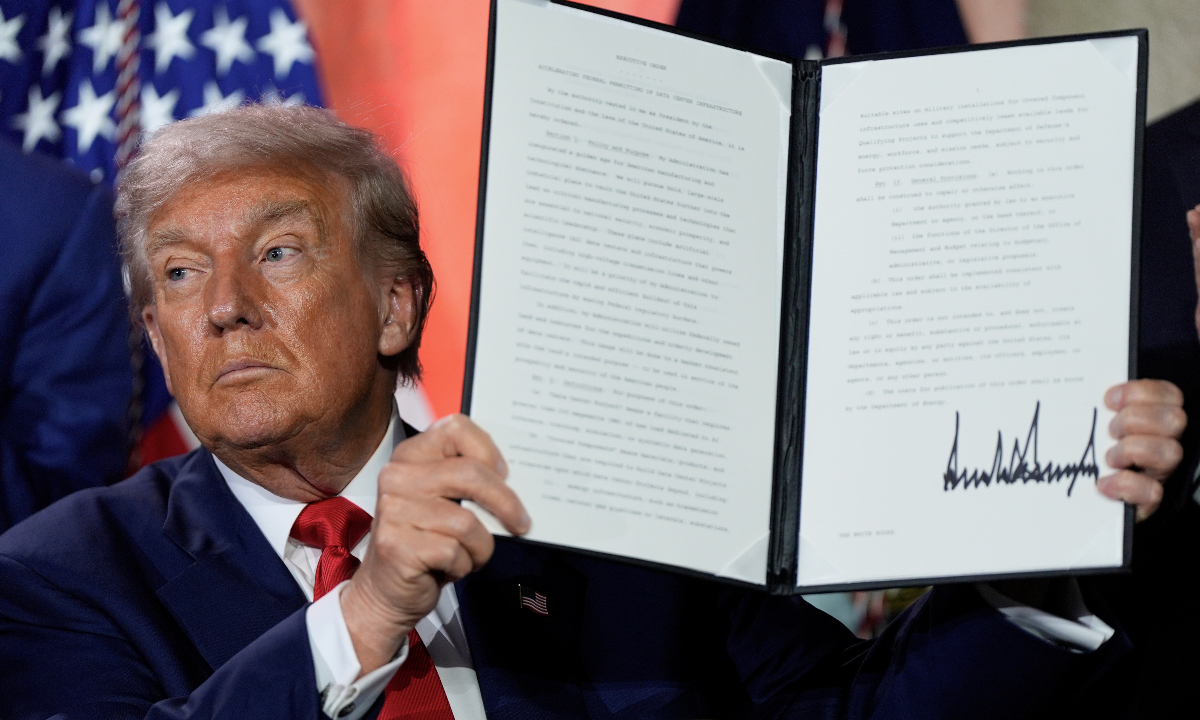
President Donald Trump holds a signed executive order regarding permitting for AI infrastructure after speaking during an AI summit at the Andrew W. Mellon Auditorium, Wednesday, July 23, 2025, in Washington.?Photo: VCG
The US government released its AI Action Plan on Wednesday, laying out over 90 concrete recommendations, spanning technological innovation, application development and global rule-making in AI. The plan is viewed as a significant policy directive in the AI field. Li Yan, director of the Institute of Sci-Tech and Cyber Security Studies at the China Institutes of Contemporary International Relations, believes that the AI Action Plan is an "overt scheme with hidden agendas."In what sense is it an "overt scheme"? First, the formulation of this report has followed a very public process. To push the plan, the Trump administration invited opinions from a broad spectrum of society and even published over 10,000 public comments it received in response to the request. This was aimed at forging domestic consensus, such as balancing the competition with China and the impact on the global market of export controls. Second, it was to test the waters for the policy and to ease the pressure by testing the reaction of all parties in advance to issues such as the adjustment of chip export controls.
Second, before the formal release of this plan on paper, the US had already begun executing its AI strategy in practice. Certain cases, including the return of NVIDIA's H20 chip to the Chinese market, exemplify the US' accelerated efforts to shape and lead the global AI ecosystem. On the other hand, under the Stargate Initiative, the US is expanding AI infrastructure and market layouts globally. In this sense, the AI Action Plan is more of a "final announcement."
According to Li, the reason why this "overt strategy" can be said to contain "hidden agendas" is due to some "new" content, such as the policy on AI models' "value neutrality." The US government requires federally procured large language models to be "objective and free from top-down ideological bias," while claiming to study whether Chinese AI models are under so-called "censorship" from the Chinese government.
This appears to be a classic case of deflecting attention and shifting blame. AI chatbot Grok recently faced bans in some countries over racially offensive comments - even including insults to foreign leaders. These controversies undoubtedly challenge the Trump administration's AI deregulatory agenda and hamper the international rollout of American AI models. It is in this light that the US government responded to the issue of the so-called AI values in the AI Action Plan.
There is also the policy that encourages "open source," but, in fact, pushes open source domestically and closed source globally to maintain the US' so-called technological leadership.
However, the actual effect of the AI Action Plan is affected by a number of factors. For instance, at home, the problems of regulatory synergies, energy and data bottlenecks need to be addressed, while externally, it depends on whether relevant countries will accept a US-dominated ecosystem. Only time will tell how the plan will roll out.
RELATED ARTICLES