China and the EU should collaboratively shape the institutional architecture of a multipolar world
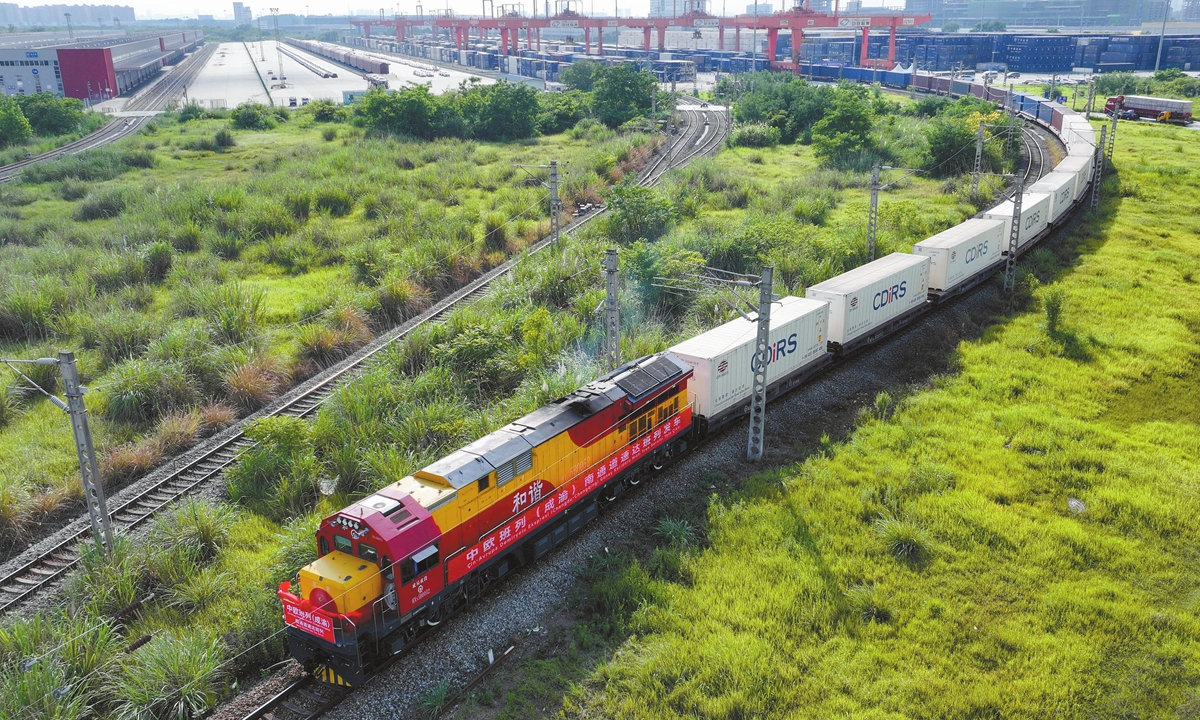
A China-Europe Railway Express (Chengdu-Chongqing) Middle Corridor Ultra-Express Block Train departs from Chengdu International Railway Port on July 9, 2025. Photo: VCG
Editor's Note:
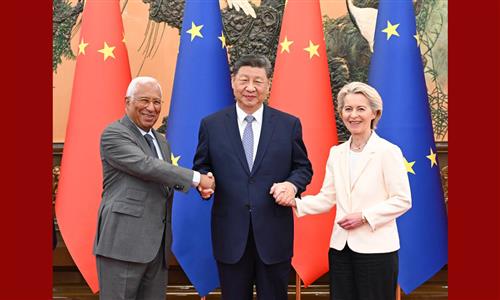
China and the EU held their 25th summit in Beijing on July 24. The summit took place on the occasion of the 50th anniversary of diplomatic relations between China and the EU, and occured at a time when the complex and multifaceted bilateral ties face both opportunities and challenges in a changing global landscape. How should the achievements of this summit be analyzed? How can China and the EU march forward in a way that benefits both sides and contributes positively to the world? Global Times (GT) reporter Wang Wenwen talked to Ulrike Guérot (Guérot), a Berlin-based German political thinker, about the recently concluded China-EU Summit and her vision for the future of this bilateral relationship.
GT: Before the summit, some Western media outlets cast a negative tone on China-EU relations, focusing on the differences between them. Nonetheless, it's widely believed that the summit yielded more results than expected. How do you view the foundations of this bilateral relationship, and how should they address their differences?
Guérot: Unfortunately, Western media are adopting a confrontational tone toward practically all states outside of the "Western" world. Therefore, I don't see China being singled out, but a general retraction of openness from the EU. This seems to be driven by the fear that its own liberal system is under strain and needs to be "defended" against the rise of the BRICS community. In doing so, Europe is alienating its own foundational values of openness, tolerance and reciprocity. There is an increasing belief on the European continent that China is no longer a "strategic partner," but a rival. I do hope that EU countries and the EU itself can autocorrect this behavior and reinvest into forms of multilateral cooperation.
GT: Trade issues were on the agenda at the summit. The EU's tariffs on Chinese electric vehicles have severely hindered mutually beneficial cooperation. What is your suggestion for the two sides to address their differences and enhance engagement?
Guérot: First of all, it is important to hold onto the common ground and the foundations of global trade, which have benefited us all greatly over the past 50 years. Free, fair trade based on common rules is essential for the stable development of the individual markets involved in trade. This foundation provides a basis for reliable planning and action.
With regard to China and the EU, it is often forgotten that eMobility is the result of joint developments and efforts by the companies involved in this technology. Due to the size of its market, China is always suitable for testing innovations and offering low-cost products thanks to high demand. If you don't want to do this, you will run into problems. Buyers in the EU will also pay attention to costs.

Ulrike Guérot Photo: Courtesy of Guérot
GT: At the summit, leaders of China and the EU issued a joint statement on climate change, showcasing the leading role of these two major economies in fulfilling international responsibilities. What other areas of cooperation would you promote between China and the EU?
Guérot: The pandemic and its consequences have shown that we will have to react flexibly to supply chain disruptions in the future and secure our supplies. This also applies to the exchange of information and the necessary free exchange among all sides involved. It is a hindrance when important information cannot be shared due to fear of responsibility. There is also an urgent need for cooperation in the modernization and expansion of the general infrastructure in terms of housing construction, road and traffic route construction, and energy.
Cooperation in high-tech, medical, pharmaceutical, IT and aerospace sectors is also important. Without communication, the free exchange of ideas, and joint practical experience, all developments suffer. Some voices in the West continue to emphasize the need to avoid dependencies. However, it is important to recognize that we still use cell phones made in China, developed and distributed by companies in the US. Dependencies are not solely negative; they can also signify stability.
Furthermore, we must promote, beyond "practical matters" such as business cooperation, tariffs, AI, or "rivalries" that summits often address, an intellectual dialogue about the emergence of a multipolar world and the roles of both Europe and China within it. This encompasses citizens dialogues, youth exchange or town twinning programs. Cultural relations and intellectual exchange are of utmost importance to enhance political understanding and cooperation in the future. We need to discover the similarities and the philosophical baselines of our societies and how they function, what divides us and what unites us, in more philosophical terms, to collaboratively shape the institutional architecture of the multipolar world in the 21st century.
GT: What do you think are the major factors affecting the EU's approaches toward China?
Guérot: The Ukraine conflict serves as a pretext but is nevertheless an important factor influencing political decisions. This was evident in the talking points of the EU at the China-EU Summit. The war in Ukraine is definitely a burden on Europe and the world order as a whole, leading to questions about compliance with existing regulations and agreements. Consequently, this results in issues that have no direct connection whatsoever with the conflict being addressed. The European problem is that the issue and the discussion have produced no consequences other than those of demarcation and rearmament. An independent diplomatic objective, however, is not even attempted.
Another concern is the eroding US economic system and the latent threat of bankruptcy, which neither the US nor global players in the world economy can afford to ignore. Under the current president, the US has abandoned the jointly developed approach and its own cultural approach. Europe has not yet succumbed to this shift. However, Europe's credibility regarding the statements and agreements it has made with China is in question. Old colonial powers are now certainly the worst advisors when it comes to resolving open issues.
GT: How do you analyze Germany's role in the overall China policy of Europe?
Guérot: Germany can improve how Europe deals with China, but I believe it must first rediscover its own strength and then return to the basics of regular exchange and sensible interaction. Anyone who doesn't engage in dialouge and fails to cultivate common ground, but instead only deals in a nitty-gritty way about what divides, will soon realize that he or she has no friends. Germany should focus much more on concrete plans, goals and projects while still acknowledging our differences. However, it is crucial that we don't waste our energy and don't just talk, but act with confidence and determination.
With respect to China, Germany especially could build on its strong philosophy tradition - from Hegel to Kant - which I think could become the leeway for an in-depth consultation about the shaping of a new international architecture that transcends rivalry. Germany is certainly pivotal in preventing the EU's discourse on China from shifting solely toward competition. Germany could and should influence the EU's agenda with China, striving to broaden it and open it up intellectually.
A peaceful world in the 21st century also needs to move beyond the misleading and uniform concept of neoliberal societies, which leads to global oligarchization at the expense of the people. Neither China nor Europe wants this. China has a lot of societal experiences to offer and I can envision a clear role for Germany in enhancing this discussion.
RELATED ARTICLES