'Fruits of happiness'
Exploring China's beautiful, harmonious countryside along Xi's footsteps
Editor's Note:
China Rural Revitalization magazine has published a series of articles on the rapid development and transformation of rural China. The articles reflect the arduous efforts of rural revitalization across the country, which is an important and genuine solution to China's rural economic development. In the future, articles selected from this series will be published.
On October 26, 2022, shortly after the conclusion of the 20th National Congress of the Communist Party of China (CPC), President Xi Jinping, also general secretary of the CPC Central Committee and chairman of the Central Military Commission, paid an inspection tour to Nangou village of Yan'an, Northwest China's Shaanxi Province. Xi stressed implementing one policy after another for the prosperity of the people, according to the Xinhua News Agency.
This lit up a beacon for Nangou village to move forward. Holding the "golden key" of rural revitalization, the people of Nangou, under the affectionate care of the General Secretary and guided by CPC's policies for prosperity, have used their hard-working hands to plant "fruits of happiness" across the village, transforming Yan'an's Red revolutionary land from barrenness to abundance, writing a magnificent epic of prosperity.
Growing golden apples
In 2022, Xi walked into an apple orchard in Nangou village and chatted with growers who were picking apples. Xi showed great concern for irrigation and water use. Local villagers told him that they had effectively solved the problem by building dams, as well as adopting drip irrigation and fine management. Xi recognized their efforts, saying, "This is exactly agricultural modernization. And you have found the right path to industrial development," according to Xinhua.
Driven by apple and other industries, in 2024, Nangou's per capita annual income reached 22,000 yuan ($3,065.8), nearly eight times that of 2014, according to Zhang Runsheng, Party secretary of Nangou village.
In the autumn of 2013, a fierce hailstorm struck Nangou's orchards, battering the unripe apples and leaving them bruised and rotting in the mud. Zhang Jianguo, a farmer in Nangou, clutched a rotten apple, tears mixing with rain as he mourned his family's yearly hopes. Days later, he trekked to the county market with a donkey cart, the bumpy dirt road jarring his bones. His about 500 kilograms of damaged apples sold for a mere 800 yuan - barely enough for the cost of fertilizers.
Back then, Nangou's farmers clung to old apple varieties, plagued by pests and low yields. Many chopped down trees to plant corn, thinking that planting apples is a waste and they are better off finding temporary work elsewhere.
Hope arrived in 2016 when experts from Northwest A&F University came to Nangou. They tested soils and selected 12 frost-resistant, disease-hardy apple varieties. However, when it became time for planting, local growers hesitated. Liu Runxi, a local farmer who had been growing apples for 20 years, had some doubts about the new varieties. Zhang Runsheng spent a week persuading him, taking him to see thriving modern orchards in neighboring counties. Seeing the apples in other orchards being snatched up by dealers, Liu set aside two mu (0.13 hectares) of his land for trial planting.
By 2018, Liu's trial plot glowed with ruby-red apples. At the county fair, they fetched 15 yuan per jin, earning him 45,000 yuan - triple the old varieties' yield. Witnessing Liu's success, Nangou farmers followed suit. In 2019, Nangou's apple cooperative united farmers with shared seedlings, training and sales. With a 2-million-yuan investment, a 200-mu demonstration orchard bloomed, guided by resident experts, transforming the village's future.
'Peach Blossom Land'
In Nangou village, nestled in Shaanxi's rugged hills, the locals often say, "thanks to the General Secretary, our lives are getting better and better."
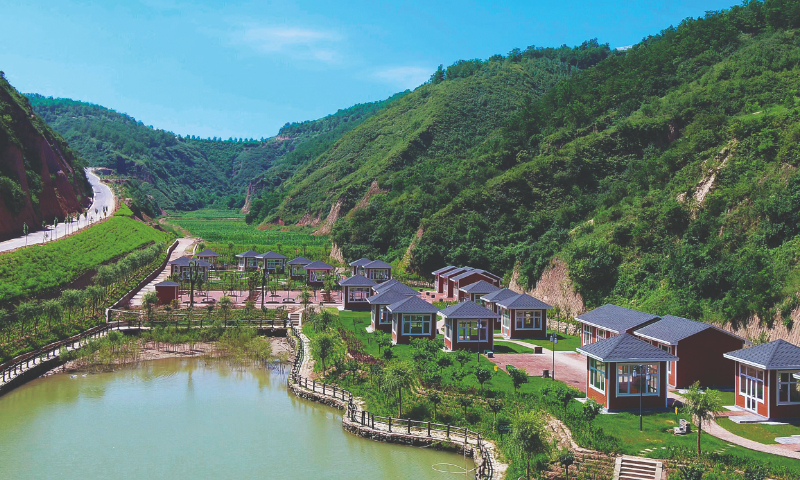
Buoyed by this spirit, the village continued to improve its infrastructure, building on the existing roads. A visitor service center, an ecological trail, and unique guesthouses were built. Today, the roads in the orchards are not only transportation and tourism routes, but also a path to happiness for the villagers.
These days, Nangou's roads hum with activity. A sorting center of fruits buzzes, workers in blue uniforms packing apples for nationwide delivery. Tourists flock in, parking right at the orchards' edge.
In 2024, tourism brought in a revenue of over 15 million yuan. The homestay of villager Wang Zhilian, linked by a stone-paved path, welcomed guests who savored her sticky oil cakes and promised to return with relatives and friends.
In the past, a single 3-meter-wide dirt road served the orchards in Nangou. A turning point came in 2018, when the village, as part of its poverty alleviation efforts, began a road construction project. These roads transformed Nangou village into a beloved "Peach Blossom Land."
Reviving historical sites
In addition to the apples, there is also a profound history in Nangou village. In 1947, when the CPC Central Committee moved to northern Shaanxi, a unit of the Red Army camped in this ravine for half a month. But as times passes, the site was crumbling - beams sagging, walls cracked, and thorny jujube bushes swallowing the underground liaison station. Elderly party member Li Weisheng lamented, "If these caves collapse, the Red Army's stories will be buried in the soil."
The General Secretary's inspection tour added momentum to the development of the Red culture in Nangou village and made the villagers more determined to protect and inherit the Red history.
With a special fund, villagers restored the site of the command post, carefully preserving every brick to recreate meeting rooms and dormitories, displaying 50 artifacts - tables, lamps, and weapons - donated by villagers or collected afar. A storybook telling Nangou's Red memories was born from elders' tales, breathing life into history.
Nangou also launched a series of Red cultural experience activities: tourists don Red Army uniforms, trek 5 kilometers along old routes, or join "battlefield rescue" activities. In 2022, partnering with a training academy in Yan'an, the village welcomed over 5,000 trainees yearly.
Now, Nangou blends farming, culture, and tourism. Daytime offers historical sites visits; evenings bring homestays, bonfires, and Shaanxi folk songs. With plans for fruit processing, deeper cultural projects, and tourism upgrades, Nangou's historical legacy shines brighter, its stories echoing across generations.
Zhang Runsheng said that the General Secretary's inspection tour to the village was a tremendous encouragement.
"We will bear the instructions in mind and work hard to further improve the mechanism of linking farmers and leading farmers, do a solid and orderly job in key tasks such as rural development, rural construction, and rural governance, and handle the people's affairs one by one," he said.
Chen Lixia is a reporter for China Rural Revitalization magazine.
China Rural Revitalization magazine has published a series of articles on the rapid development and transformation of rural China. The articles reflect the arduous efforts of rural revitalization across the country, which is an important and genuine solution to China's rural economic development. In the future, articles selected from this series will be published.
A view of fishing and barbecue houses in Nangou village, Northwest China's Shaanxi Province Photo: Courtesy of China Rural Revitalization magazine
On October 26, 2022, shortly after the conclusion of the 20th National Congress of the Communist Party of China (CPC), President Xi Jinping, also general secretary of the CPC Central Committee and chairman of the Central Military Commission, paid an inspection tour to Nangou village of Yan'an, Northwest China's Shaanxi Province. Xi stressed implementing one policy after another for the prosperity of the people, according to the Xinhua News Agency.
This lit up a beacon for Nangou village to move forward. Holding the "golden key" of rural revitalization, the people of Nangou, under the affectionate care of the General Secretary and guided by CPC's policies for prosperity, have used their hard-working hands to plant "fruits of happiness" across the village, transforming Yan'an's Red revolutionary land from barrenness to abundance, writing a magnificent epic of prosperity.
Growing golden apples
In 2022, Xi walked into an apple orchard in Nangou village and chatted with growers who were picking apples. Xi showed great concern for irrigation and water use. Local villagers told him that they had effectively solved the problem by building dams, as well as adopting drip irrigation and fine management. Xi recognized their efforts, saying, "This is exactly agricultural modernization. And you have found the right path to industrial development," according to Xinhua.
Driven by apple and other industries, in 2024, Nangou's per capita annual income reached 22,000 yuan ($3,065.8), nearly eight times that of 2014, according to Zhang Runsheng, Party secretary of Nangou village.
In the autumn of 2013, a fierce hailstorm struck Nangou's orchards, battering the unripe apples and leaving them bruised and rotting in the mud. Zhang Jianguo, a farmer in Nangou, clutched a rotten apple, tears mixing with rain as he mourned his family's yearly hopes. Days later, he trekked to the county market with a donkey cart, the bumpy dirt road jarring his bones. His about 500 kilograms of damaged apples sold for a mere 800 yuan - barely enough for the cost of fertilizers.
Back then, Nangou's farmers clung to old apple varieties, plagued by pests and low yields. Many chopped down trees to plant corn, thinking that planting apples is a waste and they are better off finding temporary work elsewhere.
Hope arrived in 2016 when experts from Northwest A&F University came to Nangou. They tested soils and selected 12 frost-resistant, disease-hardy apple varieties. However, when it became time for planting, local growers hesitated. Liu Runxi, a local farmer who had been growing apples for 20 years, had some doubts about the new varieties. Zhang Runsheng spent a week persuading him, taking him to see thriving modern orchards in neighboring counties. Seeing the apples in other orchards being snatched up by dealers, Liu set aside two mu (0.13 hectares) of his land for trial planting.
By 2018, Liu's trial plot glowed with ruby-red apples. At the county fair, they fetched 15 yuan per jin, earning him 45,000 yuan - triple the old varieties' yield. Witnessing Liu's success, Nangou farmers followed suit. In 2019, Nangou's apple cooperative united farmers with shared seedlings, training and sales. With a 2-million-yuan investment, a 200-mu demonstration orchard bloomed, guided by resident experts, transforming the village's future.
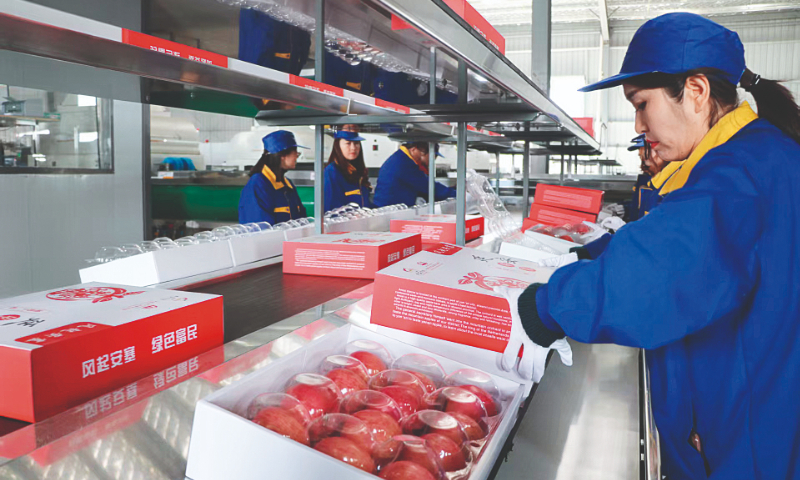
Workers pack apples at a sorting center in Nangou village, Northwest China's Shaanxi Province. Photo: Courtesy of China Rural Revitalization magazine
'Peach Blossom Land'
In Nangou village, nestled in Shaanxi's rugged hills, the locals often say, "thanks to the General Secretary, our lives are getting better and better."
Buoyed by this spirit, the village continued to improve its infrastructure, building on the existing roads. A visitor service center, an ecological trail, and unique guesthouses were built. Today, the roads in the orchards are not only transportation and tourism routes, but also a path to happiness for the villagers.
These days, Nangou's roads hum with activity. A sorting center of fruits buzzes, workers in blue uniforms packing apples for nationwide delivery. Tourists flock in, parking right at the orchards' edge.
In 2024, tourism brought in a revenue of over 15 million yuan. The homestay of villager Wang Zhilian, linked by a stone-paved path, welcomed guests who savored her sticky oil cakes and promised to return with relatives and friends.
In the past, a single 3-meter-wide dirt road served the orchards in Nangou. A turning point came in 2018, when the village, as part of its poverty alleviation efforts, began a road construction project. These roads transformed Nangou village into a beloved "Peach Blossom Land."
Reviving historical sites
In addition to the apples, there is also a profound history in Nangou village. In 1947, when the CPC Central Committee moved to northern Shaanxi, a unit of the Red Army camped in this ravine for half a month. But as times passes, the site was crumbling - beams sagging, walls cracked, and thorny jujube bushes swallowing the underground liaison station. Elderly party member Li Weisheng lamented, "If these caves collapse, the Red Army's stories will be buried in the soil."
The General Secretary's inspection tour added momentum to the development of the Red culture in Nangou village and made the villagers more determined to protect and inherit the Red history.
With a special fund, villagers restored the site of the command post, carefully preserving every brick to recreate meeting rooms and dormitories, displaying 50 artifacts - tables, lamps, and weapons - donated by villagers or collected afar. A storybook telling Nangou's Red memories was born from elders' tales, breathing life into history.
Nangou also launched a series of Red cultural experience activities: tourists don Red Army uniforms, trek 5 kilometers along old routes, or join "battlefield rescue" activities. In 2022, partnering with a training academy in Yan'an, the village welcomed over 5,000 trainees yearly.
Now, Nangou blends farming, culture, and tourism. Daytime offers historical sites visits; evenings bring homestays, bonfires, and Shaanxi folk songs. With plans for fruit processing, deeper cultural projects, and tourism upgrades, Nangou's historical legacy shines brighter, its stories echoing across generations.
Zhang Runsheng said that the General Secretary's inspection tour to the village was a tremendous encouragement.
"We will bear the instructions in mind and work hard to further improve the mechanism of linking farmers and leading farmers, do a solid and orderly job in key tasks such as rural development, rural construction, and rural governance, and handle the people's affairs one by one," he said.
Chen Lixia is a reporter for China Rural Revitalization magazine.
RELATED ARTICLES