Chinese researchers unveil world's first cross-scenario humanoid robot with 'one-brain-multi-form' architecture
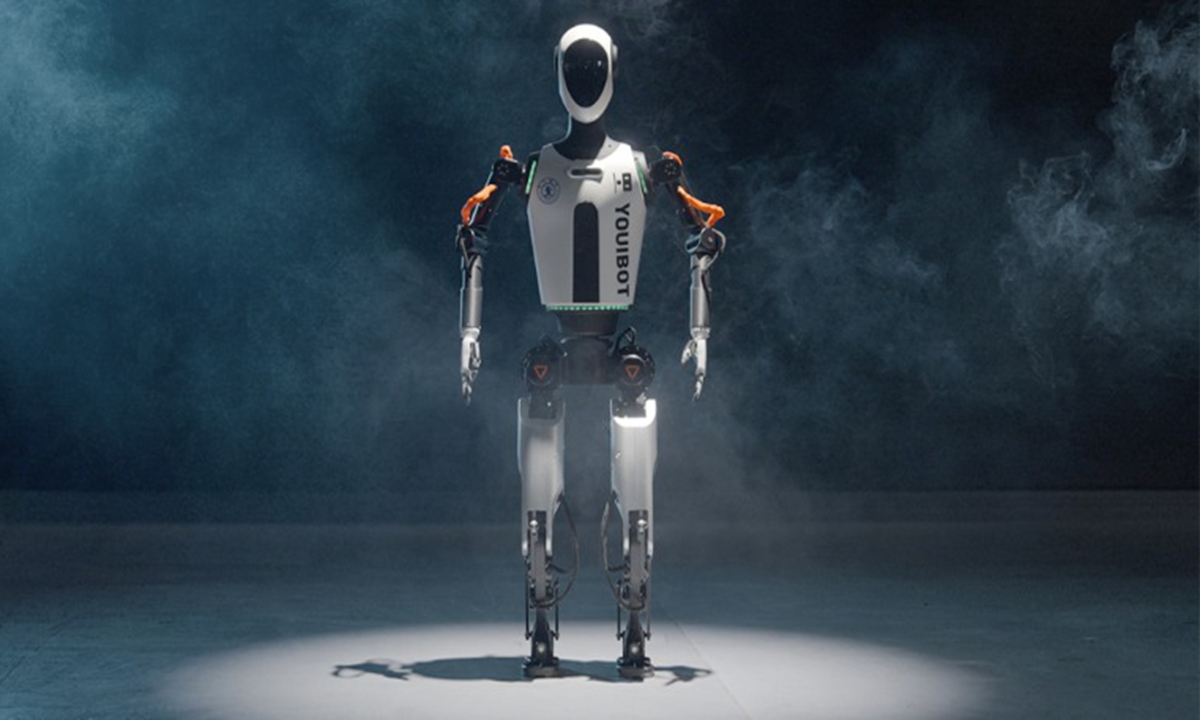
Youibot Robotics Photo: screenshot
Chinese researchers unveiled a humanoid robot on Wednesday in Hefei, Anhui Province, which is reported to be the world's first cross-scenario cluster-operating humanoid robot featuring a "one-brain-multi-form" architecture, media reports showed.
The "one-brain-multi-form" concept means that a single intelligent robotic brain can adapt to multiple embodied robot forms, allowing the selection of different robot morphologies based on specific application scenarios, according to the Science and Technology Daily.
The humanoid robot, named Ling Shu, which is built on an embodied intelligent large-model architecture, stands at 1.66 meters tall and weighs 40 kilograms. It is equipped with 33 degrees of freedom, features omnidirectional mobility, and can adapt to complex terrain environments.
The robot was co-developed by Hefei-based Youibot Robotics and the Embodied Intelligent Robot Research Institute, a joint venture between Youibot Robotics and Xi 'an Jiaotong University.
Zhang Chaohui, the founder of Youibot Robotics, told the Science and Technology Daily that humanoid robots with "one-brain-multi-form" concept provide a solution for industrial robots required to perform multiple tasks.
The robot will be deployed in key industrial processes such as intelligent inspection and auxiliary material loading, accelerating the adoption of embodied intelligence in complex industrial environments, the media report said.
For example, in an e-commerce warehouse scenario, Ling Shu precisely picks up a package from a shelf with one hand while holding a scanner in the other. With a "beep," the item is successfully scanned and entered into the system.
"The entire process integrates force control in the hands and a 3D visual perception system, enabling seamless omnidirectional movement," said Zhao Wanqiu, co-founder of Youibot Robotics, in an interview with media.
He explained that in real-world industrial and logistics settings, Ling Shu achieves millimeter-level precision, allowing it to perform tasks such as parcel sorting, fault detection in power distribution rooms and even wafer handling and equipment inspection in semiconductor fabrication facilities.
Global Times
RELATED ARTICLES