Chinese expert calls Tokyo’s advocacy questionable after Ishiba honors Hiroshima victims but undecided on ‘personal comments’ on 80th anniversary of WWII’s end
By and Xing Xiaojing Published: Aug 06, 2025 09:36 PM

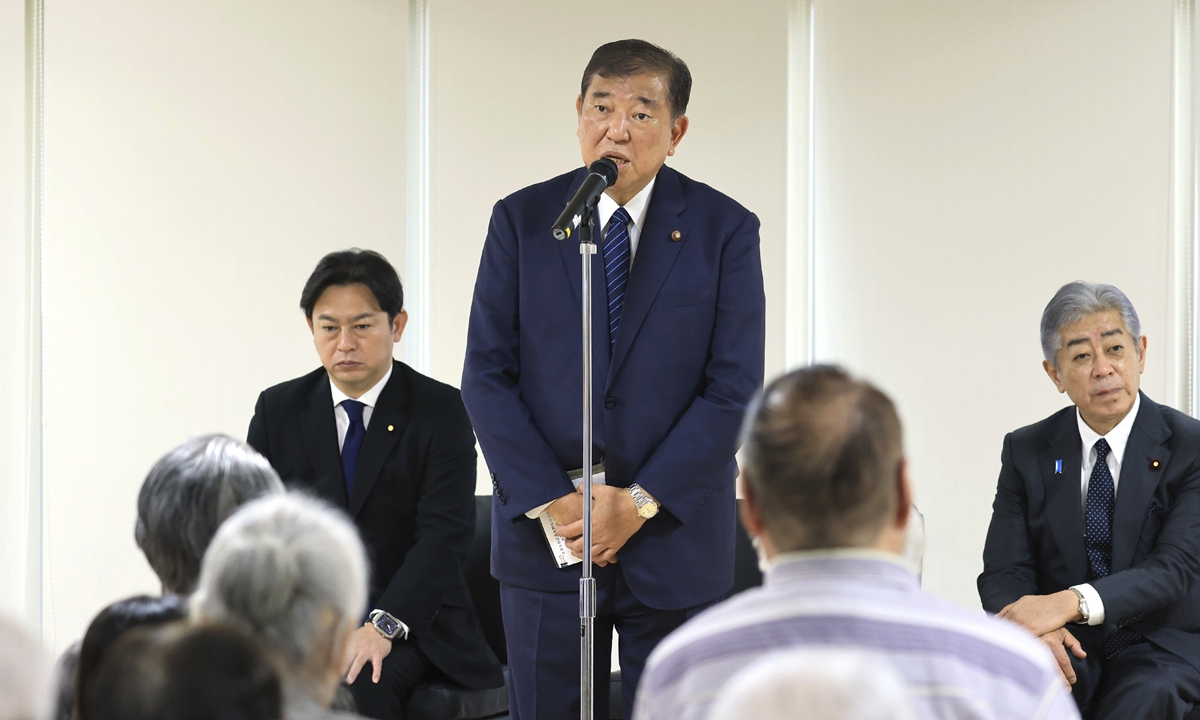
Japanese Prime Minister Shigeru Ishiba visits the Hiroshima Atomic Bomb Nursing Home Yano Orizuruen in Hiroshima City, Hiroshima Prefecture, Japan, on August 6, 2025. Photo: VCG
On the issue of how to reflect on wartime history correctly, the latest move of Japanese Prime Minister has sent contradicting message to the world. At a ceremony marking the 80th anniversary of the atomic bombing of Hiroshima, Japanese Prime Minister Shigeru Ishiba called for Japan to take the lead in bringing about "a world without nuclear weapons," and "offered condolences to the souls who were victims of the atomic bomb." Yet when it comes to issuing an official government statement on the 80th anniversary of World War II's end, Tokyo said no. While Ishiba ruled out a formal cabinet-endorsed statement, he has yet to finalize the format or timing to release his personal remarks, according to multiple media outlets.Eighty years after Japan's surrender, the country seems increasingly focused on its "victimhood" while attempting to downplay its role as an aggressor, according to observers. A Chinese expert told the Global Times on Wednesday that the key is to avoid reversing cause and effect: Japan's victimhood stemmed directly from its role as an aggressor. Failure to preserve this historical perspective may lead to narratives that obscure wartime accountability and distort the lessons of the war.
While emphasizing only its own suffering, Tokyo, abandoning its official decennial statement tradition, is backpedaling on the reckoning of past atrocities, the expert said.
According to a BBC report on Wednesday, a silent prayer was held in Japan on Wednesday morning as it marked 80 years since the US dropped an atomic bomb on the city of Hiroshima.
The Japanese prime minister highlighted Hiroshima's "sacrifices" and "suffering and hardship" during his speech at the ceremony, according to Ishiba's speech released by Asahi Shimbun on Wednesday.
"As the only nation to have suffered wartime atomic bombings, Japan's mission is to uphold the Three Non-Nuclear Principles while leading the international community's efforts toward a 'world without nuclear weapons,'" Ishiba said.
On the other hand, the formal and customary "prime minister's statement" that should have been issued on the decennial anniversary is set to be replaced by so-called "personal views" by Ishiba.
On Wednesday, Ishiba told press gathered in Hiroshima of his intention to issue "personal views" marking the 80th anniversary of the end of WWII, saying, "I would like to carefully consider the format [of the personal views] as well as the most appropriate timing for its release," Jiji Press reported.
The report said that the Japanese prime minister has already ruled out issuing an official "prime minister's statement" approved by the Cabinet. Regarding a personal comment, arrangements are being made to forgo releasing it on August 15 (the anniversary of Japan's surrender) or September 2 (the date Japan signed the Instrument of Surrender).
Japan's annual memorials for the atomic bombings of Hiroshima and Nagasaki are understandable, but such commemorations must be contextualized with the recognition that Japan's suffering was a consequence of its prior aggression and wartime atrocities during WWII, Da Zhigang, director of the Institute of Northeast Asian Studies at the Heilongjiang Provincial Academy of Social Sciences, told the Global Times on Wednesday.
"The key is to avoid reversing cause and effect: Japan's victimhood, including during the atomic bombings, air raids on Tokyo and Okinawa's devastation stemmed directly from its role as an aggressor,' Da emphasized.
"While mourning is legitimate, it must be coupled with a clear acknowledgment that Japan's actions precipitated its own suffering. Without this balance, the narrative risks obscuring historical responsibility and distorting the lessons of the war," the expert said.
Liu Jiangyong, vice dean of the Institute of Modern International Relations at Tsinghua University told the Global Times on Wednesday that historically, even without nuclear weapons, Japan was doomed to defeat as China had already launched a full counteroffensive in the war of resistance.
Though branded an "International City of Peace," Hiroshima still hosts shrines honoring war criminals, and remains a gathering place for right-wing groups, according to Liu.
Without serious reflection on its history of aggression and merely calling for "a world without nuclear weapons," Japan is, paradoxically, discussing with the US on scenarios for nuclear weapons use.
Kyodo News, citing sources, reported on July 26 that Japan and the US have been discussing a scenario, in which the US military would use nuclear weapons in the event of a so-called "contingency," during talks on so-called extended deterrence.
Whether Japan, with such a paradoxical mindset, is qualified to lead toward "a world without nuclear weapons" is highly questionable, Da said, urging the country to confront history sincerely.
Regarding Ishiba's adherence to Japan's "three non-nuclear principles" mentioned in his speech, Liu observed that emerging political forces such as the nationalist Sanseito party advocating nuclear armament have gained traction in the recent upper house election, reflecting populist trends. Ishiba's statement partly responds to this sentiment.
Japan's contradictory nuclear policy also manifests in its military cooperation with the US, including reliance on extended nuclear deterrence and discussions about nuclear sharing - which effectively undermine the non-nuclear principles despite the withdrawal of US nuclear weapons from Japan, Liu said.
To mark the 80th anniversary of the war's end, major Japanese media outlets, including Yomiuri Shimbun, NHK, Jiji Press and Asahi Shimbun have launched special sections. These features heavily emphasize stories of Japan's victimhood related to the atomic bombings, while giving far less coverage to narratives about Japan's role as a perpetrator in the war.
"This year marks the 80th anniversary of the war's end. Regarding Japan's wartime actions, there is considerable public consensus on Japan's victimhood, such as the atomic bombings of Hiroshima and Nagasaki and the air raids across Japan where the suffering inflicted by war is widely acknowledged. Yet, eight decades later, Japan has failed to reach a consensus on its role as a perpetrator. I believe this stems from the government's reluctance to squarely acknowledge its responsibility," Japanese Communist Party member and House of Councillors member Taku Yamazoe told the Global Times in Tokyo recently.
Liu stated that while the original purpose of commemorating atomic bomb victims was to promote peace and oppose war - which should serve as a mirror for Japan to confront its history - Japan has instead persistently emphasized its victimhood while avoiding acknowledgment of its aggressor past.
He pointed out Japan's contradictory behavior: on one hand cultivating a "victim" image, while on the other hand increasing military spending, whitewashing history in textbooks, and seeking constitutional revision for military expansion.
Liu emphasized that amid the current turbulent international situation, China-Japan relations are crucial for peace and stability in East Asia. Only by remembering history and facing it squarely can Japan use history as a mirror to avoid deeper rifts caused by opposing historical perspectives.
Lin Jian, a spokesperson for the Chinese Foreign Ministry, said in June at a regular press conference that "We hope Japan will deeply reflect on its historical crime, fully learn the lessons and, out of a sense of responsibility to history, to the people and to the future, make a clean break with any move that seeks to whitewash or cover up the history of aggression. We hope Japan will stick to the path of peaceful development, and earn through its actions the trust of its Asian neighbors and the international community." The remarks was made in response to media reporting that Ishiba said at the Nikkei Forum 30th Future of Asia that, Japan must remember the painful memory and lessons of history, so that it will not repeat past mistakes of war.
Chen Xingyu contributed to this story.
RELATED ARTICLES