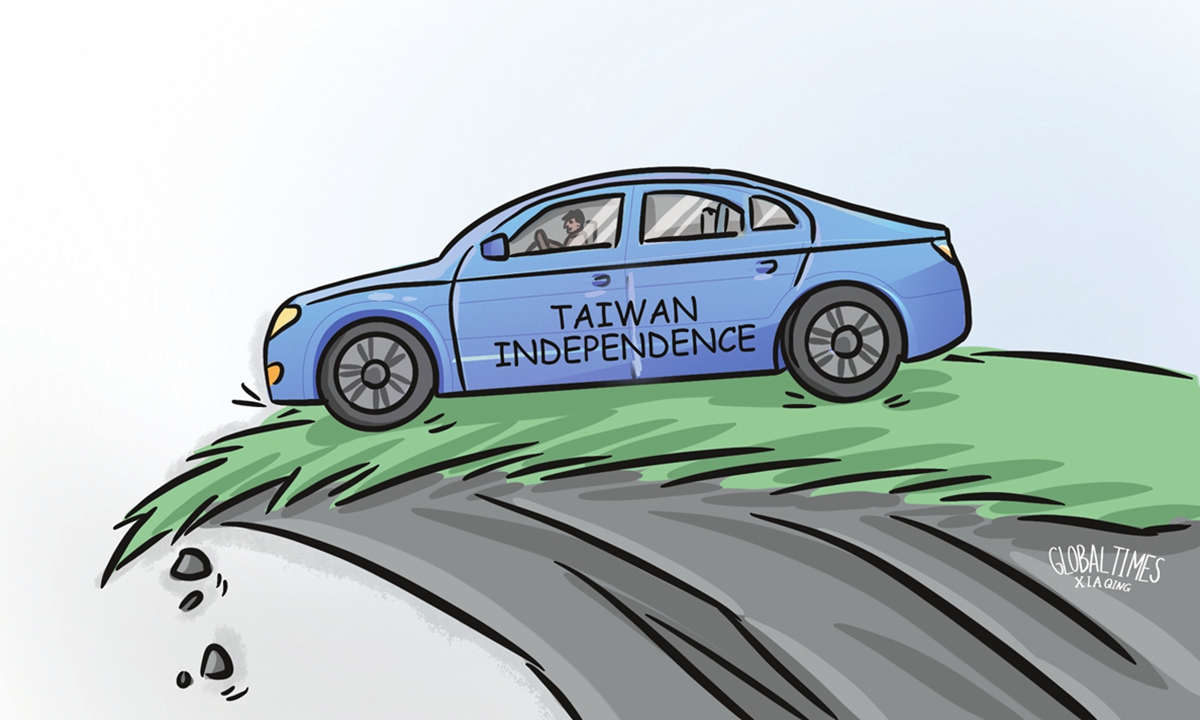
Illustration: Xia Qing/GT
On August 5, Christian Whiton, former senior adviser to the US State Department, published an article titled "How Taiwan Lost Trump." In the article, he pointed out that the misguided policies of the Lai Ching-te administration have led to a distancing from former US President Donald Trump.
On August 6, the Global Times published a piece by Bei Pingfeng titled "Lai's arms purchases will doom Taiwan's future," citing Whiton's views to expose the delusional nature of Lai's pro-independence agenda.
However, the Lai administration on August 7 attempted to link the two articles, smearing them as part of a so-called "cognitive warfare" campaign orchestrated by the mainland with "certain forces" allegedly manipulating public opinion online. Such deliberate distortion and scapegoating are nothing but new lies meant to cover up its own political predicament - lies that are an outright insult to the intelligence of the people on the island.
Lai's habit of spinning lies is nothing new. During his campaign rallies ahead of the 2024 election, he choked up in front of the cameras, claiming a typhoon had blown the roof off his own house - a calculated display of empathy that won him no small number of votes.
Yet when Typhoon Danas later devastated the island and an elderly disaster victim tearfully told Lai her own roof was leaking and she was too old to climb up and fix it, he showed no compassion. What followed was a cold, impatient response: "You'll have to climb it yourself. You can't rely on the military for everything." In that moment, Lai fully embodied the classic political betrayal - sweet talk before the vote, indifference after.
Adding to the irony, Lai repeatedly boasted about the "best-ever" relations between the US and Taiwan island - a narrative that fell apart the moment the Trump administration denied his request for a New York transit stop.
Whiton's article stated an obvious truth: when the Taiwan island is dragged onto the pro-independence bandwagon by Lai Ching-te - when all his energy is spent on political witch hunts and seeking independence through dependence on the US - Taiwan's relevance on the international stage will only continue to decline, eventually becoming a pawn and a burden in others' games. But instead of reflecting on this, the Lai administration rushed to label its critics as parroting mainland's talking points. This mindset - that anyone who doesn't agree with him must be the enemy - mirrors Lai's treatment of dissent at home: branding opposition figures in the "mass recall" campaign, dismissing disaster victims' pleas as nuisances. At its core, it all boils down to a refusal to tolerate any voice that exposes his lies. Taiwan has a highly educated population and they're beginning to see through Lai's flimsy political theatrics. According to the latest polls, public dissatisfaction with his leadership has soared to 56.6 percent, a historic high - a clear vote of no confidence in his lies. Online, more and more citizens are beginning to ask: Trump is raising tariffs, Japan wants to "steal" TSMC - is the mainland really our only adversary? Similar questions reflect a growing clarity about the dangers of Lai's anti-mainland, pro-independence path, a more rational view of cross-Straits relations, and, most importantly, a deep rejection of being lied to.
Lies are like sandcastles on the beach - they may appear sturdy, but they can't withstand the waves of reality. Typhoon Danas shattered Lai's carefully crafted image. The tariff hike and US transit rejection punctured the myth of so-called "rock-solid" ties between the US and the Taiwan island. Slowly, the fabrications Lai has woven are being exposed by hard facts. And when all the lies have crumbled, when every mask is torn away, what awaits him is abandonment - by both the people and history. After all, in an age of transparency, those who rely on lies to survive will ultimately be swept away by a public that has finally awakened.
The author is a commentator on international affairs. opinion@globaltimes.com.cn
RELATED ARTICLES

