Shenzhou-20 crew unpacks newly-delivered extravehicular spacesuits for China Space Station
Throats swabs and mixed-reality glasses also released to advance in-orbit experiments
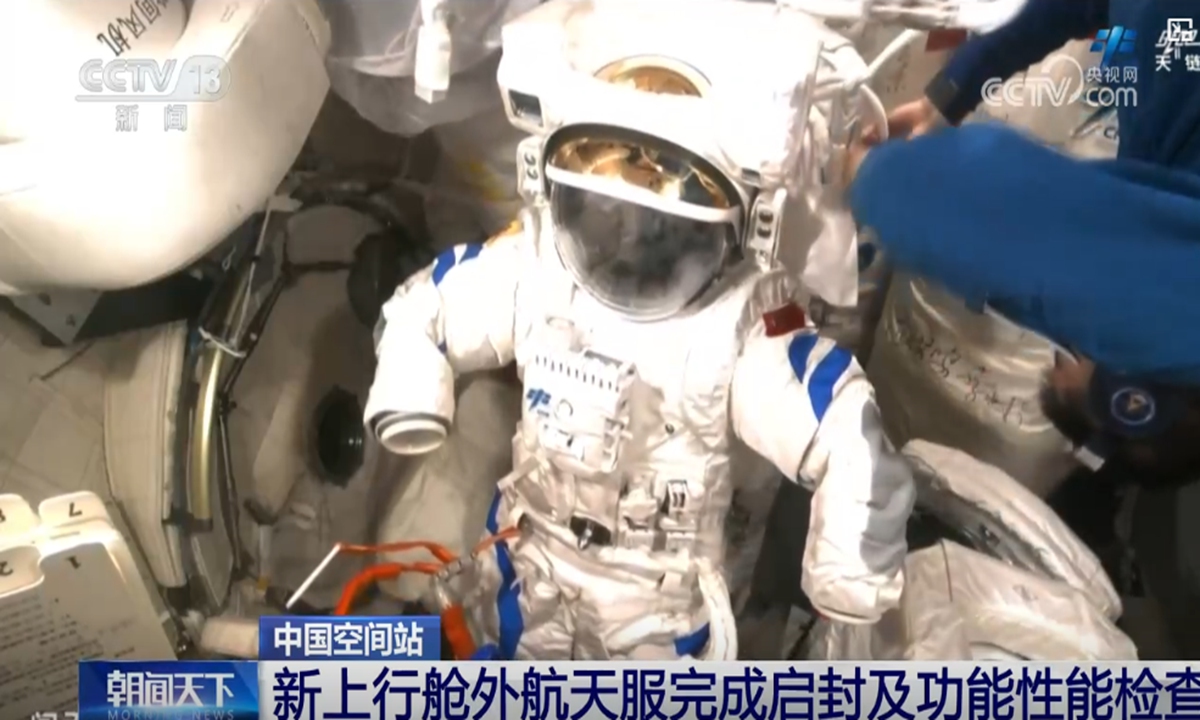
Photo: Screenshot from CCTV News
The Shenzhou-20 crew, after more than three months in orbit, reported fresh progress on Monday, China Central Television (CCTV) reported. They unpacked new extravehicular spacesuits delivered by the Tianzhou-9 cargo mission, and continued to advance in-orbit experiments. These included collecting throat swabs to study respiratory microbes' effects in space and using mixed-reality glasses for voice/gesture-controlled interaction.Regarded as miniature space stations, spacesuits embody a country's most advanced technologies. China's spacesuits, which supported the world's longest single extravehicular activity, showcase the nation's top-tier achievements in performance, safety and ergonomic design, experts said.
Last week, taikonauts Chen Dong, Chen Zhongrui and Wang Jie unpacked, transferred, unsealed, and inspected the new extravehicular spacesuits delivered aboard the Tianzhou-9 cargo spacecraft, and carried out functionality checks and maintenance, CCTV reported on Monday.
Two brand-new Feitian extravehicular spacesuits are domestically developed suits featuring a significantly extended design life, increased from the original three years and 15 uses to four years and 20 uses, according to CCTV.
Previously on March 21, Shenzhou-19 taikonauts Cai Xuzhe and Song Lingdong wore the older pair of China's spacesuits and successfully completed their third spacewalk. It marked the 19th time the spacesuits were used to support extravehicular activities (EVAs), exceeding the original design life of three years and 15 uses.
Following Shenzhou-19's return, Cai revealed an unexpected incident where during their first spacewalk, the crew were told to urgently resolve a jammed payload adapter from an earlier cargo installation, which Cai described as "more severe than ground estimates," in an interview with the CCTV.
Cai said he and Song spent more than seven hours outside in China's Feitian spacesuits fixing the stuck payload adapter. "We had primary and backup oxygen — the backup wasn't even needed. We had reserves to fall back on." Cai recalled. Their nine-hour was a success, setting both national and world records for the longest single EVA, according to media reports.
EVA spacesuits are like miniature space stations: They should be equipped with critical life support and communication systems akin to those on a space station. Key technical requirements of a spacesuit include lightweight and compact designs to prevent issues during spacewalk entries and exits, while also extending operational duration, reliability, and safety. These demands pose major technical challenges, particularly in addressing "jamming" issues that can arise from bulky suits, Song Zhongping, a Chinese aerospace affairs expert, told the Global Times on Monday.
EVA suits must also integrate seamlessly with space stations for life support and communication, reflecting cutting-edge advancements, Song said.
"China has made remarkable strides in EVA suit development. Notably, Chinese EVA suits setting a world record for the longest single spacewalk duration shows that China has reached world-leading levels in performance, safety and ergonomic adaptability," Song noted.
In addition to EVA spacesuits used for space station missions, China has also unveiled the country's moon-landing spacesuit in September 2024. According to the China Manned Space Agency, the spacesuit is made from protective materials that can effectively shield astronauts from the lunar thermal environment and lunar dust, and is equipped with a multifunctional control panel and cameras for recording close-up and long-distance scenes, Xinhua reported.
"Looking ahead, future suits are expected to incorporate jet propulsion systems for enhanced mobility. This feature will be especially critical for China's planned lunar missions by 2030, which will require extended stays on the moon's surface. Unlike space station operations, where taikonauts rely on climbing for mobility, jet-powered suits will enable safer, more reliable and efficient movement. These advancements would provide a robust foundation for deep-space exploration," Song said.
Apart from unboxing their new "outfits," the Shenzhou-20 crew conducted a range of in-orbit experiments during their stay.
In space life sciences and biotechnology, the crew is investigating how the space environment affects the human blood-brain barrier by using organ-on-chip technology. This experiment examines changes at the cellular, tissue and organ levels to better understand potential impacts on brain function and identify health risks during long-duration missions. Over the past week, they installed experimental units, transferred biological samples and completed sample collection and storage for later analyses.
In space medicine research, the Shenzhou-20 crew collected throat-swab samples from each other as part of research into how microorganisms in the station's environment may affect respiratory health. The samples have been frozen for return to Earth. They also conducted studies on bone metabolism, gut microbiota and nutritional regulation.
The crew also tested an in-orbit mixed-reality training device. Wearing lightweight MR glasses, they interacted with the system via simple voice commands or hand gestures, allowing for immersive and hands-free operational training, CCTV reported.
RELATED ARTICLES