Xi says China, Brazil can set example of unity, self-reliance in Global South
Brazil stands ready to enhance communication and coordination with China; oppose unilateral bullying practices, says Lula
By Published: Aug 12, 2025 10:19 PM

China Brazil Photo:VCG
Chinese President Xi Jinping said on Tuesday that China is ready to work with Brazil to set an example of unity and self-reliance among major countries in the Global South, and jointly build a more just world and a more sustainable planet.Xi made the remarks during his phone talks with Brazilian President Luiz Inacio Lula da Silva, according to the Xinhua News Agency.
China-Brazil ties are at their best in history, with the building of a China-Brazil community with a shared future and the alignment of the two countries' development strategies getting off to a good start and making smooth progress, Xi said.
The Chinese side stands ready to work with Brazil to seize opportunities, strengthen coordination and deliver more mutually beneficial cooperation outcomes, he added.
Xi also said that China backs the Brazilian people in defending their national sovereignty and supports Brazil in safeguarding its legitimate rights and interests, urging all countries to unite in resolutely fighting against unilateralism and protectionism.
Noting that the BRICS mechanism is a key platform for building consensus in the Global South, Xi congratulated Brazil on successfully hosting the recent BRICS Summit.
Xi called on Global South countries to jointly safeguard international fairness and justice, defend the basic norms governing international relations, and protect the legitimate rights and interests of developing countries.
China and Brazil should continue to address global challenges, ensure the success of the upcoming UN Climate Change Conference in the Brazilian city of Belem, and promote the "Friends of Peace" group's role in facilitating the political settlement of the Ukraine crisis, Xi said.
For his part, Lula said Brazil attaches great importance to its relations with China, and looks forward to strengthening cooperation with China, deepening strategic alignment and promoting greater development of bilateral ties.
He briefed Xi on the recent situation of Brazil's ties with the US, as well as Brazil's unwavering principled stance on safeguarding its own sovereignty.
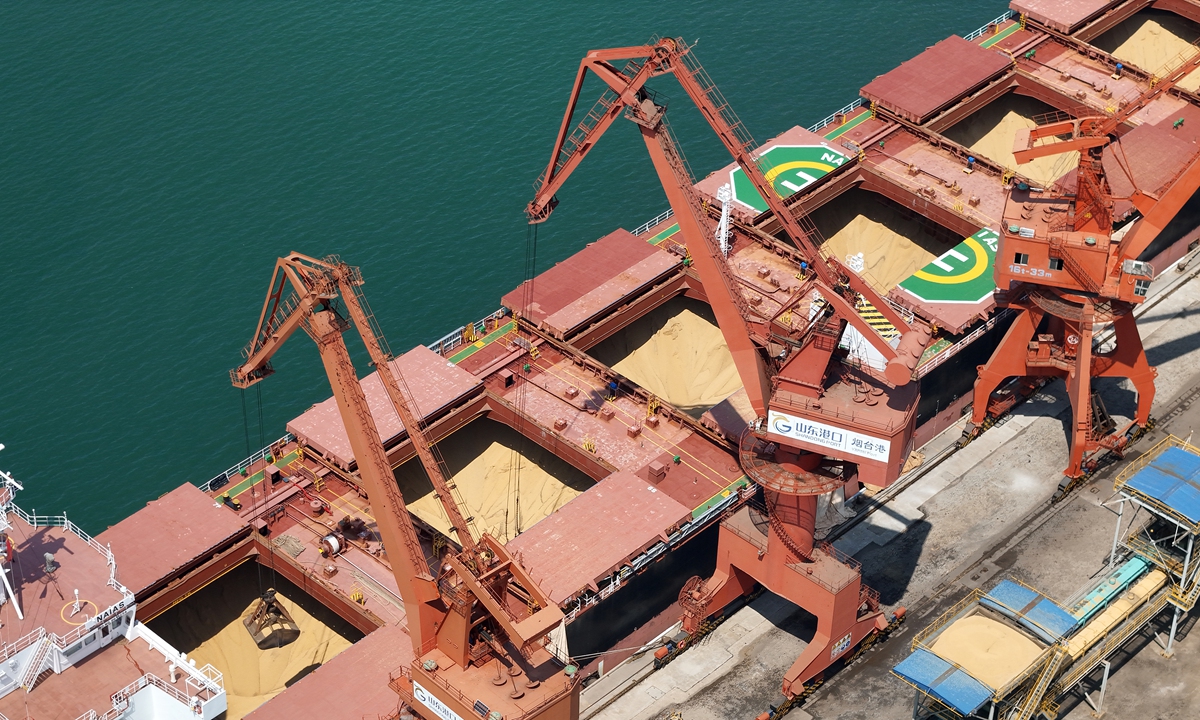
Imported soybeans from Brazil are being unloaded from a ship at the Longkou Port Area of Yantai Port in East China's Shandong Province on June 17, 2025. Photo: VCG
Lula spoke highly of China's efforts to uphold multilateralism and safeguard free trade rules, as well as its responsible role in international affairs.
The Brazilian side, he said, stands ready to enhance communication and coordination with China in multilateral mechanisms such as BRICS, oppose unilateral bullying practices and safeguard the common interests of all countries.
Multilateralism against unilateralism
The US announced a 50 percent tariff on a range of Brazilian exports, including coffee, beef and petrochemicals in July, Xinhua reported.
Last week, Lula vowed to speak with representatives of BRICS countries about US tariffs on their products.
"I will try to discuss with them how each country is affected by the situation and what the implications are, so that we can make a decision," Lula said, noting that BRICS includes several members of the G20, the group that brings together the world's 20 largest economies, according to Agency Brazil.
Lula has also spoken with Russian President Vladimir Putin and Indian Prime Minister Narendra Modi over the past few days, according to media reports.
As both are bellwethers of the Global South, Lula's call signals Brazil's effort in seeking further cooperation with China, particularly in defending national sovereignty, with both countries sharing similar objectives, Lü Xiang, a research fellow at the Chinese Academy of Social Sciences, told the Global Times.
In response to the unjust tariffs imposed by the US, Brazil is not only resolutely defending its sovereignty but also actively pursuing policy coordination with China, Lü said, adding that such a collaborative approach of unity and self-reliance has the potential to serve as a model for Global South countries to fight for their national interests.
Last week, China's top diplomat Wang Yi also had a phone call with Celso Amorim, chief advisor to the president of Brazil.
He stressed that China firmly supports Brazil in defending its right to development and opposing the bullying practices of arbitrary tariffs. As the largest developing countries in the eastern and western hemispheres respectively, China and Brazil have always supported each other, closely coordinated, and firmly safeguarded the legitimate interests of their own as well as the common interests of the Global South countries, according to Xinhua.
The policy coordination between China and Brazil, which spans both the eastern and western hemispheres as well as the northern and southern hemispheres, has the potential to become a paradigm for safeguarding the global system, which may create a constraint for countries that are advocating unilateralism, Wang Youming, Director of the Institute of Developing Countries at the China Institute of International Studies, told the Global Times.
Call for cooperation
In July, Trump warned that countries which side with the policies of the BRICS alliance that go against US interests will be hit with an extra 10 percent tariff.
"Any country aligning themselves with the Anti-American policies of BRICS, will be charged an ADDITIONAL 10% tariff. There will be no exceptions to this policy," Trump wrote on social media.
In response to Trump's remarks, Mao Ning, a spokesperson for China's Ministry of Foreign Affairs said on July 7 that BRICS is an important platform for cooperation among emerging markets and developing countries. It advocates openness, inclusiveness and win-win cooperation. It is not a bloc for confrontation, nor does it target any country.
On the US' tariff hikes, China has made its position clear more than once. Trade wars and tariff wars have no winners and protectionism leads nowhere, Mao said.
According to data from the Brazilian Central Bank, in the first half of 2025 alone, Chinese direct investments in capital holdings in Brazil totaled $379 million, surpassing any annual result since 2018, Brazilian media reported.
On August 1, the Chinese embassy in Brazil posted on X that China has approved 183 new Brazilian coffee companies to export products to the Chinese market.
Last week, in the phone call between Modi and Lula, whose country faces up to a 50 percent tariff from the US, the two leaders reiterated their goal of boosting bilateral trade to more than $20 billion annually by 2030, up from roughly $12 billion last year, according to the Brazilian president's office, Aljazeera reported
Brasilia said they also agreed to expand the reach of the preferential trade agreement between India and the South American trade bloc Mercosur, and discussed the virtual payment platforms of their countries, according to the report.
RELATED ARTICLES