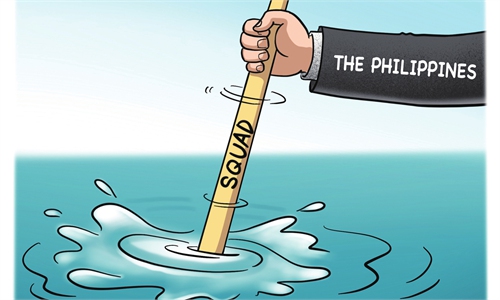
The Philippines' repeated mistakes in the South China Sea will inevitably result in a 'painful price'
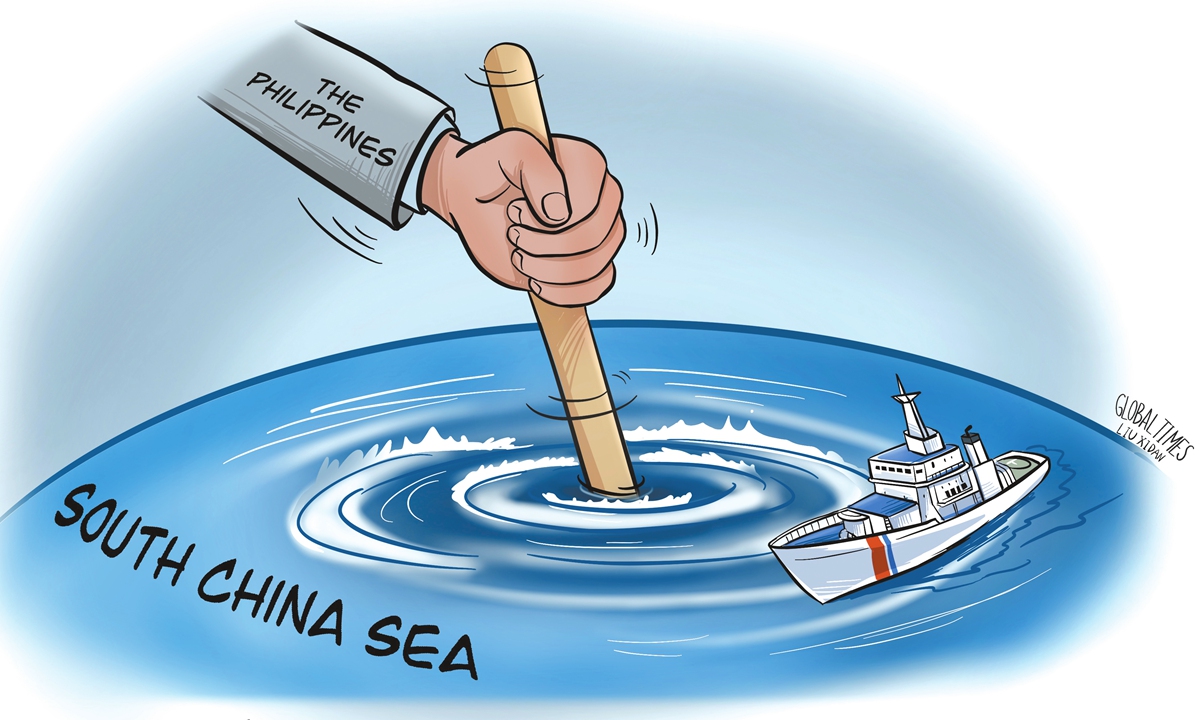
Illustration: Liu Xidan/GT
On Monday, the Philippine Coast Guard vessels and official vessels carried out a carefully planned provocation in the waters near Huangyan Dao. Despite repeated stern warnings from the Chinese side, Philippine vessels forcibly intruded into Chinese territorial waters. The China Coast Guard, in accordance with the law, took all necessary measures, including tracking, monitoring, blocking and controlling. Ding Duo, director of the Research Center for International and Regional Studies at the National Institute for South China Sea Studies, said this maritime confrontation was yet another deliberate misconduct by the Philippines aimed at infringing on China's territory, posing a serious threat to regional stability and the foundations of international legal order.China's sovereignty claim over Huangyan Dao is rooted in solid historical context and successive, effective jurisdiction. Existing international treaties and historical records all demonstrate that Huangyan Dao has never been Philippine territory. Until 1997, the Philippine government consistently recognized China's sovereignty over the island. From that point onward, however, driven by ulterior motives, Manila began asserting its own sovereignty claim over Huangyan Dao. For more than two decades thereafter, it sought to justify this claim with untenable arguments such as "Huangyan Island is closer to the Philippines than to China." In fact, "geographical proximity" has never been a criterion under international law for acquiring territory.
Recently, Manila has repeatedly sought to stir up tensions at sea, pushing for the "securitization" of the South China Sea narrative in the international public arena, in an attempt to turn the issue into a global hotspot and thereby highlight its so-called strategic value. According to Ding, Manila has been provoking China through persistent low-intensity "gray zone" maritime confrontations, employing "cognitive warfare" tactics to systematically attack China. By deploying official vessels and media crews to stage and film maritime stunts, the Philippines aims to malign China's South China Sea policy and tarnish China's international image in both the cognitive domain and the broader South China Sea discourse.
However, there is no doubt that should the Philippines persist in such provocative moves, it will inevitably face more targeted countermeasures from China. "Manila must pay a corresponding and painful price for its repeated mistakes and stubbornness," said Ding.
RELATED ARTICLES