Photo: Li Hao/GT
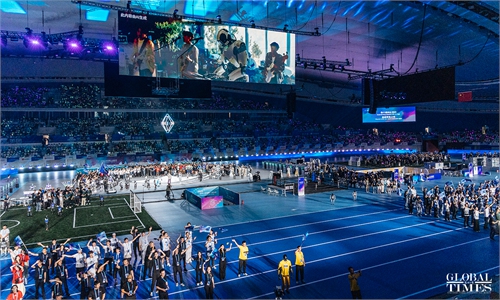
The inaugural World Humanoid Robot Games (WHRG) entered its first day of competition on Friday with an ambitious line-up that blurred the lines between sport and cutting-edge researches.
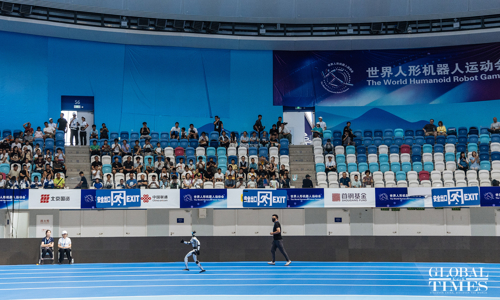
On the schedule were high-energy 5-a-side football matches - a crowd favorite - alongside the 1,500 meter, 100 meter, 400 meter and 4x100-meter relay events. Away from the track, robots took on tasks as varied as hotel service, pharmaceutical sorting, martial arts, and synchronized group dancing. In total, the morning's 16 events would produce five gold medals.
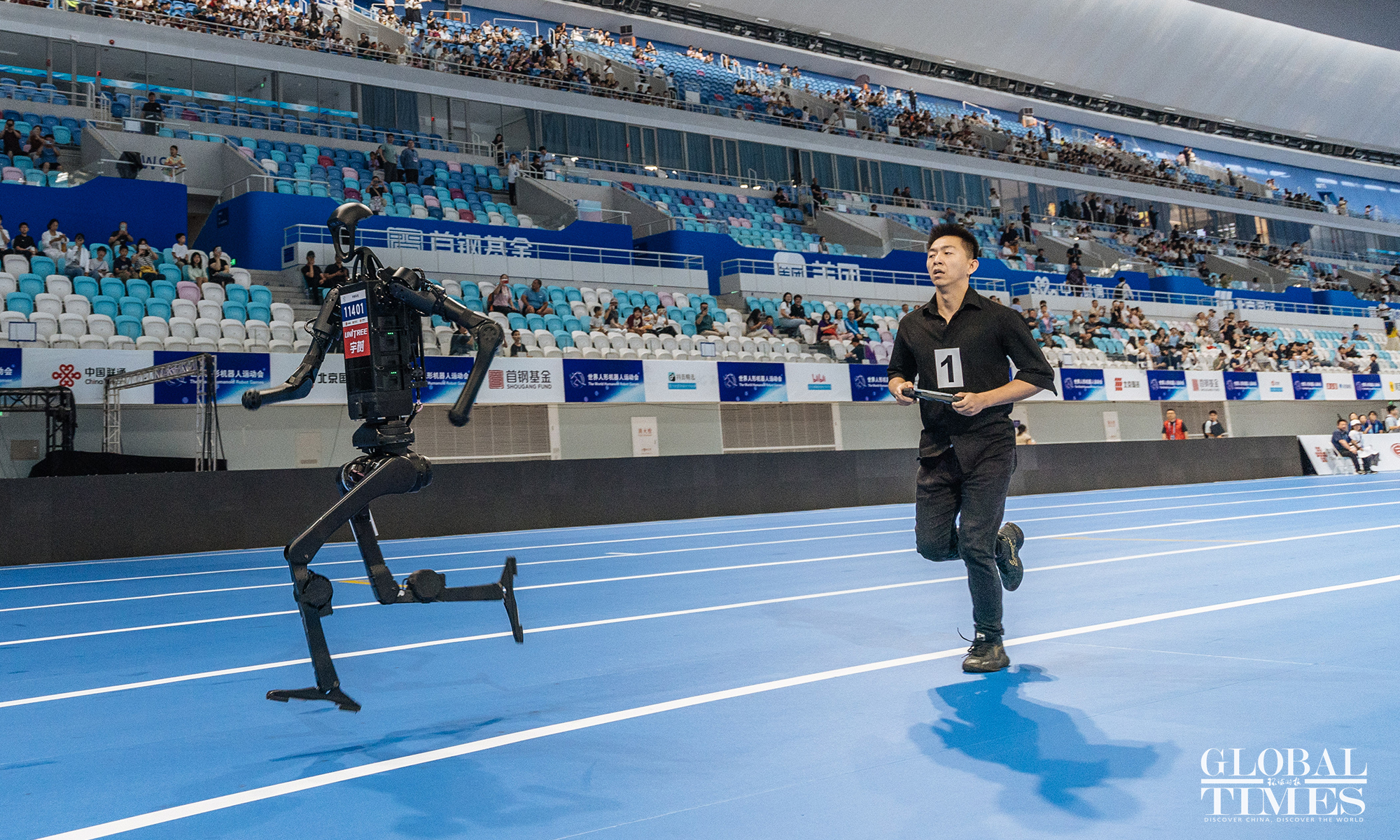
The early drama came in the 1,500 meters, where Beijing Lingyi Technology, a wholly owned subsidiary of Hangzhou Unitree Robotics, emerged victorious. Their robot, the same model that starred in the 2025 Spring Festival Gala, clocked an average speed of 3.8 meters per second over the race, with a final winning time of 6:34.40.
"This robot is a landmark for the industry," said Unitree founder and CEO Wang Xingxing. "It's about showcasing both peak speed and endurance."
When asked whether the championship-winning running humanoid robot would be adapted for other applications, Wang told Global Times that they have been developing robots for a variety of scenarios, including simple industrial applications, scientific research, and education, as well as AI algorithm development and some service-sector uses.
However, athletics competitions are fundamentally different from everyday work, so the algorithms used there may not be directly applicable, Wang said. "Still, I think these competitions provide an excellent platform for testing the stability and reliability of both hardware and algorithms. Simply put, if a robot can handle fitness, intense exercise, or long-distance running, then it would be very reliable for use in ordinary daily life."
Track events have drawn particular attention from teams, with the 100 meters described by many as the "battlefield everyone wants to win." Compared with the humanoid half-marathon held in April, participants have already shown marked improvements in gait stability and running speed.
Several Chinese companies joined the track competition alongside Unitree, including Tiangong, High Torque, and Inter City Technology. High Torque's focus, however, was less on racing and more on safety, modularity, and accessibility for research.
"We want to make humanoid robots safer, lighter, and easy to disassemble," Zhou Yuxi, a representative from High Torque, explained to the Global Times. "Smaller robots can serve as companions for children or help in monitoring and assisting elderly people. For larger robots, it's about practical capabilities like climbing stairs or navigating complex terrain, things wheeled robots can't do. I believe within five years, they will move as naturally as humans."
Five-a-side football proved a huge crowd-pleaser when played by humanoid robots, though track events were still the centerpiece of the Games, and the international presence also added another layer of meaning.
Harold Ruiter, leader of the Dutch Nao team, told the Global Times that their robot from Chinese company Booster Robotics was entirely different from the one used in last month's RoboCup. "[This one] has much better vision, can detect more objects on the field, and have improved walking and dynamic kicking," he said. Ruiter designed a team hoodie featuring Beijing's Temple of Heaven and the Great Wall. "This is our first time in China, and it's been a great cultural experience."
It's worth noting that in the Games' 3v3 and 5-a-side humanoid robot football match, all the robots were provided by Chinese tech company Booster Robotics.
Praise of the robot was echoed by Antonio Fernando, coach of Portugal's LAR@Humanoid team: "They fall many times and never break down." He also highlighted the importance of collaboration. "Our main purpose here is not the result, but the science."
Indeed, the significance of the Games goes beyond the results. Teams can build up experience and develop mature technology by striving for good results, and Chinese high school student teams have also embraced the Games as a cultural and educational milestone.
Students from Beijing National Day High School marveled at working with robots worth 200,000 yuan, and even found time for cultural exchanges, from sharing code to chatting about whisky with a Swedish programmer. Their instructor, Fan Shuang, told the Global Times the school had introduced AI courses for junior high students to prepare them for a fast-changing tech environment. "If we wait until university, it may already be too late," Fan said.
"If you try to build an all-purpose household robot immediately, it's unrealistic. But competition allows each technology - vision, locomotion and more - to be pushed to its limits. These breakthroughs can later be applied to more complex robots," said Zhao Mingguo, head of Tsinghua University's Hephaestus and director of the Tsinghua University Robot Control Laboratory.
Even teams from outside consumer robotics, like China University of Mining and Technology (Beijing), saw the Games as a bridge. "Though our research focuses on mining robots, the technologies for humanoid robots are largely shared," said Associate Professor Hao Xuedi. "This competition helps students deepen their understanding of general AI and robotics technologies."
At the heart of many breakthroughs lies "embodied intelligence" - the integration of AI into a physical entity capable of sensing, learning, and interacting dynamically with its environment. A 2024 industry report named it one of the top trends for humanoid robots, describing it as the ability to make rapid, precise responses under changing conditions.
"The Games condense that journey into high-intensity tests, where each sprint, kick and task is another step toward robots that can move, think, and adapt as naturally as humans. This reflects not only the future of robotics, but also humanity's own path of growth - striving, refining, and learning through challenges," Zhao said.
RELATED ARTICLES