China's July economic performance highlights high-tech development, to continue supporting annual growth
Improving factors to support sustained growth for rest of year
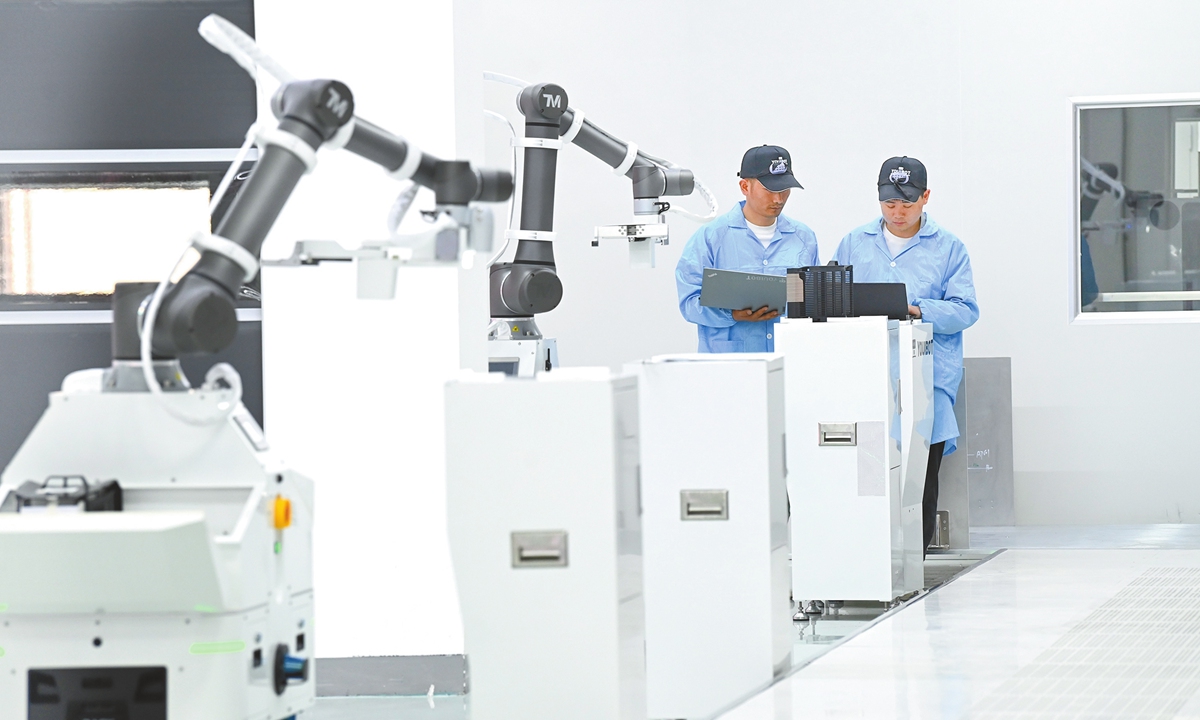
Technicians assemble and debug industrial robots at a workshop of an intelligent robotics company in Hefei, East China's Anhui Province on April 8, 2025. The workshop completes the production of one industrial robot every 36 hours on average. Photo: VCG
Despite risks and challenges, China's robust economic foundation, resilience, and potential will ensure sustained long-term growth, an official of the National Bureau of Statistics (NBS) said, as China's July economic data released on Friday showcased the economy's "innovation-driven" momentum. Meanwhile, international institutions, including the IMF, raised their 2025 GDP growth forecast for China, reflecting growing global confidence in China's economic trajectory.
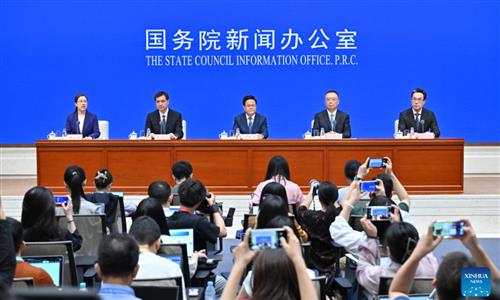
In the rest of 2025, growing market demand, the development of new quality productive forces and effective macroeconomic policies will propel China's economic growth, despite facing external challenges, NBS spokesperson Fu Linghui said on Friday at a press conference. Meanwhile, there are still very favorable conditions for the growth of China's exports in the rest of the year, he said.
Experts highlighted that multiple factors, including proactive macroeconomic policies, expanding market demand and innovation-driven industries, will robustly support China's stable growth throughout 2025, laying solid foundation for the country to achieve its annual growth target of around 5 percent.
New economic drivers shine
This confidence was based on the momentum seen from the growth potential of China's emerging and high-tech sectors, as the latest data showed that emerging industries are thriving, the digital economy is developing rapidly, and green development is improving in quality and efficiency.
NBS data released on Friday showed improvement in many industrial sectors. Nationwide, the added value of industrial enterprises above the designated size grew by 5.7 percent year-on-year in July.
The added value of the equipment manufacturing sector rose by 8.4 percent year-on-year in July, while that of high-tech manufacturing rose by 9.3 percent, according to NBS.
Notably, in July, the added value of smart unmanned aerial vehicle manufacturing companies in China soared by 80.0 percent year-on-year, with intelligent vehicle-mounted equipment manufacturing rising by 21 percent.
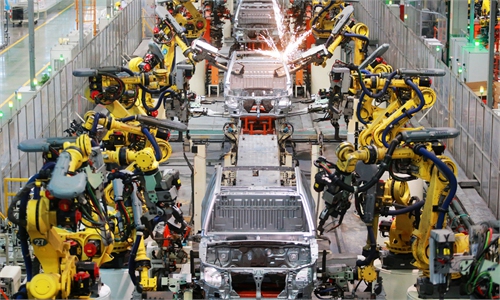
Meanwhile, NBS data showed that the output of industrial robots rose 24 percent year-on-year in July, with that of civilian drones increasing by 18.9 percent, which analysts said reflected growing domestic demand for intelligent products.
Regarding the rapidly developing new quality productive forces, Fu said that since the beginning of this year, various sectors have actively promoted the deep integration of technological and industrial innovation, vigorously advancing the high-end, intelligent, and green transformation of industries, and facilitating the application of scientific and technological achievements.
Recent robotics events in Beijing epitomize China's industrial innovation surge. The World Robot Conference 2025, held from August 8 to Tuesday, featured over 1,500 robots, while the 2025 World Humanoid Robot Games, held from Thursday to Sunday, also in Beijing, is witnessing over 500 humanoid robots from 16 countries compete.
Experts said that these events highlight a new development path driven by innovation. The rapid growth in technology-driven, digital, and green industries is reshaping China's economy and enhancing its global competitiveness. By prioritizing innovation and industrial upgrades, China is also strengthening its global supply chain resilience, they said.
Support for growth
Fu also noted that favorable conditions will support industrial growth in the next stage. "We must focus on long-term goals, strengthen innovation, nurture new quality productive forces, and promote traditional industry upgrades," said Fu.
"At present, the country has introduced relevant policies to vigorously develop new productive forces. These efforts have achieved satisfactory results and provided favorable support for high-quality economic growth," Ma Hong, a senior researcher at the Guangkai Chief Industry Research Institute, told the Global Times on Friday.
Apart from industrial growth, Fu also pointed out that multiple factors will continue to support China's stable economic growth throughout the year, including advancing new quality productive forces, expanding market demand, deepening reform and opening-up, and effective macro policies.
In terms of market demand, Fu said that as policies take effect, the consumption potential is being continuously unleashed, which has driven retail sales of consumer goods up 4.8 percent and service retail up 5.2 percent from January to July.
Overall retail sales continued to grow in July, with total retail sales of consumer goods reaching 3.878 trillion yuan ($540 billion), up by 3.7 percent year-on-year, per NBS data.
"Recent policies targeted consumption as a key growth lever, supporting multiple sectors including culture, tourism, and sports. These are expected to boost durable goods and service consumption, fostering sustained demand growth," Hong Yong, an associate research fellow at the Chinese Academy of International Trade and Economic Cooperation, told the Global Times on Friday.
Ma also said that in the second half of the year, service expenditure is expected to continue being a main catalyst for overall consumption growth. "The ongoing expansion of the sector, along with innovations in consumption scenarios, will enhance service-related spending in sectors such as telecommunications, healthcare, and elderly care," Ma said.
According to NBS data, China's services sector expanded rapidly in July, with many modern services showing strong growth momentum. In July, the Index of Services Production grew by 5.8 percent year-on-year. Specifically, that of information transmission, software and information technology services, finance, and leasing and business services grew by 11.9 percent, 8.7 percent and 8.0 percent year-on-year, respectively.
"From the perspective of exports, despite the impact of high tariffs from certain countries, China's foreign trade operators have actively expanded into diversified markets, and the volume and quality of goods exports have both increased. The resilience of foreign trade continues to be demonstrated. From January to July, China's goods exports increased by 7.3 percent, among which the export of mechanical and electrical products rose by 9.3 percent," said Fu.
Maintaining the resilience and vitality of the foreign trade sector is also among the efforts being made to deepen the reform and opening-up in the rest of the year, which include governance over rat race competition and further facilitation of dual circulation, according to Fu.
Meanwhile, Fu mentioned that in the rest of 2025, macro policies will continue to show their effects, which have stimulated the expansion of production demand and promoted the stable growth of the economy since the beginning of the year. For example, the trade-in program of consumer goods has driven the retail sales of home appliances to grow by 30.4 percent in the first seven months.
"Past policy trends favored early and proactive measures. This year's stronger-than-expected first-half growth, combined with potential new policies like tax relief or interest rate cuts by the third or fourth quarter, will help China achieve the around 5 percent growth target," said Ma.
"Policies will maintain continuity and stability in the second half. With effective policy implementation, achieving around 5 percent growth is well on track," economists at China Minsheng Bank, led by Wen Bin, said in a note sent to the Global Times on Friday.
Growing global confidence
In addition to domestic confidence, there is also rising international trust in China's development. The IMF's recent upward revision of China's 2025 GDP growth forecast by 0.8 percentage points was one example of this.
Meanwhile, in early August, S&P Global Ratings has affirmed China's "A+" sovereign credit rating with a "stable" outlook, recognizing the country's economic resilience, effective debt management, and positive growth prospects.
Foreign-funded financial institutions like Baillie Gifford commented that China is undergoing economic transformation "at unprecedented scale" and the world factory is pivoting from "made in China" to "invented in China" and will provide more development opportunities for foreign investors.
Foreign Ministry spokesperson Guo Jiakun said on July 31 that China enjoys an increasing momentum of robust economic growth with the dynamism of innovation being unleashed at a faster pace, thus contributing the most precious certainty to global development.
Experts said that amid global uncertainties, China's steady progress positions it as a "stabilizing anchor" and "growth accelerator" for the world economy, embodying certainty, opportunity, and future potential.
RELATED ARTICLES