Defying Chinese goodwill, abusing China’s self-restraint: Philippines renews provocations at Huangyan Dao
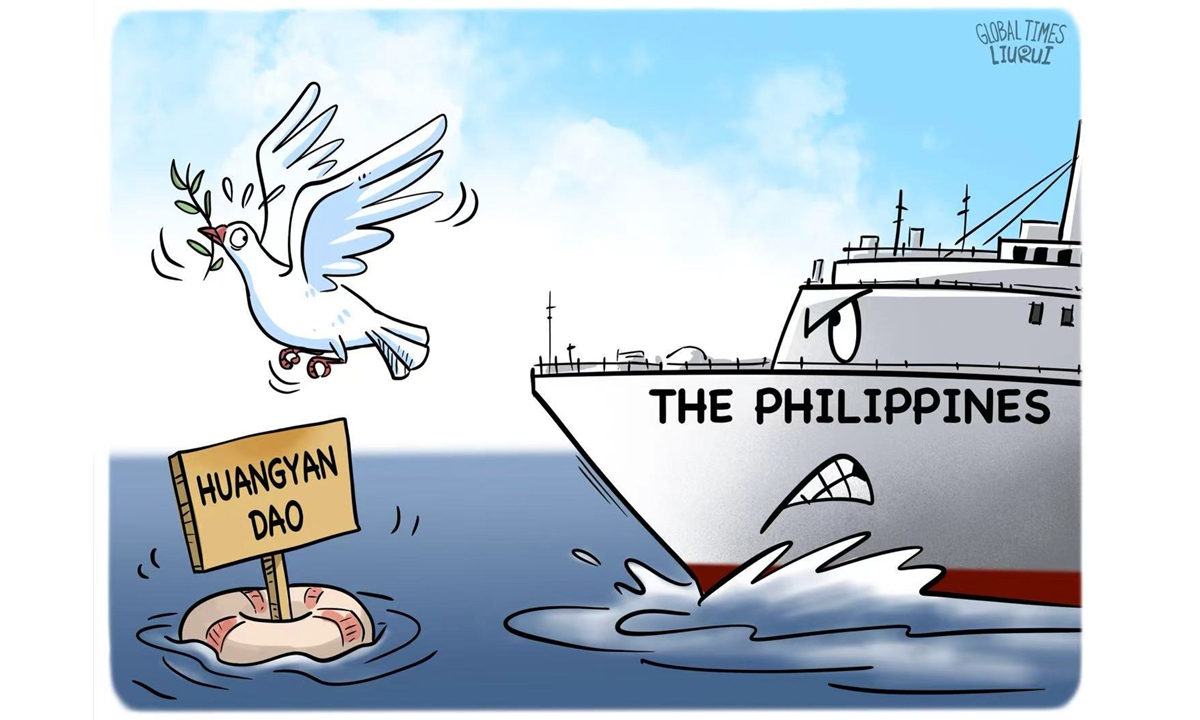
Illustration: Liu Rui/GT
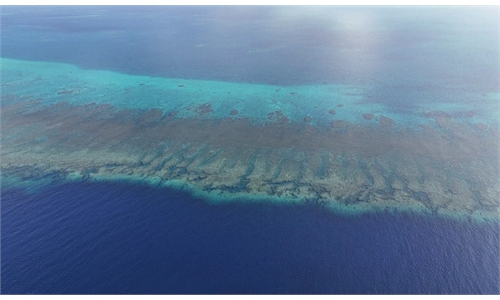
Recently, under the pretext of "delivering fuel and supplies to fishing boats," the Philippines organized a formation consisting of several coast guard vessels and official ships, approaching China's Huangyan Dao from multiple directions and forcibly intruding into China's territorial waters around the island. They engaged in unusually aggressive and highly dangerous maneuvers. In accordance with both international and domestic laws, the Chinese side implemented necessary control measures and drove away the Philippine vessels. Although such illegal actions by the Philippines are by no means unprecedented, the different approaches taken by China and the Philippines during this latest provocation make it abundantly clear who is the maintainer of peace and stability in the South China Sea, and who is the disruptor of regional order.
In this incident, faced with the Philippines' deliberate and malicious provocation, Chinese vessels and crew members, while firmly and resolutely safeguarding sovereignty, demonstrated their high degree of rationality and self-restraint. Despite having clear advantages over the Philippine side in terms of tonnage and equipment, Chinese vessels chose to adopt low-intensity maritime rights protection and law enforcement measures - such as verbal warnings and navigational maneuver alerts - targeting only the expulsion of vessels illegally intruding into Chinese waters. Even under tense circumstances, no high-intensity control measures were employed. This fully attests to China's genuine goodwill in avoiding escalation at sea wherever possible, as well as its firm determination to safeguard regional peace and stability.
In stark contrast were the Philippine side's clumsy theatrics. Under the guise of the so-called "resupplying fishing boats," the Philippines initiated trouble, ignored repeated Chinese warnings and disregarded China's patience. By dispatching a vessel to intrude into China's territorial waters around Huangyan Dao, the Philippines violated international law, including the United Nations Convention on the Law of the Sea, and seriously infringed on China's territorial sovereignty and maritime rights and interests.
Even worse, the Philippines chose to carry out such aggressive violations on the very first day of the 48th Meeting of the ASEAN-China Joint Working Group on the Implementation of the Declaration on the Conduct of Parties in the South China Sea (JWG-DOC), held from August 11 to 13. This unmistakably reveals its disdain for the DOC, its disregard for the overall peace and stability of the region, and its betrayal of the shared vision of the countries bordering the South China Sea. The Philippines' deliberate provocation and attempt to sow chaos in the South China Sea lay bare its ill intentions.
Looking at China-Philippines maritime interactions in recent years, China's rational restraint in responding to provocations and handling infringements has been consistent. However, driven by self-interest rather than national welfare, the Ferdinand Marcos Jr administration has persistently adopted irrational confrontational approaches. Even when fully aware of the truth, it has deliberately feigned ignorance - misrepresenting China's self-restraint as provocation achievements to manipulate public opinion through propaganda. Manila must understand that good neighborliness is indeed a traditional Chinese virtue, but as the Analects of Confucius say that if you repay injury with virtue, how will you repay virtue? China's patience has its limits. Should provocations in the South China Sea continue, there will be bitter consequences.
The author is a researcher at the China Institute for Marine Affairs of the Ministry of Natural Resources. opinion@globaltimes.com.cn
RELATED ARTICLES