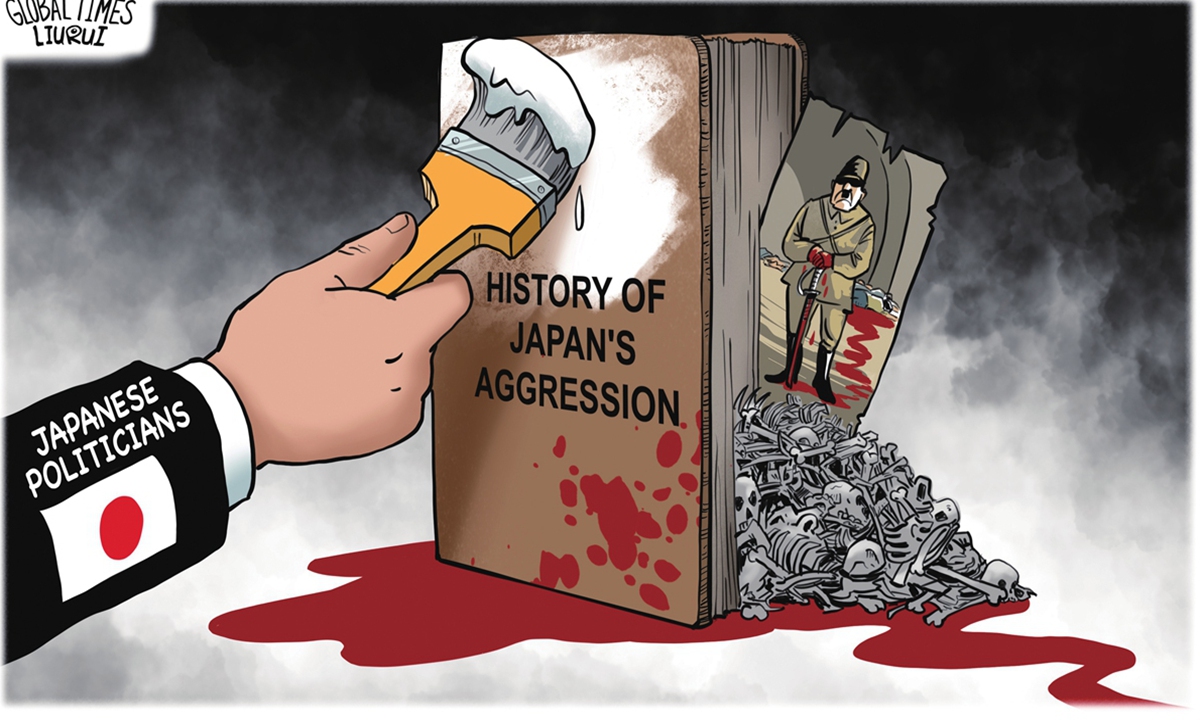
Illustration: Liu Rui/GT
As of Monday, after 25 days in theaters, the Chinese film Dead to Rights has grossed over 2.57 billion yuan ($357 million). The film has also resonated strongly with audiences in the US and New Zealand, among other countries, setting a strong precedent for this year's wave of artistic works themed on commemorating the history of the Chinese People's War of Resistance against Japanese Aggression and continuing the spirit of resistance. However, the film has been relentlessly attacked by certain Japanese right-wing groups, who have described it as "hatred education." This Chinese film exposes the denial of Japan's wartime aggression and imperialist crimes by right-wing forces, while also revealing distorted historical perspectives.
Historical revisionism is characterized by attempts to overturn established academic or societal consensus through the reinterpretation of historical records, thereby vying for the authority to define history. Japan's historical revisionism emerged soon after World War II (WWII) and reached its peak under the Shinzo Abe administration, which was eager to achieve the policy goal of "getting rid of the post-war system," "normalizing Japan" and pursuing the strategic objective of "reviving Japan."
In recent years, public discourse in Japan has increasingly approached "historical denialism," in which, for various purposes, historical facts are deliberately or unconsciously distorted, ignored, avoided, destroyed, or even fabricated. Unlike historical revisionism, historical denialism emphasizes the deliberate and purposeful invention of history and fundamentally denies objective historical realities. Some postwar Japanese right-wing forces have long sought to diminish the impact of the Nanjing Massacre, including reducing the death toll from "300,000" to "40,000 or fewer," or even outright denying the massacre's existence.
The intensification and evolution of Japan's flawed historical narrative have been ongoing, and this trend warrants heightened vigilance from the international community. As early as 2014, Japan's Liberal Democratic Party (LDP) explicitly asserted that, for the public to feel confident about Japan's history and traditional culture rather than succumb to a "masochistic view of history," it is necessary to take appropriate measures regarding the writing, screening and adoption of textbooks.
Currently, mainstream history textbooks in Japan incorporate numerous distortions and deliberate omissions in their portrayal of the atrocities committed by the Japanese military during WWII. Clearly, in the eyes of some far-right LDP politicians, "writing" equates to fabrication, "screening" signifies distortion, and "adoption" implies neglect.
China and Japan normalized relations in 1972. In the Japan-China joint communique, the Japanese government stated: "The Japanese side is keenly conscious of the responsibility for the serious damage that Japan caused in the past to the Chinese people through war, and deeply reproaches itself." Over more than five decades of challenges and progress, relations between the two countries have continued to advance despite difficulties. This hard-won achievement requires joint safeguarding by both nations; only then can they collaboratively advance regional development amid today's complex international landscape.
Of course, this must be done on the basis of Japan formally acknowledging and confronting its historical mistakes and drawing lessons from them. Japan ought not to shy away from confronting the history of Nanjing. Instead, it should seize the opportunity presented by the dissemination of films such as City of Life and Death and Dead to Rights to face the past and correct historical wrongs. Doing so would not only honor the memory of the Chinese victims killed during WWII, but also help improve Japan's standing on the global stage.
This moment presents a crucial opportunity to correct the distorted perception of history presented within Japan, testing Japanese Prime Minister Shigeru Ishiba's historical insight and political vision. Ishiba has previously expressed his intention to "advance the Japan-China strategic relationship of mutual benefit and build a constructive and stable bilateral relationship." A series of international documents - including the Cairo Declaration and the Potsdam Proclamation - unequivocally define Japan's wartime responsibility and demand the return of territories it seized from China, including the Taiwan region. These documents represent an incontrovertible outcome of the victory in the global war against fascism and remain a foundational element of the post-war international order. Therefore, it is hoped that Japan will take tangible actions to dispel the shadow of historical revisionism and "historical denialism" pushed by far-right elements, and restore justice to history.
Wang Shan is a PhD student at China Foreign Affairs University. Zhou Yongsheng is a professor at China Foreign Affairs University. opinion@globaltimes.com.cn
RELATED ARTICLES