Illustration: Liu Rui/GT
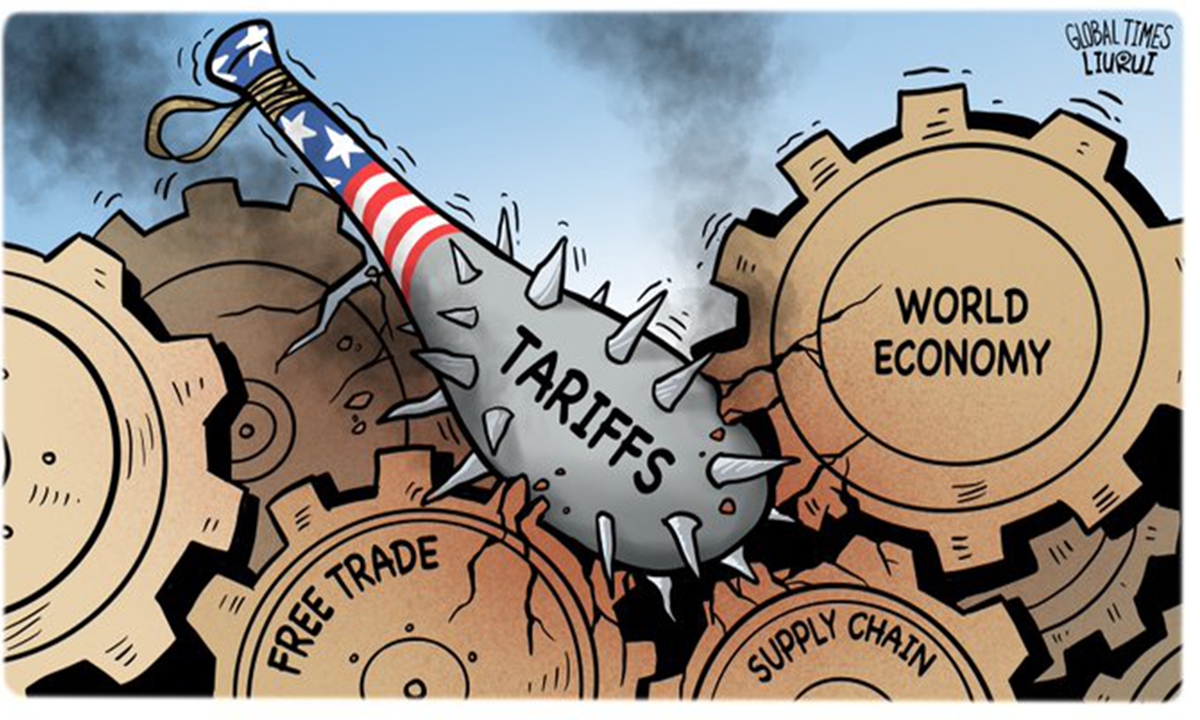
Currently, the new round of US tariffs facing many African countries is divided into four brackets - most countries face a 10-percent "baseline" tariff; more than 10 other African countries including Angola, Cameroon and Chad face 15 percent tariffs; Tunisia faces a 25 percent tariff; while South Africa, Algeria, and Libya bear the highest rate of 30 percent. Behind this differentiated tariff structure, the US pursues three strategic objectives.First, the US aspires to protect domestic manufacturing by imposing high tariffs specifically targeting Africa's competitive labor-intensive industries, such as textiles. Second, it seeks to control key resources by applying lower tariffs to resource-exporting countries, in order to facilitate US capital entry and access to African resources. Third, Washington exerts geopolitical pressure by using tariffs as a diplomatic tool to penalize countries whose foreign policy positions diverge from US interests.
African manufacturing is the sector most affected by US tariffs.
For example, Lesotho benefited from tariff exemptions under the African Growth and Opportunity Act (AGOA), exporting more than $237 million to the US in 2024. Under the new tariff regime, Lesotho's apparel exports face a 15-percent tariff, while Kenya, Eswatini, and Ethiopia, exporting similar products, face only 10 percent.
The 5 percentage point tariff difference has led some factories to consider layoffs or relocating production to other African countries. As a result, Lesotho's apparel sector has been severely hit, pushing the youth unemployment rate to 50 percent, and forcing the government to declare a two-year disaster state.
The US tariffs deliberately disrupt Africa's industrial chain integration. Under AGOA, African countries like Ethiopia, Kenya and Lesotho attempted to integrate the textile sector. The new US trade policy imposes high tariffs on finished apparel but maintains low rates on intermediate goods such as yarn and fabrics. This "differential treatment" may force African countries to abandon industrial integration, reverting to raw material suppliers.
While imposing high tariffs on African manufacturing, the US conveniently exempts crude oil by labeling it a "strategic" category. This means African oil-exporting countries can be "spared" from the US tariff war. These exemptions, while shielding these countries short-term, reinforce resource-dependent economic structures, suppress domestic manufacturing, and hinder diversification, deepening the so-called "resource curse."
Similarly, the US maintains very low tariffs on strategic minerals, including gold, platinum and manganese. Critical minerals are essential for industries like new-energy vehicles and chip manufacturing. Low tariffs minimize US import costs while allowing multinational corporations to control pricing.
The US also uses differentiated tariffs as a diplomatic tool. South Africa, the only African member of BRICS, has occasionally opposed US positions internationally, including advocating reduced reliance on the US dollar. While platinum is exempted, the average tariff on South Africa's exports rises to 30 percent, hitting key industries like automobiles and wine. In contrast, Morocco, cooperating closely with the US in security and trade, faces only 10 percent baseline tariffs on major exports. US Trade Representative Jamieson Greer insisted the US government has the authority to implement all manner of international tariffs - even when the duties have little to do with economics.
In the short term, these differentiated tariffs significantly harm African economies, while in the long term, they may: limit Africa's transition to manufacturing and high value-added industries, weaken its collective bargaining power in global trade; and complicate the creation of a unified African market.
However, Africa's total exports to the US in 2024 amounted to only $39.6 billion, or 5.8 percent of its total exports ($682 billion). By strengthening trade ties with China, the EU, and ASEAN, African countries could potentially mitigate the impact of US tariffs.
The author is the vice-dean of the Institute of African Studies at Hunan University. bizopinion@globaltimes.com.cn
RELATED ARTICLES