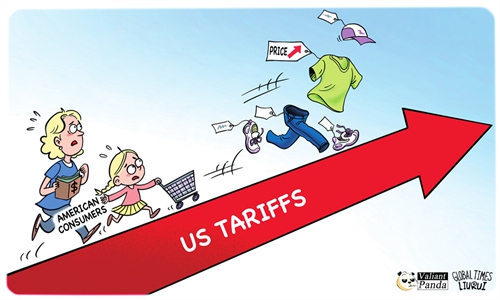
Report says one out of three US businesses planning to hike prices next year; unpredictable tariff policies weigh on business confidence, add inflation pressure: expert
By Published: Aug 19, 2025 06:47 PM

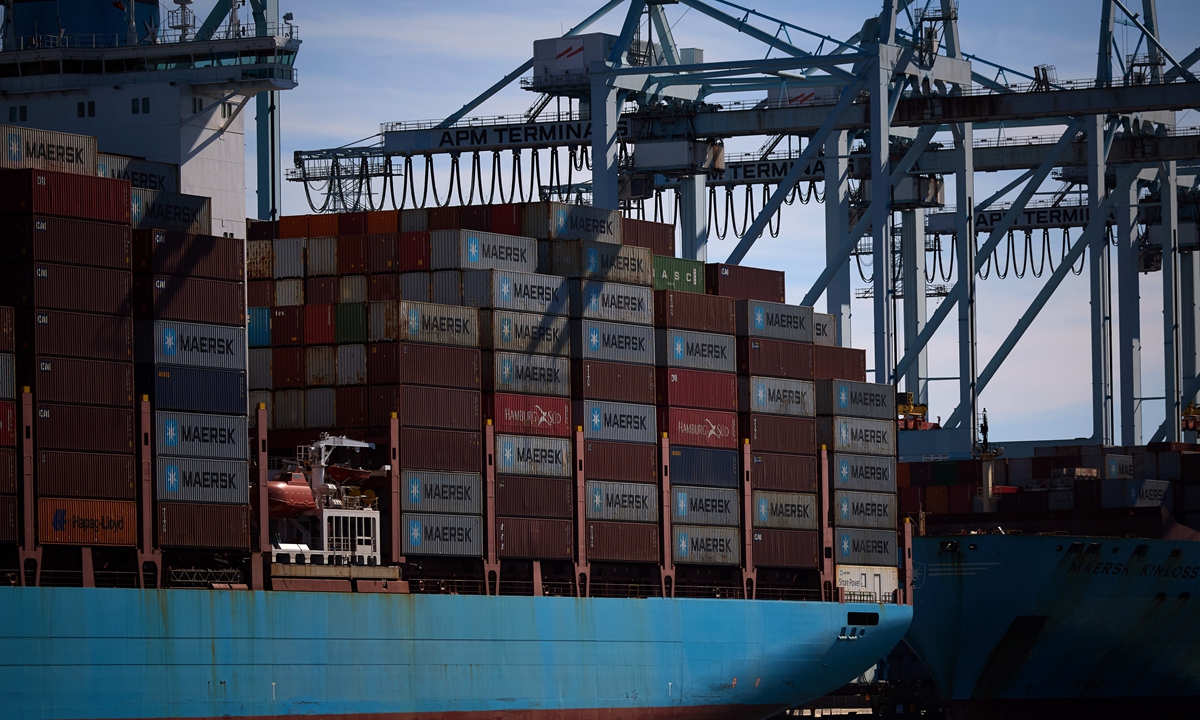
Shipping containers are loaded and unloaded onto ships at the Port of Los Angeles, California, on July 9, 2025. Photo: VCG
Nearly one in three US businesses said they expect to raise the prices they charged within six months, newsweek.com reported, citing latest findings from a new report from LendingTree, an online lending marketplace.
This reflects a growing willingness among US firms to pass higher input and import costs on to consumers, as shoppers already face high inflation, and new tariffs take effect, according to newsweek.com.
Chinese experts and US industry participants have highlighted the negative effects of the US administration's unpredictable tariff policies on business confidence and supply chain operations, warning of rising inflationary pressure.
A total of 30.9 percent of businesses anticipate charging more in the next six months as companies, large and small, are confronting rising supplier costs and new tariffs imposed by the US administration, newsweek.com reported, citing the LendingTree report.
The survey found US businesses are confronting two related pressures: rising costs for goods and services from suppliers and an uncertain tariff landscape that could increase duties on a broad range of imports, according to the report.
Only 4.3 percent of businesses anticipate lowering prices, and 64.8 percent expected no change, newsweek.com reported.
Last week, data from the US Bureau of Labor Statistics showed the Producer Price Index (PPI) for July rose 0.9 percent over the prior month, well above the 0.2 percent increase that was forecast.
On an annual basis, prices rose 3.3 percent, the most since February, while "core" producer prices, which exclude food, energy, and trade services, rose 0.6 percent last month, the most since March 2022.
Zhou Mi, a senior research fellow at the Chinese Academy of International Trade and Economic Cooperation, told the Global Times on Tuesday that during the second quarter, businesses expanded trade and increased inventory to adapt, but the structural shifts in supply and demand triggered by US tariffs will begin to demonstrate more clearly in the coming months.
In addition, repeated tariff adjustments make trading partners wary of doing business with the US, leading to potential import shortages and exacerbating inflationary pressures in the US, Zhou said.
Since late July, as the US administration modified rates for its so-called reciprocal tariffs, multiple US industry associations have voiced concerns about their impact.
"The on-again, off-again tariffs continue to cause confusion and uncertainty for importers, exporters and consumers. These fluid deadlines are not sustainable for business planning and operations," Jon Gold, vice president of supply chain and customs policy of the US National Retail Federation, told the Global Times in a statement over the weekend.
"Tariffs are creating serious headwinds for the toy industry and are disrupting the flow of toys into the US market ahead of the crucial holiday season," the US Toy Association said in a post on its website on August 12.
RELATED ARTICLES