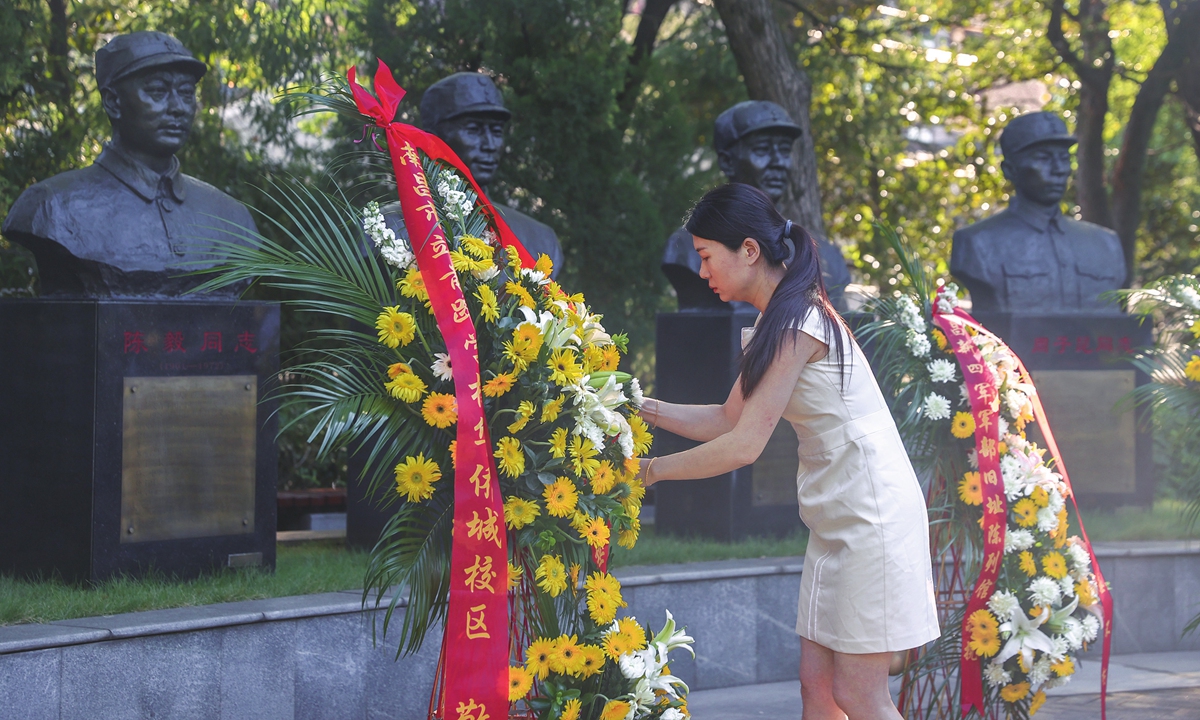
A student representative pays tribute to the revolutionary martyrs at the Former Site of Headquarters of the New Fourth Army in Nanchang, Jiangxi Province, on August 15, 2025. Photo: VCG
Editor's Note:
2025 marks the 80th anniversary of the victory in the Chinese People's War of Resistance against Japanese Aggression and the World Anti-Fascist War. Eight decades have passed, yet the world once again finds itself at a crossroads. The rise of unilateralism, ongoing geopolitical turbulence and the distortion of historical truths remind us of the enduring relevance of remembering the past and safeguarding peace. Against this backdrop, the Global Times launches the column "Revisiting WWII, Defending Peace," inviting renowned scholars and peace advocates from around the world to revisit the history of World War II (WWII) through contemporary lenses. Through diverse perspectives, the series seeks to uphold historical memory, promote shared development, and defend fairness and justice. Only by confronting history with honesty and clarity can humanity find the wisdom to shape a more peaceful and sustainable future. This is the ninth installment of this series.
On August 15, commemorations of the 80th anniversary of Japan's surrender and the end of WWII took place in many countries.There have been many other disastrous wars since 1945; yet, WWII has a stronger hold on our minds and figures more prominently in public memory than any of these. Why?
One reason is that WWII was the deadliest armed conflict in human history, claiming between 70 million and 85 million lives, approximately 3 percent of the world's population at the time. These numbers are staggering. This alone bestows upon us the duty to mourn the dead from all sides.
I was born in the Netherlands in 1958. When I was growing up, the Dutch hatred for the Germans ran deep. However, Dutch attitudes began to change after a speech by Germany's president, Richard von Weizsäcker, at the 40th anniversary of Germany's surrender. He remarked that all Germans would forever remain liable for Germany's past. He also stated, "the vast majority of today's population were either children then or had not been born. They cannot profess a guilt of their own for crimes that they did not commit. No discerning person can expect them to wear a penitential robe simply because they are Germans. But their forefathers have left them a grave legacy. All of us, whether guilty or not, whether old or young, must accept the past. We are all affected by its consequences and liable for it." In that spirit, on August 15, I also commemorated Germany's losses.
Another reason WWII continues to have such a tight grip on our minds is that it gave rise to the world's current geopolitical architecture. This structure was built by the victors, primarily the US, the UK, the Soviet Union, and, importantly, China. Those with the most power did the most to shape it. They, especially then US president Franklin D. Roosevelt, who had the most influence over its design, were also determined that the new post-war order should prevent a third world war. So far, that has been the case. Long may it last.
A third reason that explains why WWII dominates our minds is that numerous films, books, museums and monuments remind us of it almost daily. In the Netherlands, films continue to dissect the Dutch experience of WWII, including the general Dutch failure to aid its Jewish population, the betrayals of neighbors and black market exploitation. Similarly, films related to the war are ubiquitous in China. WWII continues to shape our national identities and influence our moral values.
It is only natural that each country commemorates WWII in its own way. The overarching narrative of WWII is that it was a battle against German fascism and Japanese aggression. At the same time, it played out differently in various regions of the world, in each country, and in each locality. In Asia, for instance, WWII was also a war to break free from European imperialism. Asia's nation states of today, such as India, the Philippines, Indonesia, North Korea and South Korea - trace their origins to WWII.
At Peking University, I teach a graduate course on WWII across Asia. My students are particularly interested in China's role in the war and read eagerly the excellent books written by Chinese scholars from the 1980s about China's War of Resistance against Japanese Aggression. These scholars have demonstrated that many Chinese, regardless of their background, participated in the war. Their works have made clear that many of the differences that divided China before the war were set aside during it. While little was known about Japan's atrocities in China before the 1980s, these events have now been thoroughly documented, as they should be.
In my course, we examine closely how WWII played out in India and Indonesia. Before taking my course, very few students had learned about the experiences of these countries during WWII, but they found their histories fascinating. The students of today are more globally aware, and that is a good thing. Now that China is a world power, it is essential for students to learn not just about China and the US, but also about other countries. Our teaching must evolve as our students develop new perspectives on life.
Compared to the world during WWII, we live in very different times. It is true that many inventions or their widespread applications, such as the computer, nuclear power, penicillin, radar, the jet engine, synthetic rubber and plastics, date back to WWII. However, much has changed. Currently, the most pressing issues in the world - environmental pollution, deepening popular anger arising from increasing economic inequalities, pandemics, rapidly aging populations and shifting great power relations - are very different from those that confronted the world back then. We have new tools, such as AI, to tackle these challenges. The world has moved on; so must we.
Nonetheless, some of the WWII lessons remain valuable. US politician Wendell Willkie is now a forgotten figure, but he was famous during WWII. To shape the post-war institutions of international governance, he became one of the lead exponents of the one-world idea.
Willkie died in 1944 and therefore had little influence over the construction of the post-war order. Even if that order has served us well enough, we now seem to have arrived at another inflection point. If that is the case, it is well worth recalling Willkie's counsel that the interest of all - large and small, the same and different, the important and the unimportant - must be looked after with due respect and humility, especially by the powerful.
The author is a professor of modern Chinese history at Cambridge University and a visiting chair professor at Peking University. opinion@globaltimes.com.cn
RELATED ARTICLES