Chinese researchers develop stiffness-tunable ‘Neurotentacle’ probe for brain-computer interface implantation
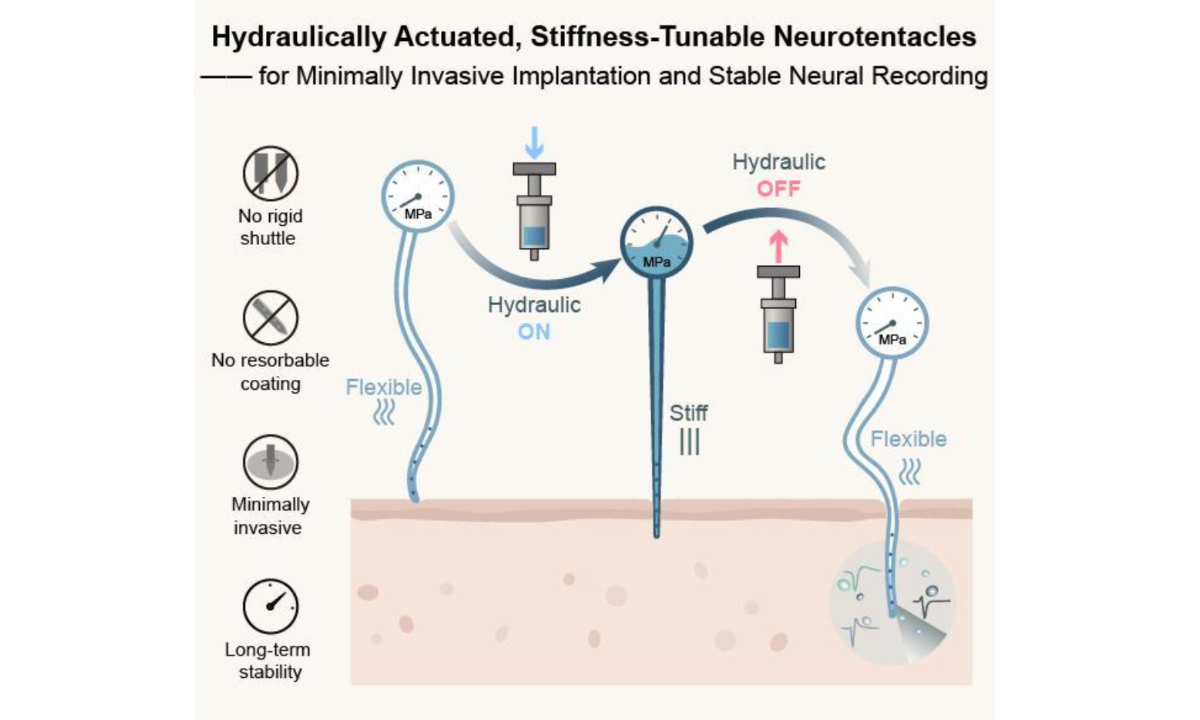
Illustration of the stiffness-tunable "Neurotentacle" probe Photo: From Advanced Science
Chinese researchers have made significant progress in developing flexible invasive brain-computer interface implants, creating a stiffness-tunable "Neurotentacle" probe that can reduce implantation damage by 74 percent, Science and Technology Daily reported Tuesday.
The "Neurotentacle" probe developed by researchers at the Institute of Semiconductors, Chinese Academy of Sciences (CAS), contains a tiny hydraulic system. During the implantation, the hydraulically actuated "Neurotentacle" probe stiffens like an inflated balloon to precisely penetrate brain tissue. Once it is in place, it softens afterward to minimize damage and returns to a flexible state to adapt to the brain's microenvironment, said the report.
The findings were published online in the international journal Advanced Science on July 21.
With the rapid development of brain-computer interfaces and neuroscience, flexible neural microelectrodes are considered an ideal approach for achieving long-term, stable neural signal acquisition, thanks to their excellent biocompatibility which reduces the immune responses in brain tissue and extends the in vivo longevity of the device.
Compared with traditional rigid electrodes, the flexible probe significantly reduces physical damage to brain tissue during insertion, suppresses post-implantation inflammatory responses, and extend their stable functioning time in the body, demonstrating strong application potential, according to the report.
However, according to Pei Weihua, a researcher at the Institute of Semiconductors and co-author of the research paper, because of the excessive softness of the material, it is very difficult for the flexible neural microelectrodes to penetrate dense brain tissue and reach the target area without external rigid support. This challenge has become the core bottleneck preventing flexible neural microelectrodes from practical application, Pei told the Global Times on Thursday.
To address this challenge, researchers developed the new type of probe called the "Neurotentacles" that stiffens during insertion to penetrate tissue and softens afterward to minimize damage and enable stable, long-term recordings. The design achieves two goals: minimizing implantation damage and enabling long-term, stable, high-quality neural recordings, according to Wang Yang, co-first author of the research paper and researcher at the Institute of Semiconductors.
A team led by Liang Jing, a fellow researcher at the Institute of Psychology, CAS, and the co-author of the research paper, validated the "Neurotentacle" probe in animal experiments.
The results showed that, compared with traditional microneedle-guided implantation methods, the "Neurotentacle" probe reduced implantation-induced damage by more than 74 percent and alleviated subsequent chronic inflammation by about 40 percent.
In addition, in long-term mouse experiments, the new probe consistently recorded clear and stable neural signals, with both the number and quality of captured effective neuronal signals surpassing those of conventional flexible electrodes, Liang said.
According to Pei, the "Neurotentacle" probe technology can effectively realize long-term neural recording with flexible neural microelectrodes, providing a powerful new tool for studying brain regions and neural circuits. This achievement marks a key step toward the practical use of flexible microelectrodes and provides an innovative pathway for the next generation of minimally invasive neural interface technologies.
RELATED ARTICLES