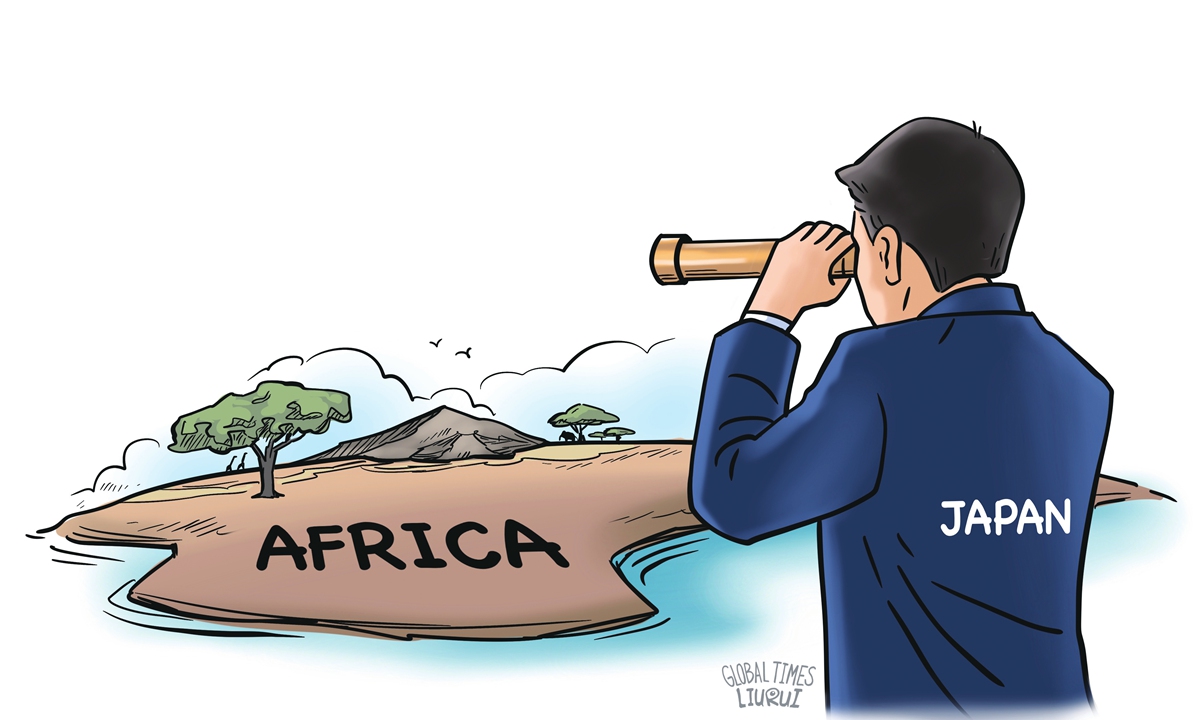
Illustration: Liu Rui/GT
The three-day Ninth Tokyo International Conference on African Development (TICAD 9) concluded recently in Yokohama, Japan, with the adoption of the TICAD 9 Yokohama Declaration 2025, which aims to strengthen multilateral trade with Africa. Representatives from 49 African countries attended this year's TICAD, an event that takes place every three years.
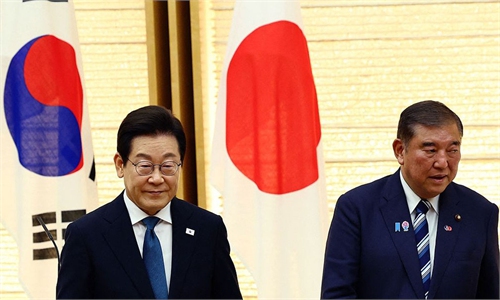
In his address to the opening ceremony on Wednesday, Japanese Prime Minister Shigeru Ishiba proposed several initiatives to enhance cooperation with Africa and support the continent's development. He also announced that more than 300 cooperation documents had been signed between Japan and African countries in various fields. It seems that Japan's diplomatic and economic engagement with Africa has accelerated rapidly.
It is worth noting, however, that much of the Japanese media coverage deliberately linked Tokyo's move to Beijing. When reporting the TICAD 9 Yokohama Declaration 2025, the Japan Times claimed that the "deep concern" over "the significant increase in Africa's total debt stocks over the past decade" mentioned in the declaration was made "in consideration of China's 'debt trap' strategy of increasing its influence by saddling developing countries with huge debts." On Wednesday, Kyodo News reported that Ishiba's plan seeks to "tap into the economic potential of a continent where China is increasing its clout." All these reveal the underlying anxiety of Tokyo and adversarial mind-set of some Japanese media.
On one hand, despite nine rounds of TICAD and many more efforts pledging to assist Africa's development, Japan's trade and investment with the continent have hardly grown. Japan's trade with Africa stood at around $24 billion in the early 2020s. In 2024, Africa accounted for only 0.5 percent of Japan's foreign direct investment by value, according to the Japanese Ministry of Finance. At the same time, China's trade with Africa approached $300 billion in 2024 -- It is estimated by the Hinrich Foundation that Africa accounts for about 15 percent of the value that China has invested.
China's clear lead in cooperation with Africa has heightened the anxiety of some forces in Japan about their country's presence and influence on the continent.
On the other hand, China's cooperation with Africa under the China-proposed Belt and Road Initiative has yielded significant results, and the concept of a global community of shared future has found resonance among African countries.
Japan, by contrast, has made little headway in recent years, with few major projects to showcase. Instead of reflecting on its own shortcomings - such as a condescending approach, neglect of African priorities and a narrow focus on "resource diplomacy" - Japan has increasingly pointed to China's growing economic, cultural and diplomatic influence in Africa. The portrayal of China as Japan's "imaginary rival" has become more open.
As early as TICAD VI held in Kenya in 2016, then Japanese prime minister Shinzo Abe inserted the concept of a "Free and Open Indo-Pacific" into his keynote speech, clearly signaling Japan's intent to use Africa as leverage against the Belt and Road Initiative.
It should be noted that anxiety and a confrontational mind-set from Japan over Africa are not new. Since TICAD I in 1993, debates have persisted over how to define Japan's role in African development and how to respond to competition with China. While Japan has often highlighted "technology transfer" and "talent training" as means to assist Africa's development, its Africa diplomacy has always been entangled with geopolitical competition and containment, having treated China as a competitor in expanding its Africa ties. In recent years, this has escalated to treating China as an outright "imaginary rival."
In fact, Japan does not need to use other countries as a foil in order to expand its cooperation with Africa. What Japan should pursue is the true path of partnership: mutual respect, fairness and justice, healthy competition and win-win cooperation. It should reflect on several points.
First, treat Africa as a "genuine partner," not as a backdrop for rivalry with China. Labeling China as an "imaginary rival" undermines the legitimacy of Japan's Africa strategy, something that African countries themselves have rejected. Many African leaders have pointed out that Africa does not lack international conferences; it lacks implementation.
Second, see Africa's development as "an opportunity for Japan itself," not as a stage for hyping the "China threat." Some voices in Japan have repeatedly exaggerated claims of "debt traps" from Chinese investment. However, many voices from Africa have debunked the "debt trap" narrative, and officials from African countries noted that the continent needs complementarity between China and Japan, "not confrontation."
Third, showing Africa "sincerity and action," rather than making loud promises that result in little substance. While covering TICAD 9, Japanese media themselves emphasized that Japan's "sincerity" is the key to success "against China's growing presence." Ironically, this underscores only the lack of genuine sincerity in Japan's engagement with Africa to date.
The author is research fellow at the Institute of Northeast Asian Studies at Heilongjiang Provincial Academy of Social Sciences and expert of Research Center of Revitalization of Northeast China. opinion@globaltimes.com.cn
RELATED ARTICLES