Illustration: Xia Qing/GT
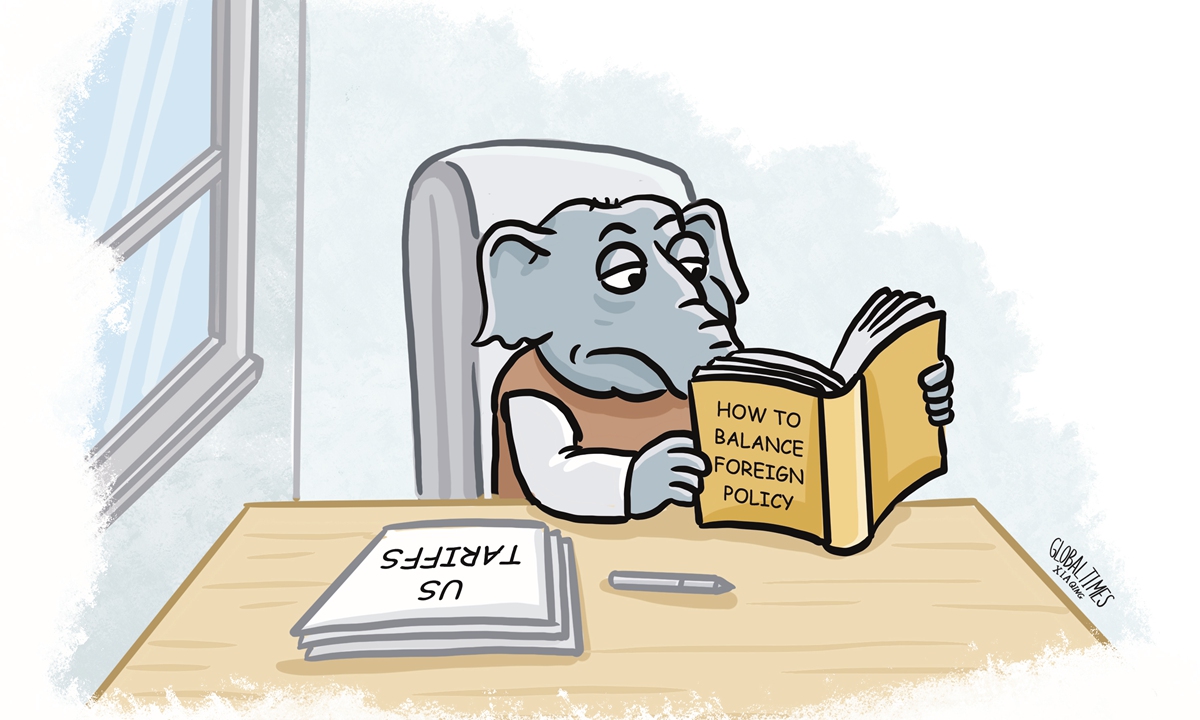
India is set to host the Quad Security Dialogue this year. However, after multiple rounds of tariff negotiations, the US and India still failed to reach a trade agreement. US' tariff pressure has severely undermined India's enthusiasm and trust in participating in the Quad, an informal strategic forum comprising India, Japan, Australia and the US. India needs a more balanced foreign policy.
On top of pressuring India to halt its imports of Russian crude oil - a demand New Delhi rejected - US President Donald Trump announced that, starting August 6, the US would impose an additional 25 percent punitive tariff on Indian goods. Combined with the existing 25 percent base tariff, Indian exports to the US now face duties of up to 50 percent, effectively shutting out the majority of Indian exports. The US also canceled the tariff negotiations originally scheduled for late August.
On Tuesday, US Treasury Secretary Scott Bessent told CNBC that India was "profiteering" during the Russia-Ukraine conflict by dramatically increasing its purchases of Russian oil, condemning the situation "unacceptable" to Washington. In response, India said it would neither open its agricultural market nor stop importing Russian oil. Indian Prime Minister Narendra Modi insisted that India would become the world's third-largest economy, and urged citizens to buy and promote domestic products. US measures have sent shockwaves through Indian society, shattering the illusion of an unshakable US-India alliance.
In recent years, India had pivoted away from its traditional policy of diplomatic balance, moving closer to Washington by actively participating in the Quad and supporting the US' "Indo-Pacific Strategy." However, US' attitude toward India shifted dramatically. Washington's goal is to bring manufacturing back to the US, not to shift it to India. The US does not want India to become the next China; India cannot be considered a "natural ally."
In the wake of the tariff disputes, some international media have reported that Trump might cancel his visit to India for the meeting, while media speculated that India could delay or downscale the event to avoid direct confrontation with the Trump administration.
In fact, after the US announced a 25 percent tariff on Indian goods, India has already made a series of diplomatic adjustments. However, this does not signal a major shift in Indian diplomacy, but rather a tactical adjustment. India will not completely abandon the Quad mechanism. Pro-American forces in India remain strong, and India has not given up on its expectations regarding the US. Economic and trade frictions are only one aspect of the US-India relationship. Both countries still share common interests in countering China within the "Indo-Pacific Strategy," and military cooperation between them will continue. The US strategic community still values India's geopolitical significance.
However, US' tariff pressure has severely undermined India's enthusiasm and trust in participating in the Quad. India has realized that cooperating with the US to foster division and confrontation in the Asia-Pacific region does not yield economic returns. India may use its role as the Quad host to reduce the exclusivity and confrontational nature of the group, returning to the positioning Modi articulated at the 2018 Shangri-La Dialogue in Singapore: That India "does not see the Indo-Pacific region as a strategy or as a club of limited members, nor as a grouping that seeks to dominate. And by no means do we consider it as directed against any country. A geographical definition, as such, cannot be."
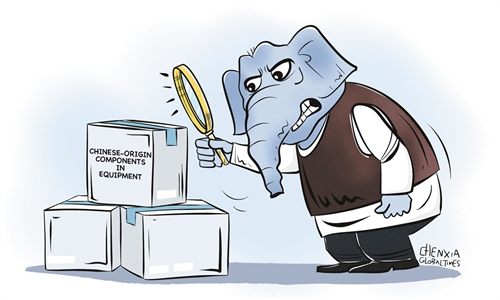
The Quad's economic cooperation agenda can be expanded while downplaying its military aspect. US' high tariffs will heavily impact India's economic development, not only reducing foreign manufacturing relocation to India but potentially causing Indian manufacturing to move elsewhere. India must therefore seek alternative markets outside the US. The Quad, with its commitment to "free and open," provides a framework for India to emphasize economic cooperation in the Asia-Pacific. India should first strengthen cooperation with the other two Quad members - Japan and Australia - Prime Minister Modi's lately August visit to Japan reflects this intention. Second, India should enhance trade and economic ties with ASEAN and China to offset the losses from US trade restrictions. Indian manufacturing, in particular, remains heavily dependent on China's supply chains.
The Modi government follows a "multi-alignment" diplomatic strategy: Cooperating with the US and the West through mechanisms like the Quad, while engaging emerging powers such as China and Russia through BRICS and Shanghai Cooperation Organisation (SCO). However, in recent years, India has leaned noticeably toward the US and the West, losing diplomatic balance. Now, India needs a more balanced foreign policy. Countries like Brazil and China, which are key BRICS members, oppose US tariff bullying. Only by developing BRICS and SCO cooperation can India enhance its strategic position, create more options and strengthen its bargaining power in negotiations with the US.
The author is a professor from the School of International Relations at Sichuan International Studies University. opinion@globaltimes.com.cn
RELATED ARTICLES