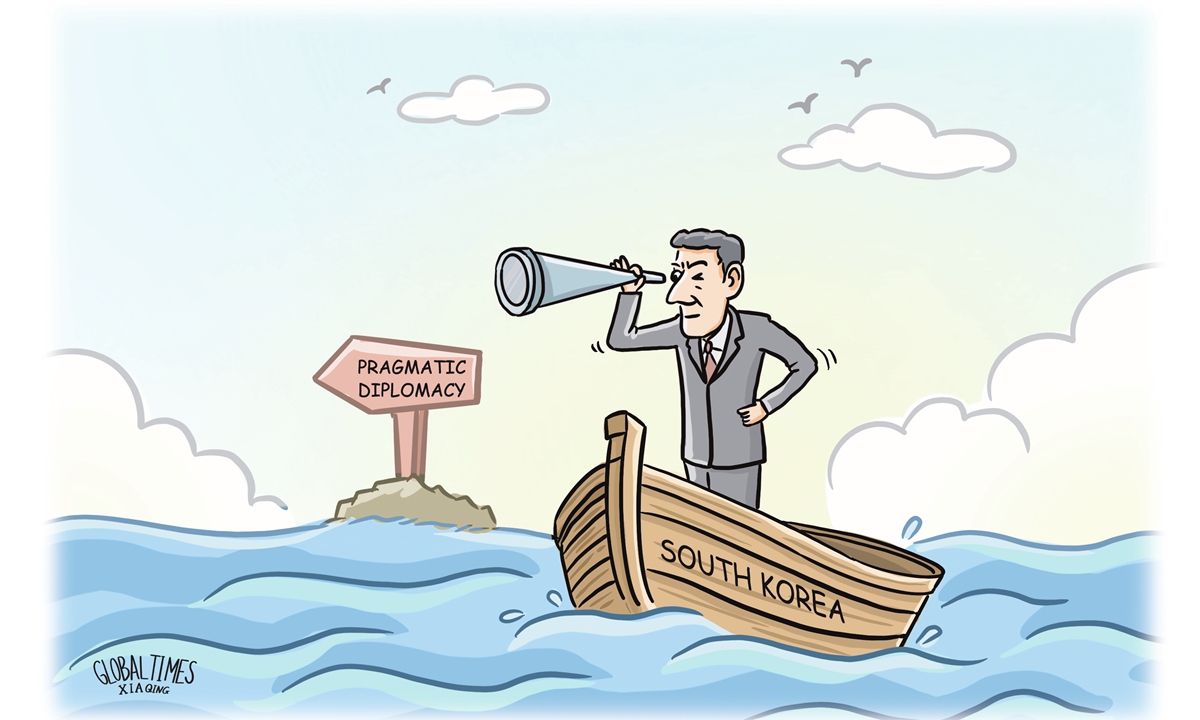
Illustration: Xia Qing/GT
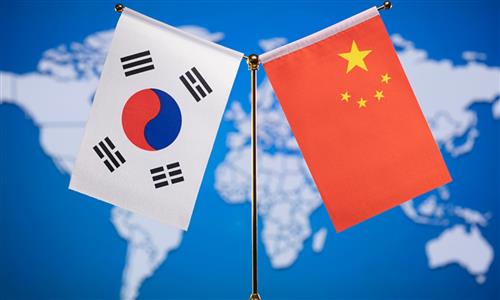
Sunday marks the 33rd anniversary of the establishment of diplomatic relations between China and the Republic of Korea (ROK). President of ROK Lee Jae-myung is carrying out the most important diplomatic initiative since taking office - dispatching a special delegation to China while visiting Japan and the US. Lee's administration seeks to maintain sound relations with China, the US and Japan at the same time, in line with its "pragmatic" foreign policy.
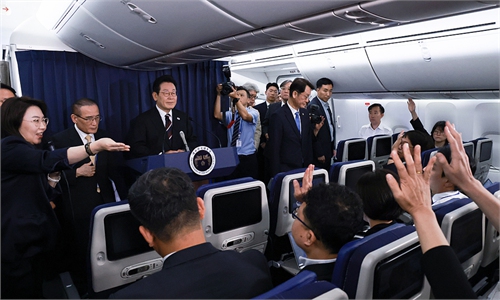
Lee dispatched a special delegation to China and delivered a letter to Chinese leader, as he embarked on his first trip to Japan and the US. This balancing act underscores the essence of Lee's "pragmatic" diplomacy - seeking maneuverability among major powers while avoiding the pitfall of "choosing sides." This stands in contrast with former president Yoon Suk-yeol's "values-based diplomacy" that tilted heavily toward Washington.
The dispatch of this envoy represents the Lee administration's first major diplomatic gesture toward China since taking office. The delegation is led by former National Assembly speaker Park Byeong-seug, along with Roh Jae-heon, son of former President Roh Tae-woo, who normalized relations with Beijing in 1992. Park has long promoted parliamentary exchanges with China, while Roh has focused on East Asian cultural cooperation. Through this lineup, Seoul intends to convey to Beijing both respect for historical bonds and commitment to present-day cooperation.
Nonetheless, Lee's balancing act faces significant risks. In the industrial and technology sectors, US "decoupling" pressures on China have left Korean investment in China hesitant, raising concerns over a potential contraction in bilateral economic cooperation. On the geopolitical front, US demands to extend the alliance's scope to the Taiwan Straits and the South China Sea risk drawing the ROK into regional conflicts. These factors constitute the main external variables shaping the future of China-ROK relations.
To South Korea, relying solely on the "tightrope-walking" balancing act between China and the US is likely not a sustainable long-term strategy. Seoul must fundamentally reassess the significance of its relationship with China and - guided by strategic, long-term thinking and a strong sense of autonomy - uphold the foundation of mutual trust and cooperation between China and South Korea.
Diplomatic ties between China and South Korea are a significant event in post-Cold War international relations. Today, the two countries have built a "strategic cooperative partnership." For many years, China has been South Korea's largest trading partner - a testament to the substantial development of China-South Korea relations. However, external factors have disrupted this progress in recent years. South Korea, disregarding strong opposition from China, insisted on allowing the US to deploy the Terminal High-Altitude Area Defense system on its territory, significantly undermining China's security interests. The administration of former South Korean president Yoon Suk-yeol followed the US' strategy of containing China, causing bilateral relations to plunge to a low point.
With the progressive faction returning to power in South Korea, under Lee's leadership, Seoul should seize this opportunity to steer bilateral ties back onto a path of robust and stable development.
Economically, China and South Korea need to forge a shared consensus that "turns competition into cooperation." Both countries should join forces to advance the establishment of a China-Japan-South Korea Free Trade Area and elevate the quality of the Regional Comprehensive Economic Partnership (RCEP), jointly resisting the headwind of rising US protectionism.
Culturally, China and South Korea ought to intensify cultural exchange and mutual learning. While China has already implemented visa-waiver policies for South Korean citizens coming to China for short-term stays, South Korea should reciprocate by easing visa restrictions for Chinese visitors. With Chinese tourists returning to South Korea, one can expect a strong boost to the South Korean consumer services sector.
Of course, Lee faces significant internal and external constraints in his efforts to improve relations with China. First, South Korea needs to demonstrate strategic autonomy, especially by remaining restrained on geopolitical issues like the Taiwan Straits and the South China Sea, and by genuinely respecting China's sovereignty and security interests. Second, the Lee administration must firmly resist domestic far-right anti-China agitators and steer South Korean public opinion toward a comprehensive, objective and rational understanding of China's development.
During his meeting with Park on Sunday, Chinese Foreign Minister Wang Yi said both sides should adhere to the original intention of establishing diplomatic relations and promote the steady and long-term development of bilateral relations in the right track. The direction of China-South Korea relations will serve as a litmus test for the effectiveness of Lee's "pragmatic diplomacy." China hopes South Korea will make wise strategic choices.
The author is a distinguished research fellow at the Department for Asia-Pacific Studies of the China Institute of International Studies. opinion@globaltimes.com.cn
RELATED ARTICLES