Japan’s ‘victimhood nationalism’ a barrier to historical reconciliation in East Asia
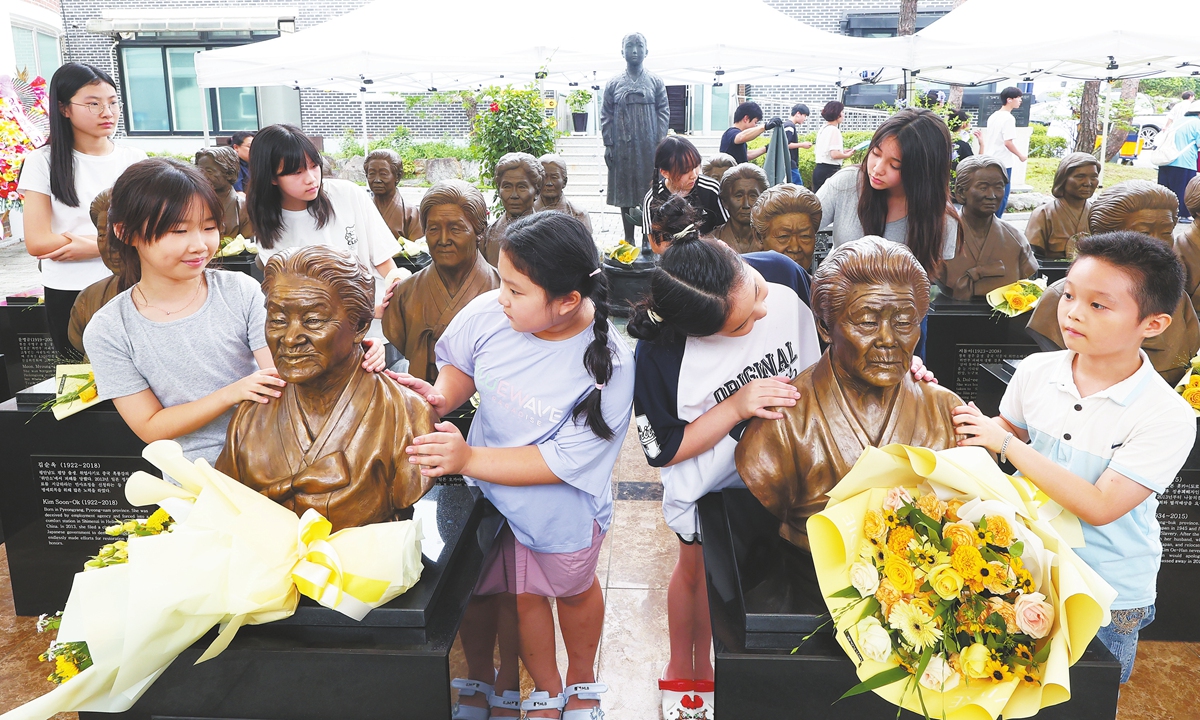
Children look at busts of "comfort women" at a memorial ceremony for victims of Japan's wartime enslavement in Gwangju, South Korea on August 9, 2025. Photo: VCG
Editor's Note:
2025 marks the 80th anniversary of the victory in the Chinese People's War of Resistance against Japanese Aggression and the World Anti-Fascist War. Eight decades have passed, yet the world once again finds itself at a crossroads. The rise of unilateralism, ongoing geopolitical turbulence and the distortion of historical truths remind us of the enduring relevance of remembering the past and safeguarding peace. Against this backdrop, the Global Times launches the column "Revisiting WWII, Defending Peace," inviting renowned scholars and peace advocates from around the world to revisit the history of WWII through contemporary lenses. Through diverse perspectives, the series seeks to uphold historical memory, promote shared development and defend fairness and justice. Only by confronting history with honesty and clarity can humanity find the wisdom to shape a more peaceful and sustainable future.
In the 10th installment of this series, Global Times (GT) reporter Xia Wenxin spoke with Lim Jie-hyun (Lim), South Korean historian and professor of Transnational History and director of the Critical Global Studies Institute at Sogang University, Seoul, about his studies on WWII history and reasons behind Japan's reluctance to truly reflect on its WWII crimes, among other topics.
GT: What is the significance of the victory in the World Anti-Fascist War for today's global peace and international order?
Lim: Did the victory of the Allied Powers over the Axis Powers of fascism bring an end to fascism? Yes and No. Yes, the Allied Powers and the global democratic wing had won WWII. Undeniably, our victory brought an end to historical Fascism, Nazism and Japanese imperialism. Unfortunately, we are seeing now that they are not dead. As a witness to the contemporary political upheaval, I cannot help but feel that we are returning to the fascist era of the 1930s. The widespread neo-populism, beyond the boundary of the West and East, prompts us to rethink, reevaluate and reformulate the historical significance of the victory of the Anti-Fascist War. Did we really win? Doesn't today's global neo-populism imply Hitler's and Mussolini's posthumous victory? Did we win the anti-Fascist war in the deepest sense? The global democratic wing won the war, but it signified only the political and military victory. WWII was the "war of position" against fascism in Italian politician Antonio Gramsci's terms - a war which, in many ways, has not yet ended. We do not simply live in a "postwar" era but in a "transwar" period, where the struggle against these lingering forces continues. The true end of the long WWII can be registered only with the defeat of the global neo-populist regime.
GT: In East Asia, both Chinese and Korean people are victims of Japanese aggression during WWII. Looking back on that chapter of history, what does victory against Japanese aggression mean for our two nations?
Lim: Yes, both Chinese and Korean people were victims of Japanese imperialism, yet they also became victors of WWII. China, as an Allied Power, and Korea, as a consequential victor, a nation liberated by the Allied victory, share this dual legacy. The official narrative celebrates the triumph of democracy over fascism, of the colonized over their colonizers, of the oppressed over their oppressors. Victims of the fascist atrocities and colonial domination won the war and shattered the fascist and imperialist world order. Still, we, the victims, did not change the rules of the game that dominated international politics. Victims and perpetrators have played by the same rules from opposite ends of the table. I believe the "long WWII" will not truly end until these rules are overturned.
GT: How much do South Koreans know about WWII history? How do they see China's role in it, in particular, the fight against Japanese aggression?
Lim: Today, South Koreans' understanding of WWII is often shaped by Eurocentric or ego-centric perspectives, with figures like Churchill, Roosevelt and Stalin more prominently remembered than Asian leaders such as Chairman Mao or Generalissimo Chiang. Chinese contributions - despite enormous suffering and pivotal sacrifice during the Asia-Pacific War - are frequently overlooked. Although the Nanjing Massacre is often recalled as a cross-reference to evoke the suffering of the Koreans, China remains a "forgotten ally."
This selective memory is not a Korean peculiarity. The Eurocentric remembrance of WWII influences the memory space of Global Asia. For example, Jewish rescuers, including Chiune Sugihara and Ho Feng-Shan, are widely celebrated, while many Asian rescuers who protected others are forgotten. On the opposite side, John Rabe is remembered as the "Oskar Schindler of China," saving the Chinese during the Nanjing Massacre. Where are all the Korean and Japanese international socialists who joined the Chinese anti-imperialist struggle? The challenge, then, lies in confronting and transcending this Eurocentric memory culture to create a more transformative and multidirectional remembrance of the past in the Asian memory space.
GT: We know that for South Korea, the disputes regarding WWII history have become one of the main obstacles in promoting its ties with Japan. What is your take on the attitude of Japanese authorities and society toward these historical issues? Do you expect their attitude to change anytime soon?
Lim: One of the most distinctive obstacles to historical reconciliation in East Asia is the phenomenon of victimhood nationalism in Japan. Japanese narratives often focus on their own national suffering - atomic bombings, Allied bombings, Japanese prisoners of war in Siberia, hikiage [literally, "repatriation," referring to the forced migrations of Japanese citizens from former colonies and overseas territories after WWII] - thereby recasting perpetrators and accomplices as victims at the close of the war.
The "the only country to have suffered from atomic bombings during war" narrative, for instance, operated as a screen memory to obscure the Japanese war atrocities toward neighboring Asians. Right-wing Japanese nationalists sometimes equate Japanese and Jewish suffering as the arch victims of white racist supremacy. In their remembrance, the A-bombing is paired with the Holocaust. They extend the narrative of victimization back to the forced opening of Japan by US Commodore Matthew Perry in 1853. "Hundred Years War" has been the buzzword among those conservative anti-Western nationalists. They stressed the Japanese-American conflict over the hegemony of the Pacific from 1853 to the present postwar era. In what world should victims apologize to their perpetrators? Japanese politicians apologized to China and Korea several times, but the authenticity of past official apologies is often questioned due to conflicting voices on the political stage and historical denialism.
The recent emergence of the rightist party Sanseito and its aggressive memory politics further narrow the path to reconciliation. The rightist turn of Japanese politics and its postcolonial melancholia are not fearful, but deplorable. As perceptions of being "surpassed" by Korea and China grow, so too does Japan's postcolonial melancholia, casting a shadow over prospects for transnational cooperation in the region. The prospects for transnational cooperation among East Asian countries look gloomier.
GT: In April, you released a book titled Victimhood Nationalism: History and Memory in a Global Age. What does the book focus on? What is "victimhood nationalism"?
Lim: My definition of "victimhood nationalism" is a narrative template to grant moral superiority and political legitimacy to a present nation of "hereditary victimhood," which inherits the legacy of ancestral victimhood in history and memory. The book highlights two central points: Firstly, the nationalist discourse has been shifting from heroes to victimhood with the globalization of memory. As victims bear the moral asset of nationalism, victimhood competition has drifted to the distasteful competition over whose nation suffered the most. Secondly, investigating the history and memory of victimhood nationalism globally, the book challenges the narrative template of victimhood nationalism that dominates the collective memory here and there. The ultimate goal is to rescue the global and national memory regimes from the nationalist competition and to promote mnemonic solidarity and history reconciliation by sacrificing victimhood nationalism globally.
GT: You recently conducted a field trip to war memorials in Europe. Could you please share your observations and findings during this trip?
Lim: A central issue currently debated in the European memory space is the postcolonial reflection on the Holocaust. Voices demanding a critical gaze at mnemonic Eurocentrism grow. The Gaza war illustrates the perils of victimhood nationalism. As sociologist Zygmunt Bauman insightfully observed, the critical lesson of the Holocaust is not the fear that such horrors may be done to us again, but the recognition that we, too, could commit them.
RELATED ARTICLES