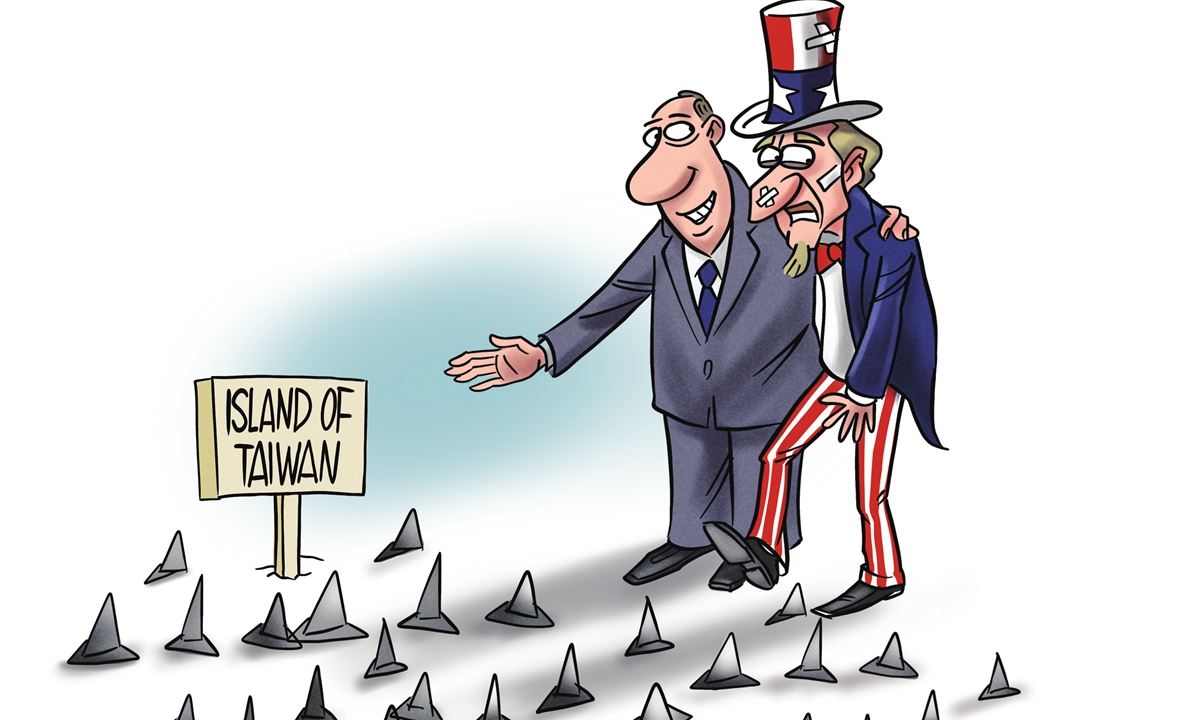
Illustration: Xia Qing/GT
Recently, the Taiwan authorities have stepped up their lobbying efforts in the US. The heads of the "defense" and "national security" departments are planning to visit the US and hold a "defense policy dialogue" with US officials. This will be the first time in recent years that such a high-level military policy dialogue will take place between the US and Taiwan authorities, fully exposing the Taiwan authorities' sinister scheme of "seeking 'Taiwan independence' by relying on the US" and "resisting reunification by force."
Since taking office, Lai Ching-te has repeatedly hyped up a so-called new "two states" theory on the island, incited the narrative of "resisting China to protect Taiwan," and escalated the promotion of "Taiwan independence" fallacies. His actions have deepened social divisions on the island, suppressed cross-Straits exchanges and cooperation, stoked confrontation between the two sides of the Straits, and undermined peace and stability in the Straits. These moves, driven solely by political self-interest and showing disregard for people's livelihoods, run counter to public opinion and lack popular support. They have drawn widespread condemnation from people on both sides of the Straits. The Democratic Progressive Party (DPP) authorities recently suffered a crushing defeat in two rounds of recall votes, further underscoring the indisputable fact that the DPP authorities have already lost the support of the public on the island.
After suffering a series of defeats, the Lai Ching-te authorities are now attempting to persuade the US to recognize its so-called role in "containing China," with the intention of relying on US backing to take reckless steps to promote "Taiwan independence." By dispatching relevant personnel to the US, the DPP authorities aim to push forward arms procurement projects, encourage Washington to continue supplying more advanced weaponry, and express their intent to expand purchases of sophisticated ships and aircraft. Moreover, the DPP authorities are lobbying the US to refine its "support Taiwan" military strategy, promote more cooperation in military training, and push for the transfer of critical military technologies and joint production of certain advanced components to the island. Through such efforts to further intertwine military-industrial interests, the Taiwan authorities are trying to bind the US even tighter to the "Taiwan independence" chariot.
The US must recognize the utmost importance of the Taiwan question in China-US relations. The one-China principle and the three Sino-US Joint Communiques were, are, and will remain the political foundation for stable relations between the two countries. Any attempt to undermine them will cause severe turbulence in bilateral ties. Without a stable, healthy and sustainable China-US relationship, the goal of "making America great again" will be nothing but an illusion, forever out of reach.
China and the US are economically interdependent, and they face a strong urgency to cooperate in addressing regional and global challenges. Addressing core issues of concern to Washington, such as drug control and trade, requires cooperation with China, and the one-China principle is the prerequisite for all cooperation.
It is clear to any keen observer that the current US government is neither satisfied with nor willing to support certain extreme practices of the DPP authorities. Fearing being treated as a "disposable pawn," the DPP authorities are continuously intensifying their lobbying in the US, seeking to collude with certain "pro-Taiwan independence forces" in the US, hyping China-US confrontation, and stoking cross-Straits tensions, in an attempt to elevate the Taiwan question onto Washington's core agenda - a continuation of their despicable scheme of relying on the US to pursue "independence."
The Lai Ching-te authorities are obsessed with provoking China-US confrontation in order to carve out space for pursuing "independence." By stepping up military and strategic coordination with the US, they seek to provoke tensions between China and the US and create a "security shield" for advancing their secessionist agenda. Such a strategy of instigating anti-China hostility in the US to promote "Taiwan independence" epitomizes the DPP's reckless approach of being so eager to sow chaos around the world. The more "Taiwan independence" advances, the less peace there will be; the more reckless these separatist moves become, the greater the instability in the Taiwan Straits. Lai's goal is to divide China, undermine peace across the Taiwan Straits and manufacture a Taiwan Straits crisis, making him an out-and-out "troublemaker" in China-US relations.
If the US fails to recognize the DPP authorities' sinister plots and resist them in a timely manner, it will fall into the "trap" designed by the Lai Ching-te authorities. Should the US and DPP authorities continue to ignore Beijing's stern warnings, undermine China's core interests and escalate tensions across the Taiwan Straits, China will definitely take resolute measures to safeguard its sovereignty and territorial integrity. The US should not make the mistake of being muddle-headed. Instead, it should adopt a clearer and firmer stance against "Taiwan independence" in order to fundamentally reduce the risks of China-US confrontation.
The Taiwan question is at the core of China's core interests and the first red line that cannot be crossed in China-US relations. China firmly opposes any forms of official interactions and military collusion between the US and the Taiwan region, resolutely rejects the DPP authorities' schemes to "rely on the US to seek independence" and Washington's attempts to "use the island of Taiwan to contain China." Stability in China-US relations serves the shared interests of both sides and the wider international community. Both countries need to return to the consensus reached by the two heads of state, respect each other's core interests, strengthen communication, avoid misjudgment, manage and control differences and explore cooperation, so as to safeguard the overall stability of bilateral ties.
The author is a professor at the Institute of International Relations at China Foreign Affairs University. opinion@globaltimes.com.cn
RELATED ARTICLES