ARTS / BOOKS
Online fiction writer revives ordinary heroes of war against Japanese aggression
Cyber pulse of victory
By Published: Aug 28, 2025 10:29 PM

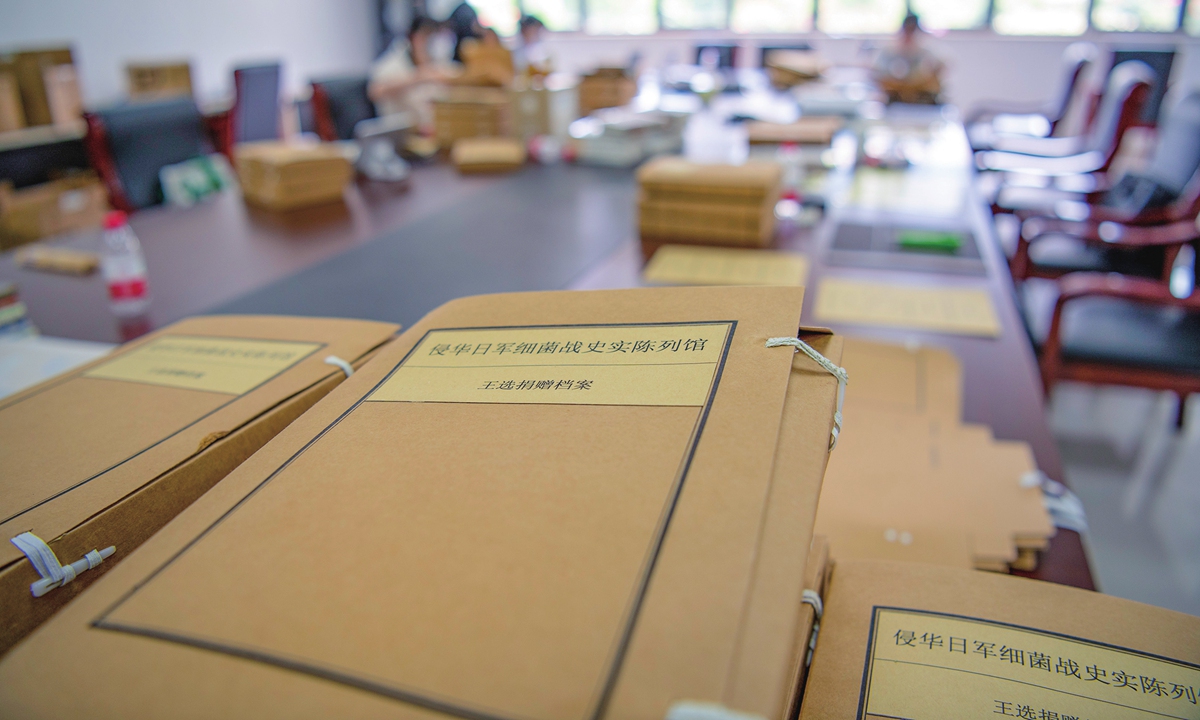
Archival materials on the bacterial warfare of the Japanese invasion of China are on display in Yiwu, Zhejiang Province.
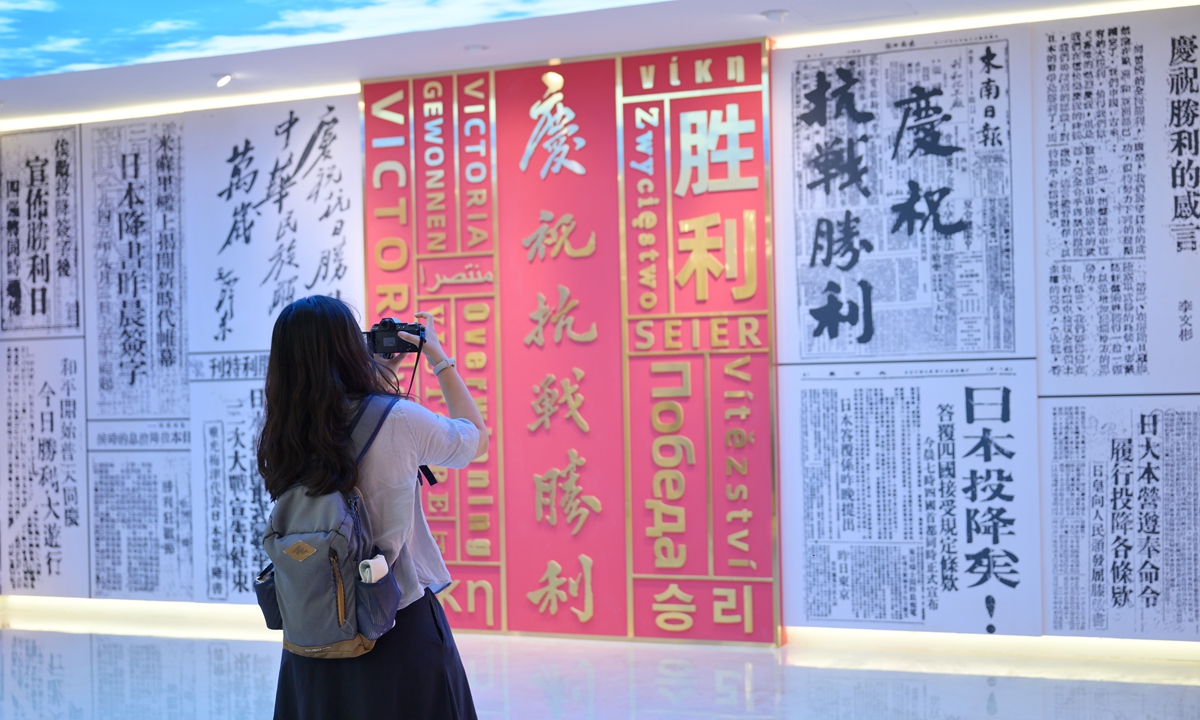
A visitor takes photo of a wall display at the Zhejiang Provincial Archives. Photos on this page: VCG
Editor's Note:World War II has inspired countless literary works worldwide, and in China, the 14-year War of Resistance Against Japanese Aggression forged a powerful tradition where literature and national destiny are intertwined. Today's Chinese writers, shaped by different backgrounds and times, continue to draw on this legacy - some as elderly survivors who experienced the war as children, some younger as digital authors using new storytelling forms to revisit the tales of resistance. Marking the 80th anniversary of victory in the war, the Global Times invites three writers across generations to share the stories behind their published works. This is the third installment of the series.
"Secret missions," "code words for contact," "deciphering final messages" - even in a brief 200-word synopsis, these keywords already hint at the dramatic twists and suspense that fill Hu Yiping's (pen name: Gulanyue) online novel Jiufang Alley. Set against the historical backdrop of the Zhejiang-Jiangxi campaign started by the Japanese invaders in 1942 and the fall of Jinhua in East China's Zhejiang Province, the story radiates a palpable tension, drawing readers into its web of intrigue.
What kind of stories emerge when the theme of the War of Resistance against Japanese Aggression (1931-45) collides with the fast-paced world of online literature?
The answer Hu, a 1980s-generation Chinese author and screenwriter, has long been exploring. Whether penning Go, Dan Niang! or Jiufang Alley, she firmly believes that the narrative techniques of online fictions can make grand historical subjects more accessible to readers. "When readers are moved to tears by the sacrifices of my characters, the weight of history naturally finds its way into their hearts," Hu told the Global Times.
As a young writer, Hu chose to dive into historical archives to cover her lack of firsthand experience possessed by elder generations regarding the Chinese people's resistance. Hu also immersed herself in walks along the historical Jiufang alley in Jinhua, striving to bridge the distance between past and present, and to truly resonate with history.
By the end of 2024, the number of online literature creators in China had surpassed 30 million. Hu is not alone - behind those soaring numbers are more individual writers who, when facing the solemn subject of the War of Resistance, approached it with reverence. Through the tools of online storytelling, they have produced related works that are not only high in quality but also widely acclaimed by readers.
Maintaining historical hue
"Beneath the bluestone slabs lies more than just the lingering aroma of wine - it is where passion and patriotism of ordinary people, though buried by the dust of the years, have never faded."
This line from Jiufang Alley deeply moved Hu. Writing it, she pictured ordinary people along the 600-meter-long alley - though unfamiliar with grand theories, each quietly defended their home under Japanese occupation. The bluestone road witnessed both daily life and hidden acts of resistance; every crack held a story. Hu's goal is to bring these stories to life, crafting a novel that keeps readers engaged.
Hu said she never shied away from the pain of that period just to make her novels more entertaining. During her writing, she spent countless hours in Jinhua's archives and local gazetteer offices, poring over original documents, studying compilations like the historical materials of the Zhejiang-Jiangxi campaign word by word, and even uncovering Japanese military maps of blockade zones. Through this research, she came to understand how, in May 1942, the Japanese invaders launched the Zhejiang-Jiangxi campaign, making Jinhua a crucial battleground and primary target of attack.
She also interviewed many survivors and descendants of those who lived through the campaign, learning the harrowing truth of how Japanese planes dropped plague-infested fleas over Ningbo, Quzhou, Yiwu and Jinhua - causing a deadly outbreak that claimed some 60,000 lives.
These historical facts became the backbone of her novel, supporting both her creative vision and sense of purpose.
At the same time, Hu sought to integrate the heaviness of history with characters with whom readers could relate, emotional resonance and a tightly woven narrative in her novel. In one scene, for example, the two protagonists lock eyes across a steaming bowl of wine in a cellar, their silent connection speaking volumes. And the writer embarks on a mission of "searching for the serum needle" to rescue the infected people as a major storyline, incorporating cryptic puzzles and suspense to create a "hook for the next chapter."
Such tense narrative pace, emotional resonance and immersive scene description, she believes, combine to create online literature's unique strength in telling the stories of the wartime.
Heroes are not born
In recent years, both the number and quality of online Chinese novels about the War of Resistance have risen. As authors and readers become more historically literate, works that relied too heavily on fantasy or defied narrative logic - such as stories with invincible protagonists wielding mysterious weapons - have gradually fallen out of favor, Zhang Peng, a cultural researcher and associate professor at Nanjing Normal University, told the Global Times.
Hu's novel Jiufang Alley was ultimately selected by Zhejiang Literature and Art Publishing House for print publication. Jin Rongliang, a press editor, explained that many online platforms now feature special sections dedicated to "war of resistance" stories, but when choosing which works to publish, they prioritize literary quality - specifically, well-structured plots and multidimensional characters. "The best works combine historical depth with the vibrancy of daily life," Jin told the Global Times.
"Victory in the war was never the result of miraculous moves, but the sacrifice of countless ordinary people," Hu remarked. In her stories, resistance fighters died with grenades in hand, while opportunists gradually became true patriots - mirroring real people forced by the war to make difficult choices. These characters are meant to reflect reality: True heroism lies in stepping forward despite knowing they will die, not in being invincible by nature.
"To write compelling war stories, online authors must preserve both the pain of history and the warmth of humanity," Hu advised newcomers of online literature. "What truly resonates is not mythic legend, but the flashes of human courage that shine in the darkest times."

Writer Gulanyue Photo: Courtesy of Gulanyue
RELATED ARTICLES