US extends tariff exclusions for Chinese products for three months; experts call for further pragmatic adjustments
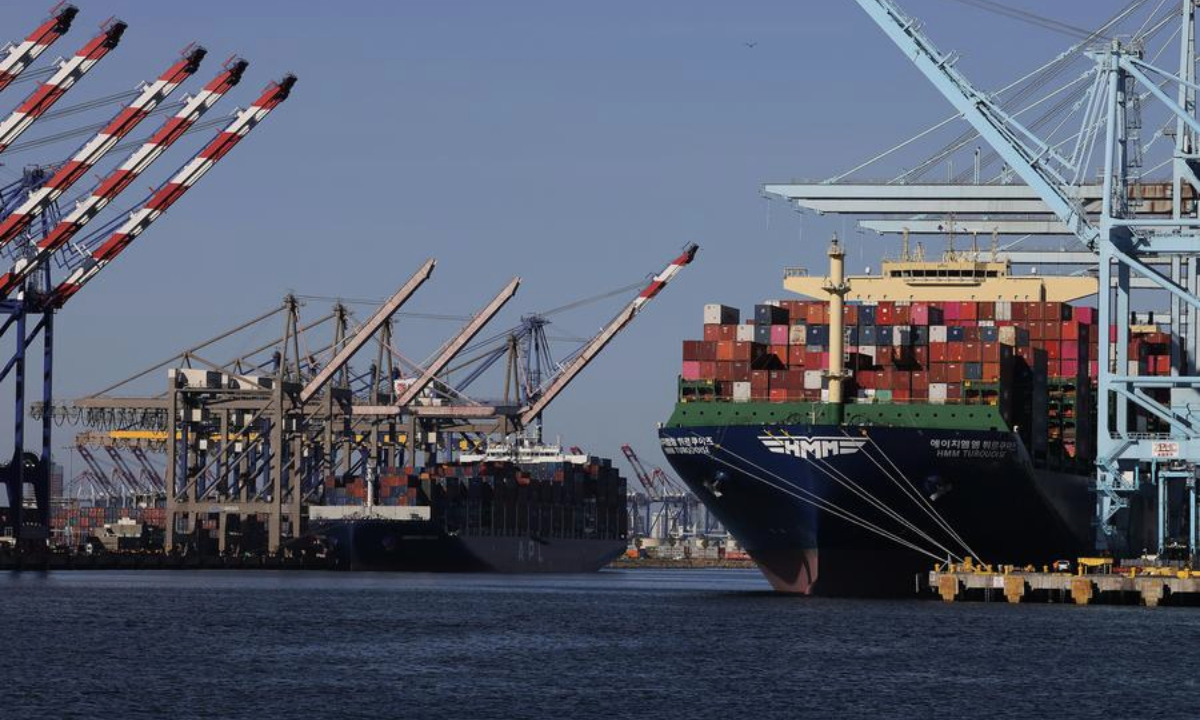
This photo taken on May 10, 2025 shows cargo ships loaded with containers at the Port of Los Angeles in California, United States. (Photo by Qiu Chen/Xinhua)
The US Trade Representative (USTR) office on Thursday local time announced the extension of certain exclusions under the so-called Section 301 tariffs for China for three months until November. Chinese experts urged the US to further extend tariff exemptions, along with more pragmatic adjustments to achieve stable trade ties.
"The extension is critical for US businesses and supply chains. Exemptions reduce tariff burdens, as alternatives to Chinese products are scarce. High 301 tariffs harm bilateral trade," Zhou Mi, a senior research fellow at the Chinese Academy of International Trade and Economic Cooperation, told the Global Times on Friday.
According to a document released by the USTR on Thursday, it has extended the exclusions in the Section 301 investigation by excluding from additional duties certain products from China. The exclusions were previously scheduled to expire on August 31, 2025, but have now been extended through November 29, 2025.
The USTR had previously modified actions in the Section 301 investigation by excluding certain Chinese products from additional duties. On May 30, 2024, 164 exclusions were extended through May 31, 2025, and on September 18, 2024, 14 exclusions for solar manufacturing equipment were announced, effective until May 31, 2025. On May 31, 2025, these exclusions were further extended through August 31, 2025, according to previous announcements by the USTR.
Experts pointed out that it is the US that initiated aggressive tariff policies, which have harmed both sides, disrupted global supply chains, and damaged US industries. Pressure from American businesses may have prompted the latest extensions of the tariff exclusions, they said.
"The US government's tariff hikes focus on short-term gains, ignoring the bigger picture. These measures not only raise costs for US businesses and consumers but also disrupt global supply chain cooperation," Huo Jianguo, a vice chairman of the China Society for World Trade Organization Studies in Beijing, told the Global Times.
Analysts urged the US to take more pragmatic actions to achieve stable trade ties with China, as the current bilateral economic and trade negotiations are actually in a stage of relative stability.
China's Ministry of Commerce (MOFCOM) confirmed on Thursday that a Chinese trade delegation, led by Li Chenggang, vice commerce minister and China international trade representative with MOFCOM, will visit Washington to meet with US officials after visiting Canada from August 24 to 27.
"China is willing to work with the US to leverage the bilateral economic and trade consultation mechanism, resolve issues through equal-footed dialogue and communication, and jointly maintain the steady, healthy and sustainable development of China-US economic and trade relations," a spokesperson for MOFCOM said on Thursday when announcing Li's Washington visit.
Zhou noted that the talks may identify priority areas for cooperation, given the broad scope of China-US trade issues and differing perceptions. But the talks will center on the consensus reached in the previous meetings - the China-US Economic and Trade Meeting in Geneva, the first meeting of the China-US economic and trade consultation mechanism held in London in June and a round of economic and trade talks in Stockholm, Sweden in July.
"Building on prior dialogues, both sides can clarify focus areas to advance long-term trade ties," said Zhou.
"The talks this time are likely to expand the scope of the negotiations, but still under the overarching framework that has been largely agreed upon by the two countries during the latest trade negotiations," Li Yong, a senior research fellow at the China Association of International Trade, told the Global Times on Friday.
Experts pointed out that so far, China-US tariff negotiations have shown a complex dynamic of de-escalation and continued pressure. Tariff reductions and extensions offer market certainty, but tech restrictions and security disputes hinder comprehensive agreements, they said.
"The interests of China and the US are complex and need to be based on mutual benefit and win-win cooperation. China has always welcomed cooperation from the US side, but will resolutely counter unilateral suppression. This principle remains unchanged. We hope that the US side will listen to China's voice, adjust its strategy, and jointly promote a stable and mutually beneficial economic and trade relationship," said Zhou.
Chinese Vice Foreign Minister Ma Zhaoxu said on Friday that China is willing to pursue mutual respect, peaceful coexistence, and win-win cooperation with the US, while firmly safeguarding its national sovereignty, security, and development interests.
Ma made the remarks on China-US relations during a press conference on preparations for V-Day commemorations.
Ma stressed that attempts to pressure or coerce China will not succeed, and efforts to contain China's development or obstruct the great rejuvenation of the Chinese nation are doomed to fail.
"We stand ready to work with the US in the same direction, to implement the important consensus reached by the two heads of state, maintain communication, manage differences, expand cooperation, and continue to explore the right path for two major countries to coexist in the new era," Ma said.
Experts also noted that China advocates mutual benefit and opposes unilateral actions, while urging pragmatic US adjustments for the sake of stable trade ties.
RELATED ARTICLES