What should Washington learn from suspension of parcel shipments by multiple countries to US: Global Times editorial

Illustration: Liu Xiangya/GT
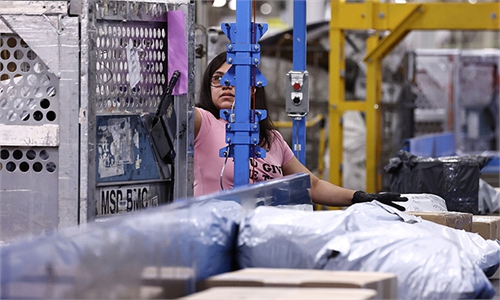
The turbulence within the global trading system continues unabated. Since Friday, the US has suspended the duty-free treatment for imported parcels valued at $800 or less. This arrangement - originally designed to facilitate and benefit cross-border e-commerce and US consumers - has been abruptly terminated, marking a significant escalation in US tariff policy. Postal services from over 20 countries have already suspended parcel shipments bound for the US. PostEurop warns that the tariff enforcement and cooperation mechanisms are "a lack of clarity." A senior executive at the US-based global logistics firm ePost Global also unequivocally said that "customers are going to be very shocked." The Universal Postal Union, a United Nations specialized agency, has written to the US Secretary of State to convey member countries' concerns regarding operational disruption.
The fact that the duty-exemption for low-value parcels has existed since 1938 speaks volumes about the immense benefits it has conferred on American consumers and countless small businesses as a trade facilitation measure. Over the long term, a vast array of affordable consumer goods entered the US market through this policy, fulfilling the needs of ordinary households and small-to-medium enterprises. Statistics show that the number of low-value parcels in the US jumped nearly 10-fold from 139 million in fiscal 2015 to 1.36 billion in 2024 - which reflects the genuine and substantial demand from US consumers and the many small businesses that rely on cross-border direct shipping. The Washington Post said that this measure shifted more of the burden onto ordinary families and small businesses, rather than actually targeting unfair competition. Today, not only American consumers will lost access to high-quality, diverse goods, but for small vendors in the US. The stark reality has become: "either raise prices, or lose orders."
According to a paper published by scholars at the National Bureau of Economic Research, 73 percent of cross-border direct mail consumption in the poorest regions of the US falls under "small exemptions." The complete removal of the "small exemption" would impose a cost pressure of between $11 billion and $13 billion on American consumers.
At the same time, some US small and medium-sized enterprises that rely on imports of intermediate goods in small parcels for assembly, which are already operating on thin profit margins with weak risk resilience, are now directly facing rising costs. These severely affected groups are by no means an insignificant part of America's economy and society. Data from the Office of the US Trade Representative show that small businesses are an important backbone of the US economy, creating two-thirds of all new jobs in recent decades. By taking such measures, the US is essentially locking its most dynamic market sectors into a tariff cage, engaging in self-inflicted harm under the banner of "national interest."
Time and again, facts have proven that the essence of international trade is mutual benefit, and exchanges and reciprocity create shared prosperity. The recent suspension of parcel deliveries to the US by multiple countries is a clear reflection of how unilateralism and protectionism end up harming both sides.
The global trade landscape has taken shape through years of adjustment, forming a tightly knit network of cooperation. The two-way flow of goods, the allocation of production factors, and the mutually beneficial results of trade together strengthen this web and sustain the stability of global supply and production chains. The vast number of small parcels flowing into the US is itself a product of economic globalization.
Neither excessively high tariffs nor other "small yard and high fence" protectionist policies can erase the demand that already exists between trade partners; they will only damage global supply chains while also harming the US itself.
Washington's tariff measures run counter to economic laws and undermine established rules, and are now facing growing backlash. Recently, France has called for the assessment of retaliatory measures against US digital companies; India has also adopted restrictive measures to express opposition to US tariff policies.
According to media reports, the Brazilian government has begun considering retaliatory trade measures against the US. The more the US abuses tariffs, the more backlash and resistance it will face globally. As The Guardian put it, rather than "a tool of economic coercion," the US instead wields tariffs as "a political weapon." And the tariffs are "reshaping old alliances" as the Global South "plots its own path."
What the world needs are bridges of cooperation, not "small yard and high fence." A stable international trade environment is the precondition for global growth and development, and the foundation of America's own prosperity. The suspension of parcel deliveries to the US by multiple countries, along with the recent wave of international responses to US tariff policies, is a vivid lesson in practice. If Washington truly wishes to "make America great again," it should work with other countries to safeguard the international trading system and global opportunities for development.
RELATED ARTICLES