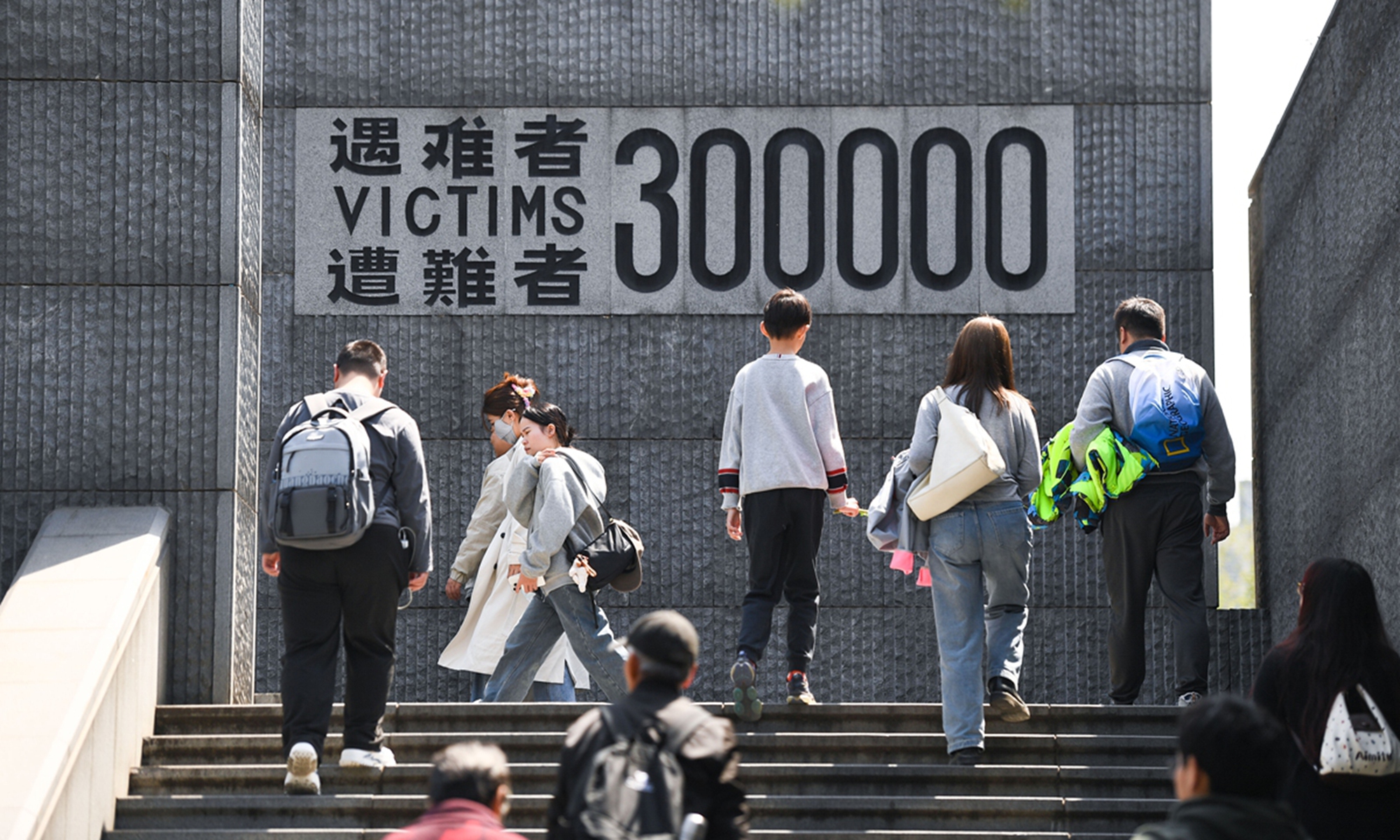
People mourn at the Memorial Hall of the Victims in Nanjing Massacre by Japanese Invaders, in Nanjing, East China's Jiangsu Province on April 4, 2025. Photos: VCG
Japan's then-emperor Hirohito read out the imperial edict on the radio 80 years ago, which only announced the end of the war but did not explicitly admit Japan's defeat. Japan had in fact accepted surrender, but its top leaders have long been reluctant to acknowledge its crimes of foreign aggression. In their speeches, they admitted their "national policy error" but rarely apologize publicly. Domestic public opinion in Japan has repeatedly exaggerated the pre-war young soldiers' "rebellion" and offense against high-ranking officials. For example, many film and television works depicting the February 26 incident have highlighted the bloody scenes of lower-level officers and soldiers attacking important officials with swords and guns. Although this is a self-exposure of domestic scandals, it actually shifted the blame downwards. Official Japanese history books also claim that the "unauthorized" actions of front-line officers in other countries broke the government's "no expansion" policy at the time.
However, anyone familiar with the condition of Japan before its defeat knows that Japan was a society where strict obedience was expected from the lower ranks, and the military was rigidly hierarchical. How could a group of young officers have bypassed their superiors to launch a war of aggression that mobilized the entire nation? A careful study of the government-military-zaibatsu (powerful industrial and financial conglomerates) relationship of the time can expose the attempts to whitewash the guilt of Japan's leadership and understand why their war crimes have remained unsettled for so many years.
Senior military and political officials and zaibatsu were the masterminds of the invasion
The brutality of Japanese soldiers during their wars of aggression horrified the world. A closer look reveals, in part, the distorted combination of Western imperialist fascist ideals of "survival of the fittest" and Japan's samurai tradition. The Japanese islands in ancient times were long divided by daimyo or warlords, who fostered a professional samurai class within society and cultivated their character that could desperately serve their superiors and ruthlessly slaughter their subordinates. Before and after the Meiji Restoration, Japanese society underwent capitalist reforms. The samurai class was nominally abolished, and many of its members became professional soldiers. The old Japanese military, especially the army, retained numerous factions, and the feudal master-slave system persisted between superiors and subordinates. Young officers often followed the orders of their "masters" in factional struggles, acting as thugs against those who opposed them.
After the Meiji Restoration officially began in 1868, the emperor transitioned from a religious leader to the ultimate authority in Japan. The previously separate warlord armies were unified into the "Imperial Army." Some small Japanese industrialists seized the opportunity to develop into large capitalist conglomerates, serving as pillars of both military and political power. The Mitsui, one of the most powerful financial conglomerates established in the early Meiji era, contributed significantly to the establishment of the "Imperial Army."
When Japan launched the First Sino-Japanese War, its annual fiscal revenue was only 80 million yen. It was only through the nationwide fundraising of 250 million yen led by various conglomerates that Japan was able to develop its military industry and win the war. The indemnity and confiscated items collected from China from this plundering war was equivalent to 360 million yen. The Japanese government then used the war profits to reward major conglomerates such as Mitsui. This in turn fueled the expansionist ambitions of the government, zaibatsu and military, fostering an aggressive national policy of "getting rich through war."
After the First Sino-Japanese War, Japan continued its relentless foreign aggression, with the top leadership divided into "officials" for decision-making, "zaibatsu" for support, and "military" for action. However, even when these three parties "cooperated," disagreements often arose. While their expansionist ideals were shared, the profit-calculating zaibatsu, fearing losses, were relatively cautious, while the military officers who were superstitious about "Bushido," were filled with fanatical youngsters. Because the consequences were unpredictable, politicians, zaibatsu and veteran military officers often advocated a phased approach and waited behind the scenes when war broke out. Younger military personnel, however, were determined to provoke conflict, while they would be scapegoated if they failed.
The September 18 Incident, instigated by the Japanese army in 1931, was portrayed by Japan as an "unauthorized act" by a few Kwantung Army staff officers. In reality, it was a coordinated stunt. At the time, Japan was facing a global economic crisis, with its economy plummeting by one-third. The Japanese leaders wanted to revive the economy by invading Northeast China, and "Manchuria and Mongolia are Japan's lifeline" became a catch phrase in Japan. However, officials and zaibatsu feared economic sanctions from the US and Britain, and the military brass was also wary, so they instructed the Kwantung Army's second-rate officers to take the lead. The order to open fire in Shenyang was given by three staff officers: Kenji Doihara, Kanji Ishiwara, and Seishirō Itagaki. Kwantung Army Commander Shigeru Honjo feigned ignorance beforehand, only ordering the full force into action after seeing the Northeastern Army not resisting. When the Kwantung Army occupied key locations like Shenyang and Changchun, the Japanese government declared to the international community that it was adhering to a policy of non-expansion, yet the army quickly implemented a full-scale occupation. Seeing that the US and Britain did not intervene, the Japanese top brass approved the establishment of the "Manchukuo" and promoted officials like Doihara and Itagaki. How could this be an "unauthorized" action by young military officers?
The complex origins behind the "alliance of government, military and zaibatsu"
Anyone familiar with Japanese history will notice that the names of many zaibatsu magnates and political elites often include "Taro," "Ichiro," or "Ryuichi." This stems from Japan's long-standing practice of primogeniture, in which the eldest son inherited the family estate. By contrast, since Emperor Wu of Han dynasty introduced the "Tui'en Ling," a decree issued to weaken the power of the feudal lords and strengthen central authority, China generally practiced partible inheritance among sons. This gave rise to the saying "wealth does not last beyond three generations," as large family fortunes typically dissipated by the time of the grandchildren. In Japan, however, the practice of passing family assets exclusively to the eldest son led to enduring "hundred-year shops." Before WWII, most of the 40,000 enterprises and businesses in Japan had this long lineage. After the Meiji Restoration, the bureaucratic system was built largely with representatives from these conglomerates, often in hereditary fashion. As a result, power and wealth became concentrated in the hands of a few families across generations. The four great prewar zaibatsu - Mitsui, Mitsubishi, Sumitomo, and Yasuda - controlled nearly half of Japan's industrial production, and their stance significantly shaped decisions by the government and military. For instance, after the Japanese army occupied Northeast China, the Mitsui group and others quickly followed to "develop" and plunder resources. The enormous profits they reaped only fueled their expansionist ambitions, which in turn drove support for further aggression into North and Central China.
A closer look at the names of prewar Japanese officers reveals many with "Jiro," "Kenji," "Saburo," or "Shiro" - second, third, or fourth sons. This reflected the reality that, apart from the eldest, younger sons had to strike out on their own once grown. In earlier times, they often became lower-ranking samurai, monks, or even rōnin. By modern times, attending military academies and climbing the ranks offered a new path. Eldest sons in families without much property also entered the army. Before the war, lieutenants earned less than university graduates, and those who married often faced financial hardship. Promotion to major tripled one's pay, hence the saying "poor lieutenants, wealthy majors." A general's rank promised privileges comparable to those of the upper elite. On the eve of the all-out invasion of China in 1937, the Japanese army was capped at around 300,000 troops, with only about 40,000 officers. Advancement depended mainly on battlefield exploits and patronage by superiors. Many lower-ranking lieutenants thus hoped for war, currying favor with certain senior figures and working as their "diehard followers."
Before the war, the Japanese military leadership was not only divided by regional factions but also by disagreements over the three main aggression directions: invading China, attacking the Soviet Union, or plundering Southeast Asia. Furthermore, they also engaged in disputes with the political circles over the allocation of military funds. Even ruthless military leaders often sought to resolve internal disagreements through violence, often having their subordinates take action due to their own inconvenience to intervene.
Before and after the September 18 Incident, assassination attempts on the prime minister, generals, and other high-ranking officials occurred repeatedly in Japan, with the perpetrators almost always being lieutenant-level officers. For example, in 1932, a group of young officers broke into the home of then prime minister Inukai Tsuyoshi and assassinated him because the veteran minister opposed increasing military spending. The perpetrators were later pardoned after some military and political figures claimed they were motivated by "patriotism." On February 26, 1936, amid a fierce conflict between the "Control" faction and the "Imperial Way" faction in the army, several young captains led approximately 1,400 troops staged a mutiny in Tokyo, killing several high-ranking generals and senior officials. Prior to the February 26 incident, several "Imperial Way" faction generals secretly expressed support for the rebels, declaring that those they intended to attack "deserved to be killed." However, this incident, angering the Emperor, was suppressed, and several lieutenants were executed, while the high-ranking officials who supported them were not held accountable. Later, Japanese authorities and some media outlets described these events as "lower-level rebellion," but those with intimate knowledge of the situation clearly saw it as a high-level internal conflict.
The Japanese zaibatsu did not participate in the internal strife in the military on surface, but in fact they believed that the "Imperial Way" faction who advocated attacking the Soviet Union in the north would not gain anything. Therefore the "Control" faction who advocated invading China got secret support and dominated the military after the February 26 Incident. In the following five years after the Japanese army occupied Northeast China, Japan's total economic output doubled. While the zaibatsu made huge profits, the income of the lower classes also increased. This led to a frenzy of supporting aggression and expansion in Japanese society, and those young military officers who caused conflicts abroad became popular "national heroes." This vicious stimulus led to the unanimous demand of the government, military and zaibatsu circles to expand the war. The Japanese invasion chariot moved further from Northeast China to most of China, and even rushed to the Pacific battlefield and could not be stopped.
Why do the Tokyo Trials leave a "historical shortfall"?
The Chinese people waged a bitter and extraordinary war of resistance, and when the US, after suffering early setbacks in the Pacific War, soon shifted to a counteroffensive, the Japanese military's losses far outweighed the gains from its plunder. Japan's domestic zaibatsu - the powerful industrial and financial conglomerates - not only saw their dreams of wartime profiteering shattered but also faced the prospect of losing their entire fortunes. Starting in the latter half of 1944, Japan's major business conglomerates and the politicians representing them began privately discussing the need to seek an early peace with the US. Japan's former emperor Hirohito even dispatched his younger brother, Prince Nobuhito, to Switzerland to oversee secret negotiations with the Americans. In February 1945, Fumimaro Konoe - a former prime minister and scion of Japan's highest aristocracy whose lineage stretched back centuries - compiled the views of political and business leaders into a confidential memorial to the emperor, warning that defeat had become inevitable. He argued that to preserve the national polity, the military would have to be sacrificed - particularly the officers who had taken the lead since the September 18 Incident.
During the secret negotiations in Switzerland, the US - aiming to end the war swiftly to minimize its own losses and to secure postwar control over Japan as a counterweight to the Soviet Union - agreed in early summer 1945 that Japan could retain the imperial institution, provided it declared unconditional surrender. At first, Japan's emperor still sought to bargain for better terms, but after the Soviet Union entered the war in early August and the US dropped atomic bombs on Hiroshima and Nagasaki, he decided during the Imperial Conference to accept the American conditions.
At that time, most of Japan's top military leaders believed that, with 7 million troops still at their disposal and the home islands not yet invaded, surrender was unnecessary. Army Minister Korechika Anami even shouted during the Imperial Conference that Japan should fight to the bitter end. However, the Emperor's "sacred decision" was supported by civilian officials and the powerful zaibatsu business conglomerates. Without political and financial backing, the military could no longer continue the war. Soon afterward, Anami and several other senior commanders committed suicide at home. In Tokyo, young hardline officers who attempted to stage an uprising and refused to surrender ultimately shot themselves in public squares.
Japan's former Prime Minister Hideki Tojo, who had long since stepped down and was living in seclusion, also attempted to shoot himself in the chest but missed his heart and was rescued. The newly appointed Army Minister Sadamichi Shimomura scolded him for failing to "face the tribunal and take responsibility on behalf of the Emperor." This episode of fierce internal conflict within Japan's militarist leadership - and its ultimate resolution - clearly reveals who the true architects and principal orchestrators of Japan's war of aggression were.
After Japan's unconditional surrender, more than 400,000 US troops were stationed across the Japanese home islands. Under the joint demands of the global anti-fascist forces, the US oversaw the establishment of the International Military Tribunal for the Far East in Tokyo, which ultimately sentenced seven Class-A war criminals to death, while others received life imprisonment or various fixed-term sentences.
While the punishment of these war criminals served the cause of justice, yet the trials left significant regrets. Those held accountable were primarily the so-called "bald-headed militarists," while members of the Japanese imperial family were spared prosecution due to prior US assurances - including Prince Yasuhiko Asaka, who was directly involved in commanding the Nanjing Massacre. Likewise, the powerful zaibatsu conglomerates emerged largely unscathed. As Joseph Clark Grew, who served as US Under Secretary of State and ambassador to Japan, reported to the White House: "Japan's big businessmen were our friends before the war, and they remain our friends after the war."
During the occupation, American occupation authorities formally dissolved only the Mitsui zaibatsu, and even then, merely split it into several companies. Most other conglomerates survived intact and went on to become leading postwar corporations, upgrading their industrial capabilities by aligning with US capital and adopting new technologies. Meanwhile, victims from China, South Korea, and other countries who had been forced into labor by Japan and its affiliated enterprises repeatedly demanded reparations after the war, but their claims have long struggled to receive fair and just responses.
The root cause of this historical shortfall lies in the fact that, after World War II, the US, driven by its own strategic interests, adopted a policy of co-opting and leveraging Japan's business conglomerates while preserving the imperial system. As a result, certain politicians who had represented industrial and commercial interests during the war continued to hold power afterward. For example, Nobusuke Kishi - Minister of Commerce and Industry during the war, a Class-A war criminal, and the maternal grandfather of former Prime Minister Shinzo Abe - even became Japan's prime minister in the 1950s. With individuals bearing the burden of war crimes controlling the government and continuing to dominate Japan's political and economic spheres, how could they be expected to fully reckon with the country's acts of aggression? Therefore, when we revisit history, we must not only strongly condemn the atrocities committed by the aggressors on the battlefield but also probe into the deeper domestic causes within Japan. Only by doing so can we remain vigilant against the resurgence of Japanese militarism and firmly safeguard the hard-won peace.
The author is a military history expert and retired professor. opinion@globaltimes.com.cn
RELATED ARTICLES