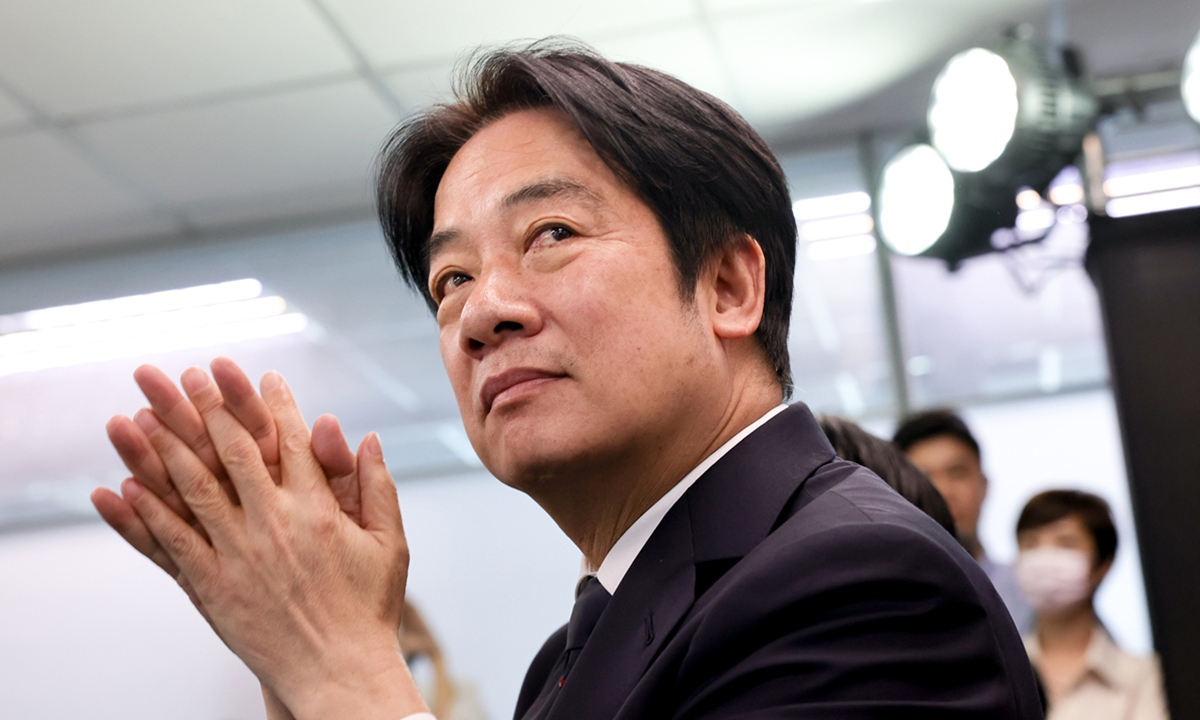
Lai Ching-te Photo: VCG
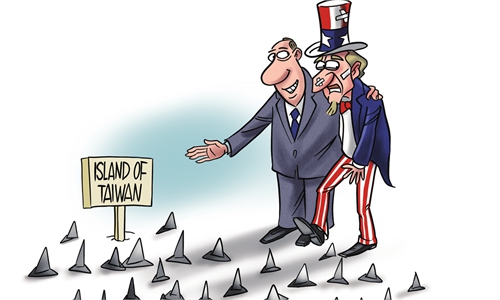
As the V-Day military parade in Beijing approaches, Taiwan's Democratic Progressive Party (DPP) authorities have resorted to intimidation, warning that former Kuomintang officials who participate in related events in the Chinese mainland will be prosecuted if they are considered "prominent figures." In response, Chinese mainland officials criticized such sordid behavior from Taiwan regional leader Lai Ching-te and the DPP as shameless. These words carry particular weight when applied to Lai.
What many readers may not know is that Lai's father, Lai Chao-jin, was a miner in Ruifang, Taipei County (now Ruifang District, New Taipei City), who, along with his fellow miners, suffered the brutality of Japanese invaders. From May 30 to June 1, 1895, gunfire roared across Ruifang as Taiwan's military and civilians fought the Japanese army with their blood and flesh. In 1943, tragedy struck again when Japanese military police, under the pretext of "anti-Japanese resistance," rounded up miners in Ruifang. Local coal mine owner Li Jian-xing and some 500 workers were thrown into prison; and more than 300 perished with no remains left behind.
Lai Chao-jin must have personally heard the cries of his compatriots while also suffering the inhuman torture inflicted by Japanese colonial rulers. Never would he have imagined that, 80 years after Japan's unconditional surrender, his own son - Lai Ching-te, now the regional leader of Taiwan - would coldly use the phrase "end of war" instead of "war of resistance" to betray the bitter suffering of his father's generation, the injustice suffered by the 300 miners who died without a trace, and the blood and dignity of the people of Ruifang. Nor could he have imagined that Lai Ching-te would be branded by some on the island as "the biggest traitor in 400 years of Taiwan's history."
For the sake of "seeking independence by relying on foreign powers," Lai Ching-te flatters Japan, willing to betray his father's generation and bury both his father's suffering and the 300 lost miners beneath the words "end of war." Yet, when votes are at stake, he parades his identity as a "miner's son," shedding crocodile tears to gain sympathy. If a man can betray the blood and tears of the father who gave him life, and he can sell out the souls of 300 unjustly dead miners, he could also sell out Taiwan's future, the Chinese nation's dignity and the well-being of Taiwan's residents. Lai Ching-te's actions betray not only his father, but also Taiwan itself.
On April 11, 2025, Wang Yifu, president of the Beijing-based National Society of Taiwan Studies, published an article titled "The Story of Ruifang" on WeChat account StraitsPlus. I quote it here to share with readers, hoping that Lai Ching-te will learn how to be a human and reconsider his actions after seeing it:
"The Story of Ruifang"
...From May 30 to June 1, 1895, the residents of Taiwan fought a battle in Ruifang to resist the Japanese invasion. Nearly 50 years later, in 1943, another tragic story unfolded in Ruifang - the "anti-Japanese army incident in Ruifang." At that time, local coal mine owner Li Jian-xing clashed with Japanese police agents. The Japanese police and secret agents reported to the military and gendarmerie, accusing Li of secretly organizing an anti-Japanese force in Ruifang and of possessing confidential letters from Chinese generals Bai Chongxi and Yu Hanmou. As a result, large contingents of Japanese troops, gendarmes, police and agents surrounded the Ruifang mines, arresting Li's family members and more than 500 miners. By the time Taiwan was liberated in 1945, only about 100 of those arrested survived; more than 300 others perished in prison, leaving no remains behind.
After his release, Li Jian-xing became the head of Ruifang. I mentioned in another article his connection with the "Taiwan Retrocession Tribute Group." On August 29, 1946, a group of 15 representatives from the island of Taiwan, who formed the "Tribute Group" on their own initiative and at their own expense, left Taipei, passed through Shanghai and arrived in Nanjing. Their activities included "paying respects at the Mausoleum of Sun Yat-sen" and "offering tribute at the Mausoleum of the Yellow Emperor." Li Jian-xing, as one of the members, participated in all of the events. In Nanjing, Bai Chongxi received the mission and "held an in-depth conversation on the current situation for about an hour."
The author is a commentator on international affairs. opinion@globaltimes.com.cn
RELATED ARTICLES