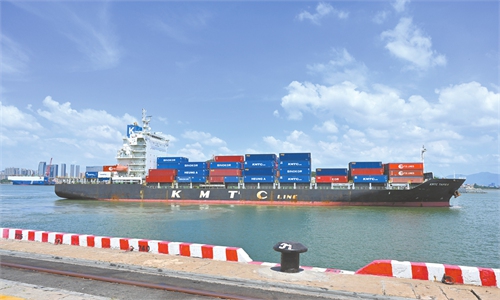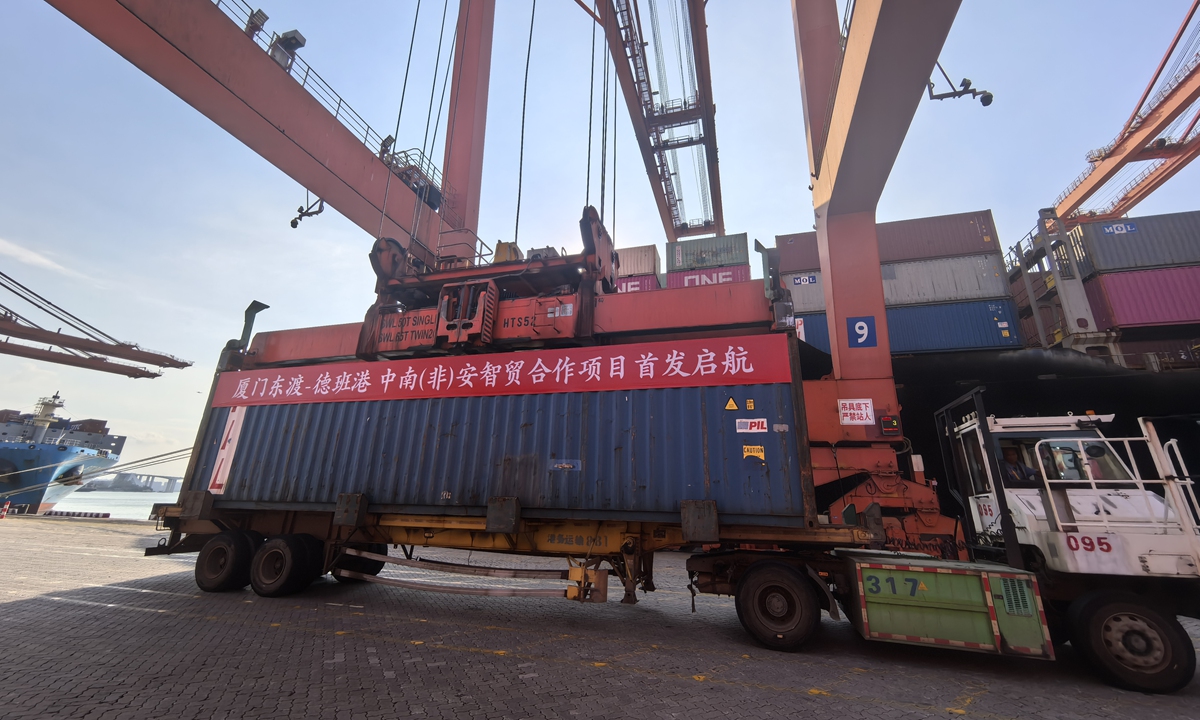
A crane lifts a container of the SSTL pilot program to South Africa at Dongdu Port, Xiamen, East China's Fujian Province, on August 31, 2025. Photo: Courtesy of Xiamen Customs
A shipment labeled "Security Smart Trade Lane" (SSTL) containing IP phones, videoconferencing terminals and other goods worth 5.254 million yuan ($734,527), has cleared Dongdu Customs, under Xiamen Customs, marking the official launch of the SSTL pilot program, the first of its kind between China and other BRICS countries.The pilot China-South Africa SSTL adopts a model of information sharing and mutual recognition of supervision. Participating pilot enterprises enjoy priority customs clearance in both countries. If goods have been inspected by the exporting country's customs, the importing country's customs agency generally waives inspection. This streamlines the logistics chain, cuts costs, and boosts efficiency, according to a statement Xiamen Customs sent to the Global Times on Sunday.
The batch of goods were sent from Xiamen's Dongdu Port to Durban Port, South Africa. Chen Limei, customs affairs manager at Yealink (Xiamen) Network Technology Co, the first company to join the pilot program, said that preliminary estimates show its exports to South Africa are clearing more than 60 percent faster under the program.
Song Wei, a professor at the School of International Relations and Diplomacy at Beijing Foreign Studies University, pointed out that the launch of the program is an important measure to enhance connectivity and promote trade, as it shortens the logistics distance between China and South Africa, streamlines customs procedures, reduces time and costs, and advances bilateral cooperation.
Song further noted that US-imposed tariffs have harmed global trade especially for African countries. "If the pilot program proves successful, especially within the BRICS framework, it can be expanded to more developing countries and along the Belt and Road Initiative," she said.
Xiamen Port now operates 24 BRICS routes, connecting six countries and 20 ports. From January to July this year, its throughput with other BRICS countries reached 248,200 standard containers, up 4.9 percent year-on-year, according to data from Xiamen Customs.
Cai Yi, an official with the Xiamen Customs, said that the launch of the program not only establishes a green trade corridor for nearby cities, but also provides valuable experience for extending the model to other BRICS routes, further integrating Xiamen into the bloc's development framework.
In June 2005, the World Customs Organization (WCO) Council adopted the SAFE Framework of Standards to Secure and Facilitate Global Trade (SAFE Framework) that would act as a deterrent to international terrorism, to secure revenue collections and to promote trade facilitation worldwide, according to the WCO's official website.
SSTL is the world's first international cooperation project to fully implement the Framework of Standards, officially launched on November 19, 2007, on the maritime route connecting Shenzhen in China, Felixstowe in the UK, and Rotterdam in the Netherlands.
The SSTL has also expanded to land ports. On February 28, 2019, Chengdu in Southwest China's Sichuan Province applied to join as a pilot city and confirmed that a railway route of the China-Europe Freight Service from Chengdu to Lodz, Poland, and related enterprises would be included in the SSTL of the project, the Xinhua News Agency reported.
Manzhouli Port, the largest land border port in North China's Inner Mongolia Autonomous Region, announced on July 16, 2019, that it had officially joined the project, according to the China News Services.
RELATED ARTICLES